


The obesity paradox: Analysis from the SMAtteo COvid-19 REgistry (SMACORE) cohort
- PMID: 32988724
- PMCID: PMC7418787
- DOI: 10.1016/j.numecd.2020.07.047
The obesity paradox: Analysis from the SMAtteo COvid-19 REgistry (SMACORE) cohort
Abstract
Background and aims: Obesity has been suggested as a possible risk factor for a more severe course of COVID-19; however, conclusive evidence is lacking and few studies have investigated the role of BMI as a risk factor for admission to intensive care unit (ICU) and mortality. We retrospectively analyzed a COVID-19 cohort recruited during the first 40 days of the epidemic in Italy. We examined the association between obesity and 30-day mortality, admission to ICU, mortality and length of hospital stay in patients with COVID-19.
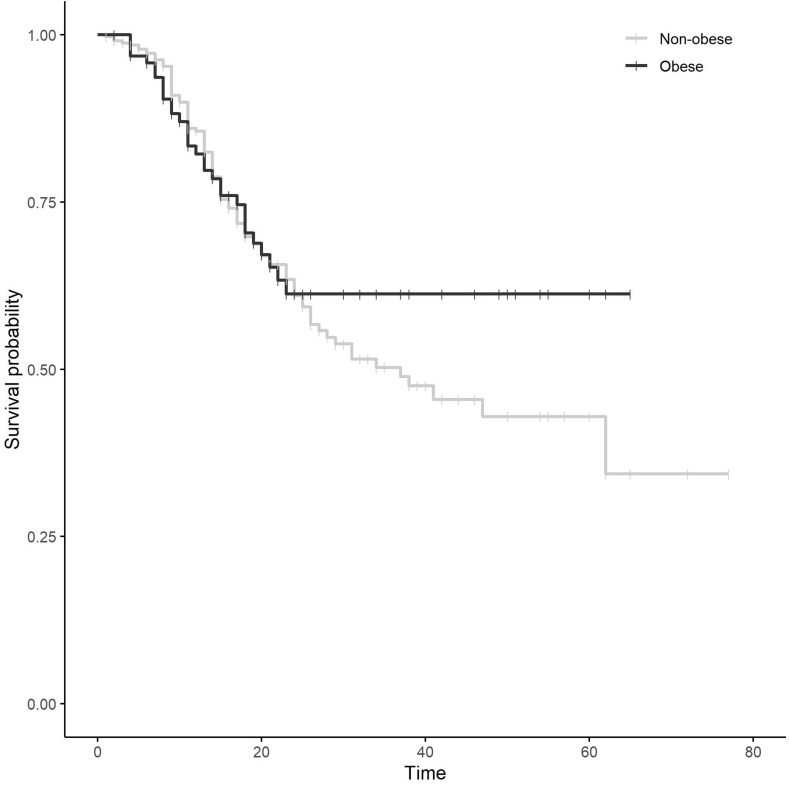
Methods and results: Demographic, clinical and outcome data were retrospectively analyzed in 331 patients with COVID-19 admitted to hospital between 21 February and 31 March 2020. The predictive effect of obesity on mortality was assessed using a Cox proportional-hazard regression model, its effect on ICU admission and mortality in the ICU using logistic regressions, and its effect on length of hospital stay using a linear regression. Seventy-four of 331 patients had a BMI ≥30 kg/m2. Among obese patients, 21 (28.4%) required admission in ICU and 25 died (33.8%). After controlling for sex, age, comorbidities and clinical data, obesity was not significantly associated with mortality, mortality in ICU and length of hospital stay. The effect of obesity on ICU admission remained significant after controlling for sex, age, interstitial lung disease, heart disease and serum C-reactive protein.
Conclusions: Obese patients with COVID-19 were more likely to be admitted to ICU than non-obese patients. However, there were no significant differences in mortality between the two groups.
Keywords: BMI; COVID-19; ICU; Obesity; SARS-CoV-2; Severe disease.
Copyright © 2020 The Italian Diabetes Society, the Italian Society for the Study of Atherosclerosis, the Italian Society of Human Nutrition and the Department of Clinical Medicine and Surgery, Federico II University. Published by Elsevier B.V. All rights reserved.
Figures
References
-
- WHO director-general's opening remarks at the media briefing on COVID-19. 11 March 2020. https://www.who.int/dg/speeches/detail/who-director-general-s-opening-re...
-
- WHO. Obesity: preventing and managing the global epidemic. World Health Organization: technical report series. WHO Tech Rep Ser No 894 2000:252. ISBN: 92 4 120894 5. - PubMed
-
- Obesity and overweight. n.d. https://www.who.int/news-room/fact-sheets/detail/obesity-and-overweight. [Accessed 30 April 2020].
Publication types
MeSH terms
Substances
LinkOut - more resources
Full Text Sources
Medical
Research Materials
Miscellaneous
