


β-Amyloid and tau biomarkers and clinical phenotype in dementia with Lewy bodies
- PMID: 32989106
- PMCID: PMC7836666
- DOI: 10.1212/WNL.0000000000010943
β-Amyloid and tau biomarkers and clinical phenotype in dementia with Lewy bodies
Abstract
Objective: In a multicenter cohort of probable dementia with Lewy bodies (DLB), we tested the hypothesis that β-amyloid and tau biomarker positivity increases with age, which is modified by APOE genotype and sex, and that there are isolated and synergistic associations with the clinical phenotype.
Methods: We included 417 patients with DLB (age 45-93 years, 31% women). Positivity on β-amyloid (A+) and tau (T+) biomarkers was determined by CSF β-amyloid1-42 and phosphorylated tau in the European cohort and by Pittsburgh compound B and AV-1451 PET in the Mayo Clinic cohort. Patients were stratified into 4 groups: A-T-, A+T-, A-T+, and A+T+.
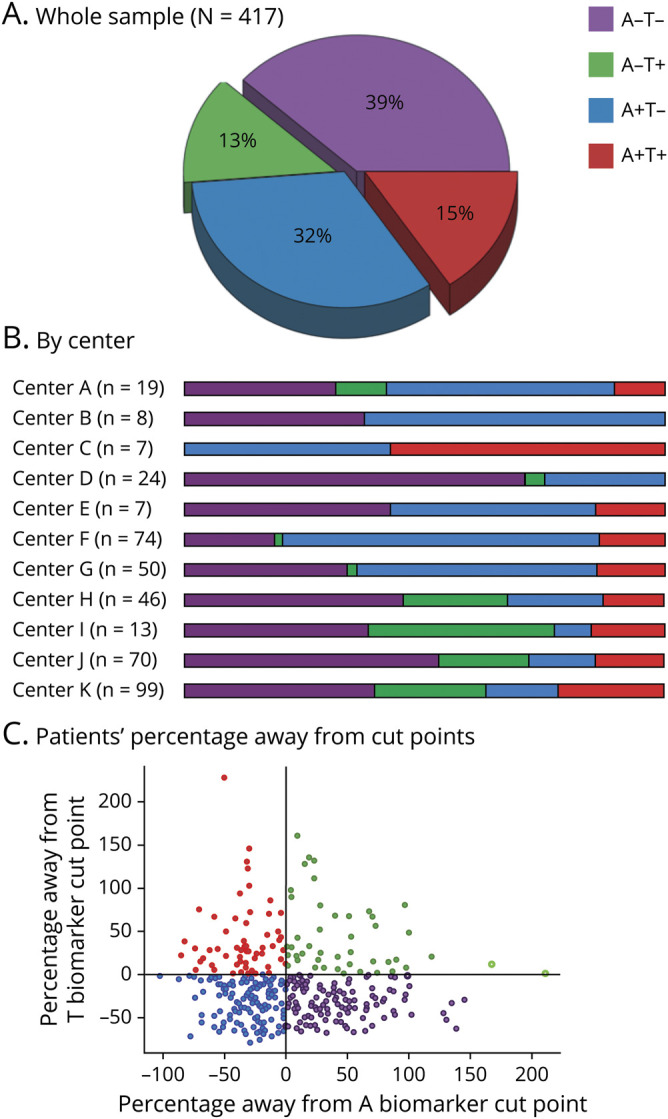
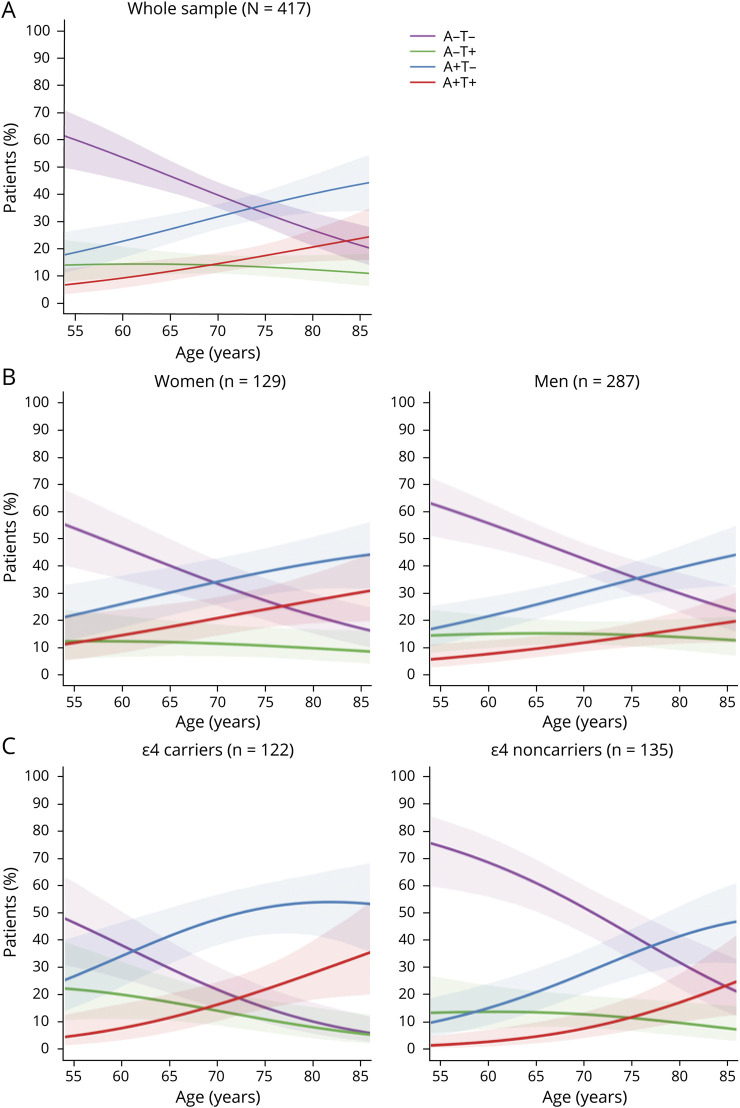
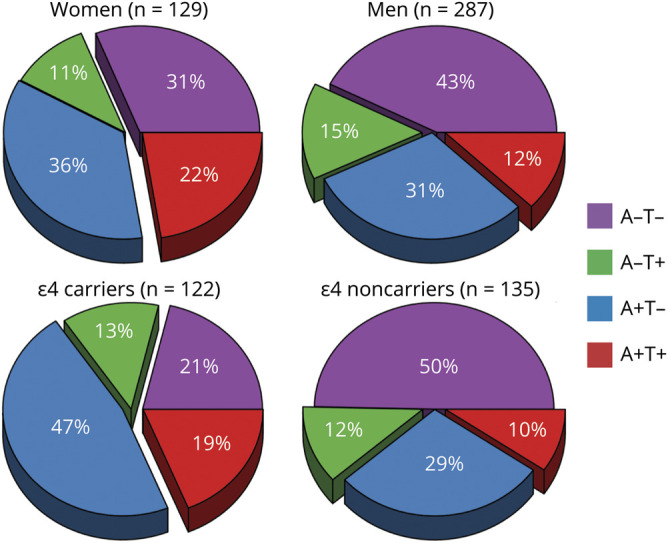
Results: A-T- was the largest group (39%), followed by A+T- (32%), A+T+ (15%), and A-T+ (13%). The percentage of A-T- decreased with age, and A+ and T+ increased with age in both women and men. A+ increased more in APOE ε4 carriers with age than in noncarriers. A+ was the main predictor of lower cognitive performance when considered together with T+. T+ was associated with a lower frequency of parkinsonism and probable REM sleep behavior disorder. There were no significant interactions between A+ and T+ in relation to the clinical phenotype.
Conclusions: Alzheimer disease pathologic changes are common in DLB and are associated with the clinical phenotype. β-Amyloid is associated with cognitive impairment, and tau pathology is associated with lower frequency of clinical features of DLB. These findings have important implications for diagnosis, prognosis, and disease monitoring, as well as for clinical trials targeting disease-specific proteins in DLB.
Classification of evidence: This study provides Class II evidence that in patients with probable DLB, β-amyloid is associated with lower cognitive performance and tau pathology is associated with lower frequency of clinical features of DLB.
© 2020 American Academy of Neurology.
Figures
Comment in
-
Alzheimer disease biomarker profiles in dementia with Lewy bodies: Does A plus T spell D-L-B?Neurology. 2020 Dec 15;95(24):1076-1077. doi: 10.1212/WNL.0000000000010958. Epub 2020 Sep 28. Neurology. 2020. PMID: 32989112 No abstract available.
References
-
- Schoonenboom NS, Reesink FE, Verwey NA, et al. Cerebrospinal fluid markers for differential dementia diagnosis in a large memory clinic cohort. Neurology 2012;78:47–54. - PubMed
-
- Lee SH, Cho H, Choi JY, et al. Distinct patterns of amyloid-dependent tau accumulation in Lewy body diseases. Mov Disord 2018;33:262–272. - PubMed
Publication types
MeSH terms
Substances
Grants and funding
LinkOut - more resources
Full Text Sources
Medical
Miscellaneous
