. 2020 Oct 13;117(41):25327-25334.
doi: 10.1073/pnas.2004596117. Epub 2020 Sep 28.

Organic matter from the Chicxulub crater exacerbated the K-Pg impact winter

Affiliations

Organic matter from the Chicxulub crater exacerbated the K-Pg impact winter

Shelby L Lyons et al. Proc Natl Acad Sci U S A. .

Abstract

An asteroid impact in the Yucatán Peninsula set off a sequence of events that led to the Cretaceous-Paleogene (K-Pg) mass extinction of 76% species, including the nonavian dinosaurs. The impact hit a carbonate platform and released sulfate aerosols and dust into Earth's upper atmosphere, which cooled and darkened the planet-a scenario known as an impact winter. Organic burn markers are observed in K-Pg boundary records globally, but their source is debated. If some were derived from sedimentary carbon, and not solely wildfires, it implies soot from the target rock also contributed to the impact winter. Characteristics of polycyclic aromatic hydrocarbons (PAHs) in the Chicxulub crater sediments and at two deep ocean sites indicate a fossil carbon source that experienced rapid heating, consistent with organic matter ejected during the formation of the crater. Furthermore, PAH size distributions proximal and distal to the crater indicate the ejected carbon was dispersed globally by atmospheric processes. Molecular and charcoal evidence indicates wildfires were also present but more delayed and protracted and likely played a less acute role in biotic extinctions than previously suggested. Based on stratigraphy near the crater, between 7.5 × 10¹⁴ and 2.5 × 10¹⁵ g of black carbon was released from the target and ejected into the atmosphere, where it circulated the globe within a few hours. This carbon, together with sulfate aerosols and dust, initiated an impact winter and global darkening that curtailed photosynthesis and is widely considered to have caused the K-Pg mass extinction.

Keywords: Chicxulub impact crater; Cretaceous–Paleogene; impact winter; polycyclic aromatic hydrocarbons; wildfires.


Conflict of interest statement

The authors declare no competing interest.

Figures
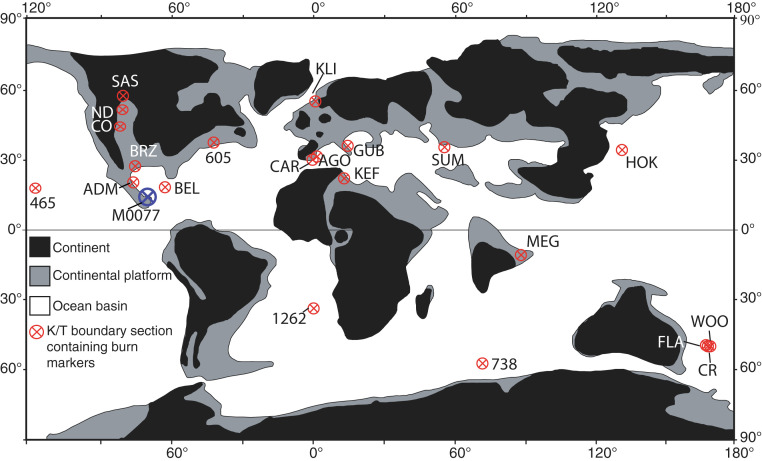
Fig. 1.
Fig. 1.
Compilation of global sites with burn marker observations at the K–Pg boundary. All sites marked in red contain burn markers, including the Chicxulub impact site, marked by a blue cross. Numbers refer to Deep Sea Drilling Project/ODP/IODP sites. ADM, Arroyo de Mimbral, Mexico; AGO, Agost, Spain; BEL, Beloc, Haiti; BRZ, Brazos, Texas, United States; CAR, Caravaca, Spain; CO, Colorado, United States (Madrid East South, Clear Creek North, and Berwind Canyon); CR, Chancet Rocks, New Zealand; FLA, Flaxbourne River, New Zealand; GUB, Gubbio, Italy; HOK, Kawaruppu, Hokkaido, Japan; KEF, El Kef, Tunisia; KLI, Stevns Klint, Denmark; MEG, Meghalaya, India; ND, Mud Buttes, North Dakota, United States; SAS, Saskatchewan, Canada sites (Rock Creek East, Wood Mountain Creek); SUM, Sumbar, Turkmenistan; WOO, Woodside Creek, New Zealand. Sites with elevated total or specific PAH spike: M0077 (26), 738, 1262, MEG (27), CAR (20), KLI (22), GUB (22), WOO (22), HOK (28), ADM (21), ND (29), CO (29), BEL (14), 605 (30). Sites with elevated soot or charcoal: M0077 (26, 31), 738 (31), 1262 (31), CAR (20), KLI (18, 23, 32), GUB (18), WOO (18, 23, 33), ADM (21), CR (18, 33), BRZ (34), KEF (35), AGO (32, 35), SUM (24), 465 (36), SAS (37). Sites with carbon cenospheres: KLI (19), WOO (19), SAS (19). Sites with fullerenes: WOO (38), FLA (38), BRZ (34). Figure modified from Bralower et al. (2020) (31).
Fig. 2.
Fig. 2.
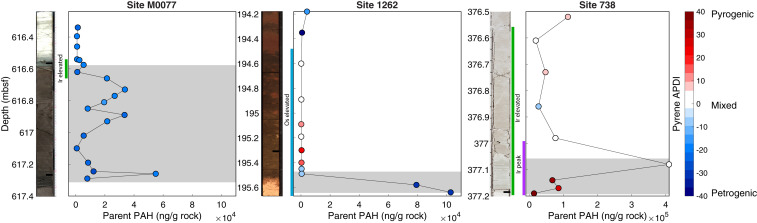
Parent PAH concentrations across the K–Pg boundary interval for sites M0077, 1262, and 738. K–Pg boundary deposits are highlighted in gray, and samples are colored by the pyrene APDI index (67). Warm colors represent more pyrogenic inputs, cool colors represent more petrogenic inputs, and white represents mixed inputs. Black rectangles on core photographs denote intervals with charcoal observations (26, 31). Vertical green bars represent intervals with elevated (>0.25 ppb) Ir concentrations, and purple bars represent intervals with peak (>1 ppb) Ir concentrations. Vertical blue bars represent intervals with low, extraterrestrial 187Os/188Os ratios (57, 59, 63). Sites M0077 and 1262 are displayed on a 0 to 1.1 × 10⁵ ng/g axis; site 738 is displayed on a 0 to 4 × 10⁵ ng/g axis.
Fig. 3.
Fig. 3.
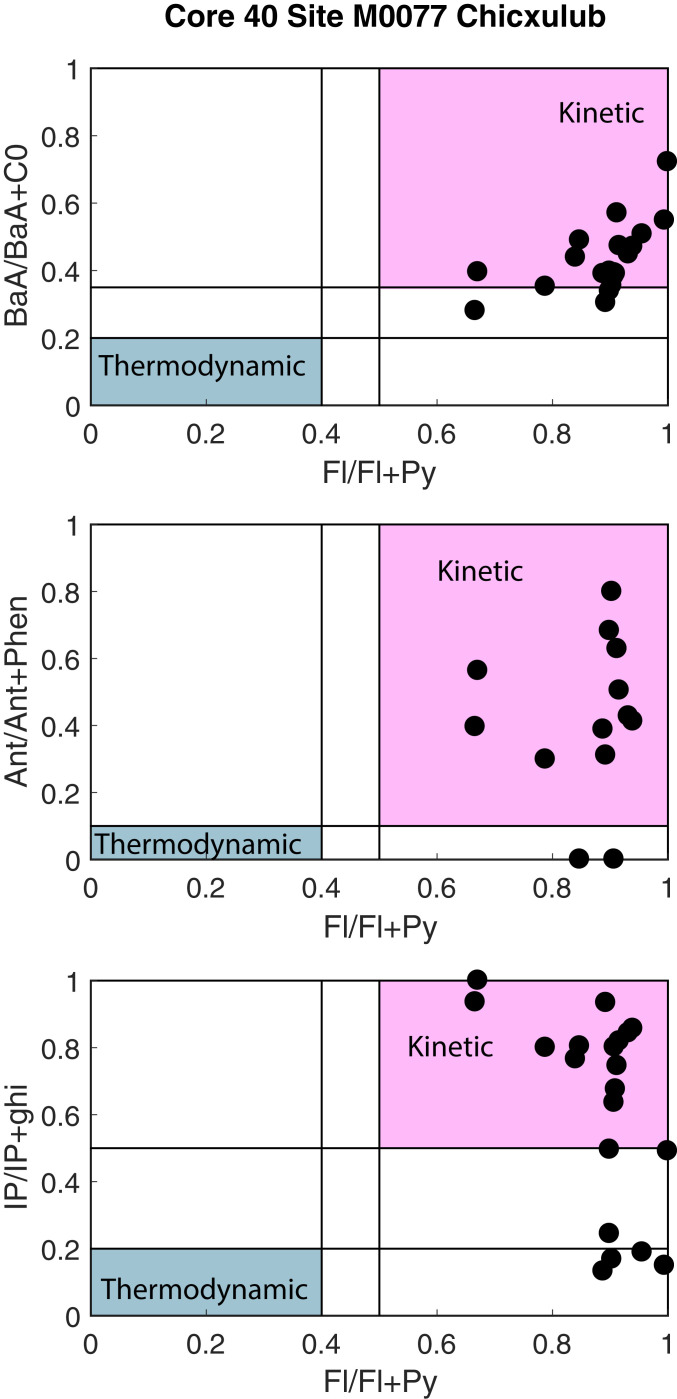
Chicxulub PAHs ratios are dominated by kinetic isomers based on kinetic/(kinetic + thermodynamic) isomer ratio biplots. Pink quadrants represent kinetically favored PAH ratios, blue quadrants represent thermodynamically favored PAH ratios, and white space indicates mixed kinetic and thermodynamic sources. Solid black lines represent observational cutoff values from Rocha and Palma (71): Fl/Fl+Py: thermodynamic <0.4, kinetic >0.5; BaA/BaA+C0: thermodynamic <0.2, kinetic >0.35; Ant/Ant+Phen: thermodynamic <0.1, kinetic >0.1; IP/IP+ghi: thermodynamic <0.2, kinetic >0.5. PAH abbreviations: Ant, anthracene; BaA, benz[a]anthrance; C0, chrysene; Fl, fluoranthene; ghi, benzo[ghi]perylene; IP, indeno[1,2,3-c,d]pyrene; Phen, phenanthrene; Py, pyrene (43).
Fig. 4.
Fig. 4.
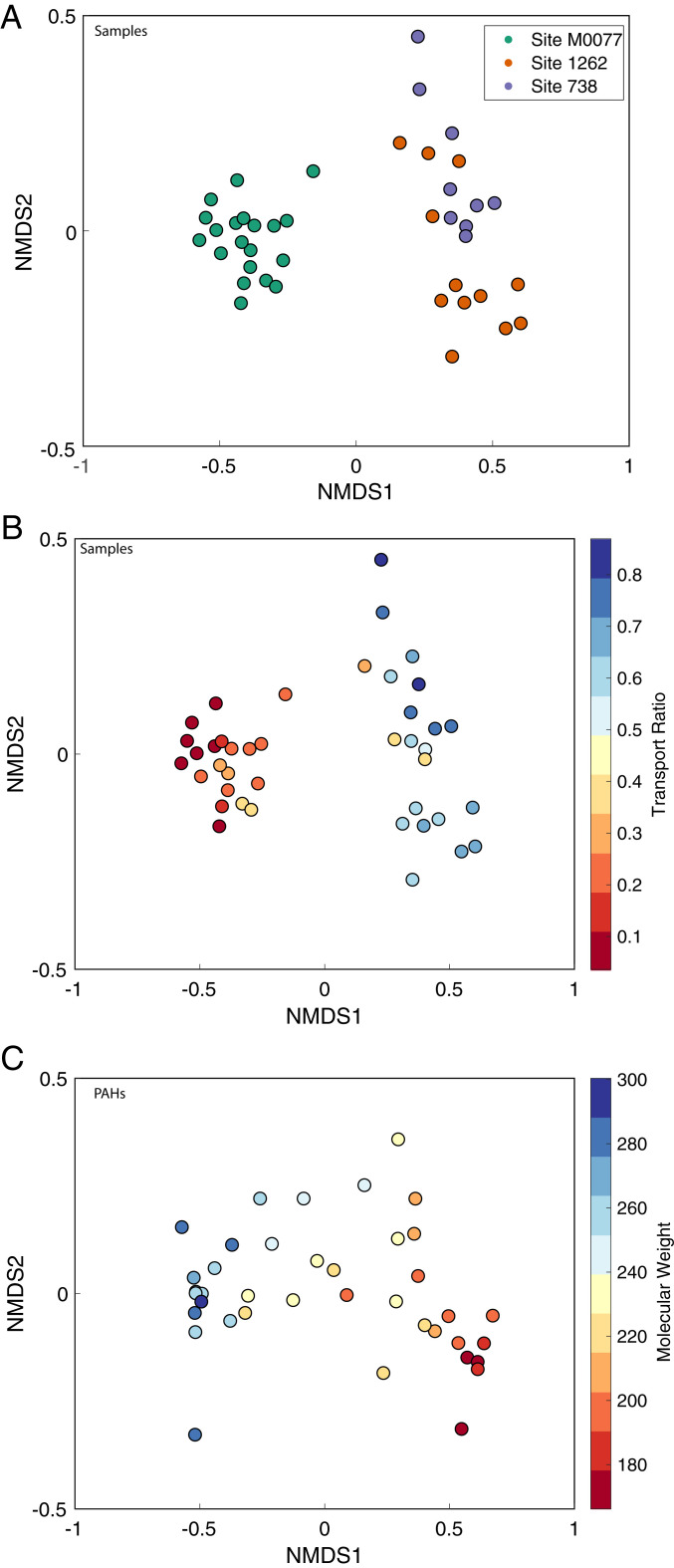
NMDS of samples from sites M0077, 738, and 1262 demonstrate the effect of transport on PAH composition. (A) Samples from all sites plotted based on their NMDS scores colored by location demonstrates a difference in molecular composition between the impact site (site M0077) and the two distal sites (sites 738 and 1262). (B) Samples from all sites colored by their transport ratio (67). Low transport ratio values (warm colors) load negatively on NMDS1 and represent PAH compositions difficult to transport; high transport ratio values (cool colors) load positively on NMDS1 and represent PAH compositions more susceptible to transport. (C) PAHs plotted by NMDS scores colored by molecular weight. Low-molecular-weight PAHs (warm colors) load positively on NMDS1; high-molecular-weight PAHs (cool colors) load negatively on NMDS1.

References

    1. Artemieva N., Morgan J., Expedition 364 science party, quantifying the release of climate-active gases by large meteorite impacts with a case study of Chicxulub. Geophys. Res. Lett. 44, 10180–10188 (2017).
    1. Renne P. R. et al. ., Time scales of critical events around the Cretaceous-Paleogene boundary. Science 339, 684–687 (2013). - PubMed
    1. Alvarez L. W., Alvarez W., Asaro F., Michel H. V., Extraterrestrial cause for the Cretaceous-Tertiary extinction. Science 208, 1095–1108 (1980). - PubMed
    1. Collins G. S. et al. .; IODP-ICDP Expedition 364 Science Party; Third-Party Scientists , A steeply-inclined trajectory for the Chicxulub impact. Nat. Commun. 11, 1480 (2020). - PMC - PubMed
    1. Hildebrand A. R. et al. ., Chicxulub crater: A possible Cretaceous/Tertiary boundary impact crater on the Yucatán Peninsula, Mexico. Geology 19, 867–871 (1991).

Publication types

LinkOut - more resources