


Predictors of Health Utility in Relapsing-Remitting and Secondary-Progressive Multiple Sclerosis: Implications for Future Economic Models of Disease-Modifying Therapies
- PMID: 32989685
- PMCID: PMC7867536
- DOI: 10.1007/s40273-020-00964-w
Predictors of Health Utility in Relapsing-Remitting and Secondary-Progressive Multiple Sclerosis: Implications for Future Economic Models of Disease-Modifying Therapies
Abstract
Background: Decision-analytic models used in economic evaluations of disease-modifying therapies for relapsing-remitting multiple sclerosis (RRMS) have characterized disease progression and accrue quality-adjusted life-years from utility values based on the Expanded Disability Status Scale (EDSS), the occurrence of relapses, and progression to secondary-progressive multiple sclerosis (SPMS). The EDSS, used to characterize disability progression, has several limitations. If the EDSS is the only disability measure used in economic evaluations, the long-term clinical and economic implications of disease-modifying therapies may not be properly assessed.
Objective: The objective of this study was to explore if supplementary disability measures including the Timed 25-Foot Walk (T25FW), 9-Hole Peg Test (9HPT), and Paced Auditory Serial Addition Test (PASAT) significantly contribute additional information on health utility in RRMS and SPMS otherwise not captured by the EDSS and relapses and, therefore, should be considered in future economic evaluations of disease-modifying therapies.
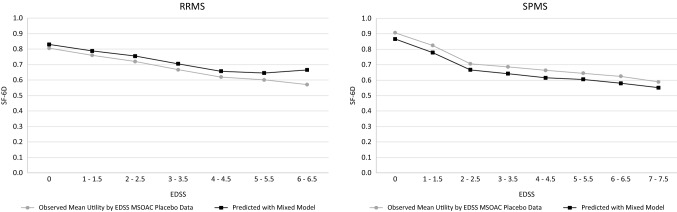
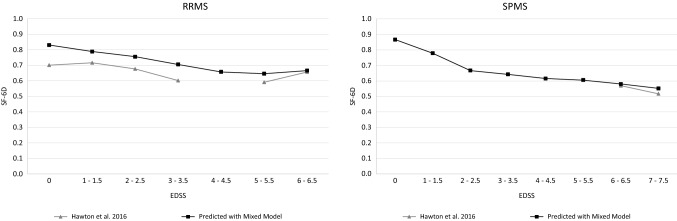
Methods: Short-Form Six-Dimension utility scores were derived from the RAND 36-Item Health Survey 1.0 individual-level data available in the Multiple Sclerosis Outcome Assessment Consortium (MSOAC) Placebo Database. Repeated-measures mixed-effects models were conducted to estimate the effects of EDSS, T25FW, 9HPT (dominant and non-dominant hand), PASAT, and relapses on changes in utility over time, controlling for demographics.
Results: A higher level of EDSS, longer time to complete the T25FW test, and a recent relapse were significant predictors of lower utility in people with RRMS and SPMS. 9HPT and PASAT were not significant predictors.
Conclusions: This study suggests that in addition to EDSS and recent relapses, T25FW significantly predicts utility in RRMS and SPMS. These findings support the use of T25FW to supplement the EDSS and the occurrence of relapses to characterize the course of disease progression and to more accurately accrue quality-adjusted life-years in future economic evaluations of disease-modifying therapies for the treatment of RRMS.
Conflict of interest statement
Luis Hernandez is an employee of Takeda Pharmaceuticals International Co., his role at Takeda Pharmaceuticals is unrelated to this research. Malinda O’Donnell is an employee of Evidera, a company that provides consulting and other research services to pharmaceutical, device, government, and non-government organizations. Her role at Evidera is unrelated to this research. In addition, Malinda O’Donnell reports ownership of stocks in PPD, Inc. Maarten Postma is a Professor at the University of Groningen and has received grants and honoraria from various pharmaceutical companies all unrelated to this research, but sometimes in the area of multiple sclerosis and from companies developing, producing, and marketing multiple sclerosis drugs. He also reports ownership of stocks in Ingress Health and Pharmacoeconomics Advice Groningen.
Figures
References
MeSH terms
LinkOut - more resources
Full Text Sources
Medical
