


Rates of Attrition and Dropout in App-Based Interventions for Chronic Disease: Systematic Review and Meta-Analysis
- PMID: 32990635
- PMCID: PMC7556375
- DOI: 10.2196/20283
Rates of Attrition and Dropout in App-Based Interventions for Chronic Disease: Systematic Review and Meta-Analysis
Abstract
Background: Chronic disease represents a large and growing burden to the health care system worldwide. One method of managing this burden is the use of app-based interventions; however attrition, defined as lack of patient use of the intervention, is an issue for these interventions. While many apps have been developed, there is some evidence that they have significant issues with sustained use, with up to 98% of people only using the app for a short time before dropping out and/or dropping use down to the point where the app is no longer effective at helping to manage disease.
Objective: Our objectives are to systematically appraise and perform a meta-analysis on dropout rates in apps for chronic disease and to qualitatively synthesize possible reasons for these dropout rates that could be addressed in future interventions.
Methods: MEDLINE (Medical Literature Analysis and Retrieval System Online), PubMed, Cochrane CENTRAL (Central Register of Controlled Trials), and Embase were searched from 2003 to the present to look at mobile health (mHealth) and attrition or dropout. Studies, either randomized controlled trials (RCTs) or observational trials, looking at chronic disease with measures of dropout were included. Meta-analysis of attrition rates was conducted in Stata, version 15.1 (StataCorp LLC). Included studies were also qualitatively synthesized to examine reasons for dropout and avenues for future research.
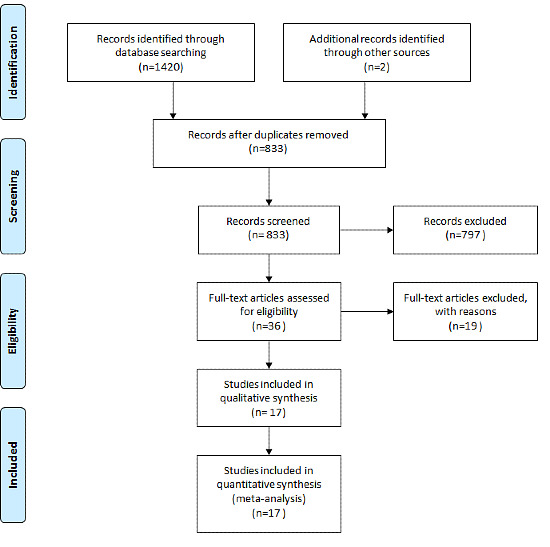
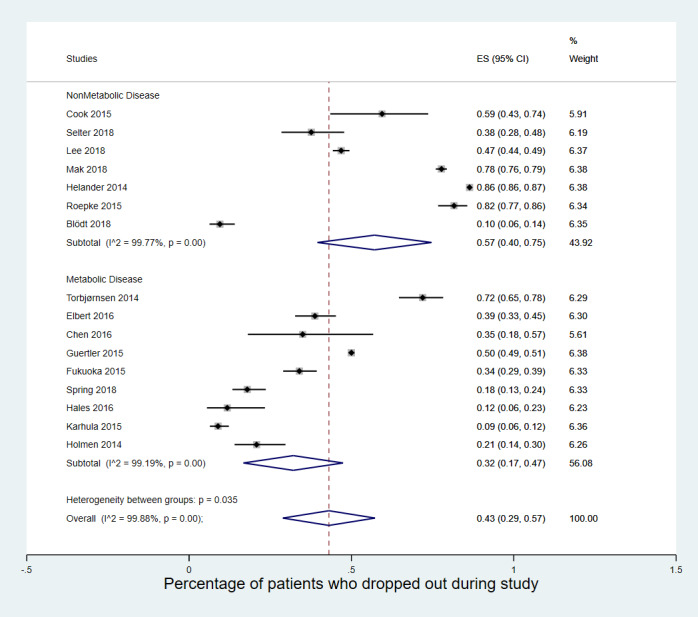
Results: Of 833 studies identified in the literature search, 17 were included in the review and meta-analysis. Out of 17 studies, 9 (53%) were RCTs and 8 (47%) were observational trials, with both types covering a range of chronic diseases. The pooled dropout rate was 43% (95% CI 29-57), with observational studies having a higher dropout rate (49%, 95% CI 27-70) than RCTs in more controlled scenarios, which only had a 40% dropout rate (95% CI 16-63). The studies were extremely varied, which is represented statistically in the high degree of heterogeneity (I2>99%). Qualitative synthesis revealed a range of reasons relating to attrition from app-based interventions, including social, demographic, and behavioral factors that could be addressed.
Conclusions: Dropout rates in mHealth interventions are high, but possible areas to minimize attrition exist. Reducing dropout rates will make these apps more effective for disease management in the long term.
Trial registration: International Prospective Register of Systematic Reviews (PROSPERO) CRD42019128737; https://www.crd.york.ac.uk/prospero/display_record.php?ID=CRD42019128737.
Keywords: attrition; chronic disease; dropout; mHealth; mobile apps.
©Gideon Meyerowitz-Katz, Sumathy Ravi, Leonard Arnolda, Xiaoqi Feng, Glen Maberly, Thomas Astell-Burt. Originally published in the Journal of Medical Internet Research (http://www.jmir.org), 29.09.2020.
Conflict of interest statement
Conflicts of Interest: None declared.
Figures
References
-
- Global Report on Diabetes. Geneva, Switzerland: World Health Organization; 2016. [2020-09-22]. https://apps.who.int/iris/bitstream/handle/10665/204871/9789241565257_en....
-
- Diabetes: The Silent Pandemic and its Impact on Australia. Canberra, Australia: Diabetes Australia; 2015. [2020-05-01]. https://static.diabetesaustralia.com.au/s/fileassets/diabetes-australia/....
Publication types
MeSH terms
LinkOut - more resources
Full Text Sources
Medical
