


Prevalence and predictors of aortic root abscess among patients with left-sided infective endocarditis: a cross-sectional comparative study
- PMID: 32990862
- PMCID: PMC7524951
- DOI: 10.1186/s43044-020-00098-6
Prevalence and predictors of aortic root abscess among patients with left-sided infective endocarditis: a cross-sectional comparative study
Abstract
Background: Aortic root abscess (ARA) is a major complication of infective endocarditis that is associated with increased morbidity and mortality. Limited data are present about patient characteristics and outcomes in this lethal disease. We aimed to study the clinical and echocardiographic characteristics of patients with ARA compared to patients with left-sided infective endocarditis without ARA. We included patients with a definite diagnosis of left-sided infective endocarditis according to modified Duke's criteria. The patients were classified into two groups according to the presence of ARA (ARA and NO-ARA groups). All the patients were studied regarding their demographic data, clinical characteristics, laboratory and imaging data, and complications.
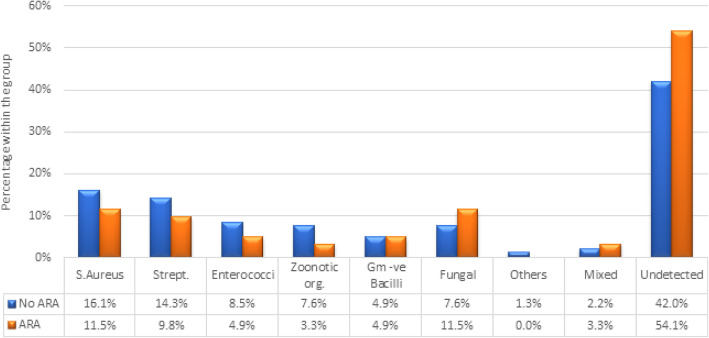
Results: We included 285 patients with left-sided infective endocarditis. The incidence of ARA was 21.4% (61 patients). Underlying heart disease, mechanical prosthesis, bicuspid aortic valve, and prior IE were significantly higher in ARA. The level of CRP was higher in ARA (p = 0.03). ARA group showed more aortic valve vegetations (73.8% vs. 37.1%, p < 0.001), more aortic paravalvular leakage (26.7% vs. 4.5%, p < 0.001), and less mitral valve vegetations (21.3% vs. 68.8%, p < 0.001). Logistic regression analysis showed that the odds of ARA increased in the following conditions: aortic paravalvular leak (OR 3.9, 95% CI 1.2-13, p = 0.03), mechanical prosthesis (OR 3.6, 95% CI 1.5-8.7, p = 0.005), aortic valve vegetations (OR 3.0, 95% CI 1.2-8.0, p = 0.02), and undetected organism (OR 2.3, 95% CI 1.1-4.6, p = 0.02), while the odds of ARA decreased with mitral valve vegetations (OR 0.2, 95% CI 0.08-0.5, p = 0.001). We did not find a difference between both groups regarding the incidence of major complications, including in-hospital mortality.
Conclusion: In our study, ARA occurred in one fifth of patients with left-sided IE. Patients with mechanical prosthesis, aortic paravalvular leakage, aortic vegetations, and undetected organisms had higher odds of ARA, while patients with mitral vegetations had lower odds of ARA.
Keywords: Aortic root abscess; Infective endocarditis; Paravalvular leakage.
Conflict of interest statement
The authors declare that they have no competing interests.
Figures



References
-
- Habib G, Lancellotti P, Antunes MJ, Bongiorni MG, Casalta J-P, Del Zotti F, et al. 2015 ESC guidelines for the management of infective endocarditis: the task force for the management of infective endocarditis of the European Society of Cardiology (ESC) endorsed by: European Association for Cardio-Thoracic Surgery (EACTS), the European A. Eur Heart J. 2015;36(44):3075–3128. doi: 10.1093/eurheartj/ehv319. - DOI - PubMed
-
- Heldman AW, Hartert TV, Ray SC, Daoud EG, Kowalski TE, Pompili VJ, et al. Oral antibiotic treatment of right-sided staphylococcal endocarditis in injection drug users: prospective randomized comparison with parenteral therapy. Am J Med. 1996;101(1):68–76. doi: 10.1016/S0002-9343(96)00070-8. - DOI - PubMed
-
- Stamboulian D, Bonvehi P, Arevalo C, Bologna R, Cassetti I, Scilingo V, et al. Antibiotic management of outpatients with endocarditis due to penicillin-susceptible streptococci. Rev Infect Dis. 1991;13(Supplement_2):S160–3. - PubMed
LinkOut - more resources
Full Text Sources
Research Materials
Miscellaneous