


Sex, gender and COVID-19: a call to action
- PMID: 32990927
- PMCID: PMC7523484
- DOI: 10.17269/s41997-020-00417-z
Sex, gender and COVID-19: a call to action
Abstract
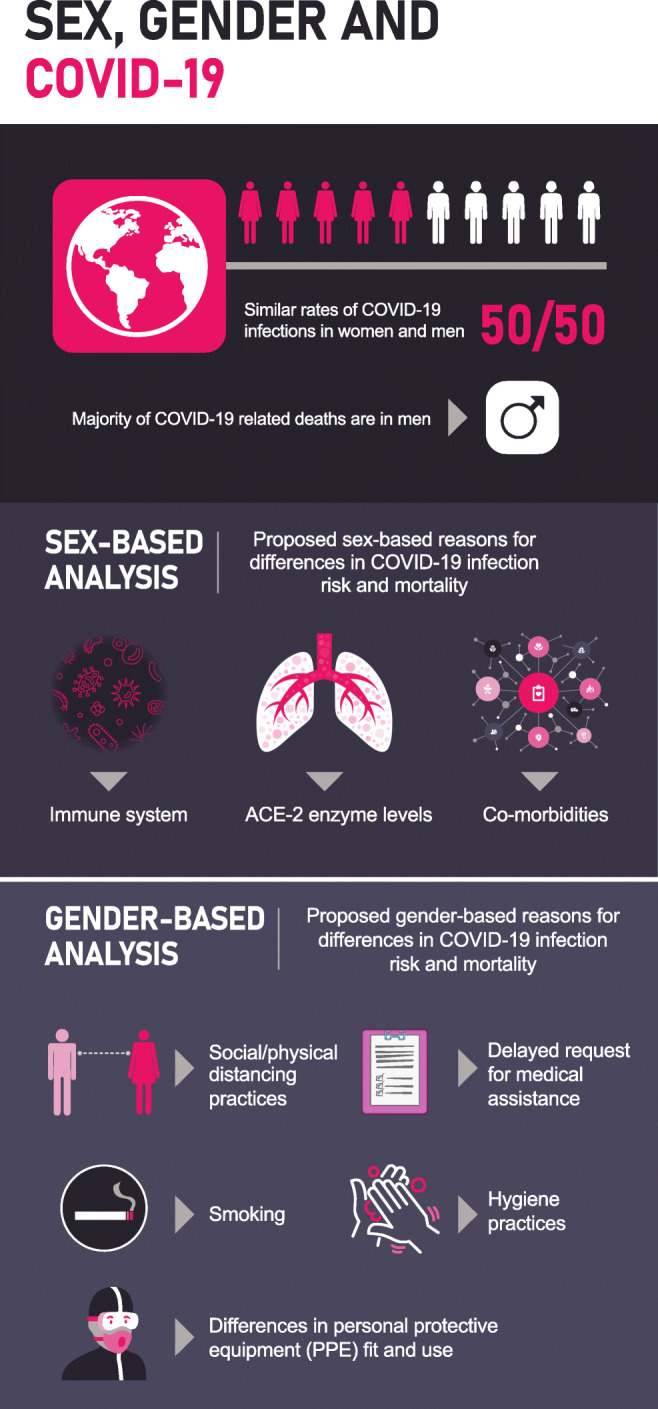
An understanding of the influence of sex (biological attributes) and gender (socially constructed roles, behaviours, expressions, identities) factors on the risk of infection, hospitalization and death is of urgent importance in the COVID-19 pandemic response effort. Despite similar global rates of infection with Severe Acute Respiratory Syndrome-Coronavirus-2 (SARS-CoV-2, the virus responsible for the COVID-19 pandemic), hospitalizations and mortality are higher in men than in women. Females may be less vulnerable to viral infection due to sex-based differences in immune responses and renin-angiotensin system activity. The response and side effects of currently studied potential therapies for COVID-19, such as hydroxychloroquine, likely differ by sex. Women form the majority of the health care workforce and a uniform approach to sizing of personal protective equipment may provide differing levels of protection from viral infection to health care workers of varying shapes and sizes. Important gender differences exist in the response to public health measures to prevent and contain spread of COVID-19, as well as presentation for testing and medical care, which may inadvertently propagate viral spread. Targeted approaches that consider both sex and gender, as well as measures of intersectionality, are urgently needed in the response efforts against COVID-19.
RéSUMé: Il est d’une importance primordiale, pour riposter à la pandémie de COVID-19, de comprendre l’influence des facteurs liés au sexe (les attributs biologiques) et au genre (les rôles, comportements, expressions et identités socialement construits) sur les risques d’infection, d’hospitalisation et de décès. Malgré la similarité mondiale des taux d’infection par le coronavirus du syndrome respiratoire aigu sévère 2 (SRAS-Cov-2, le virus responsable de la pandémie de COVID-19), les hospitalisations et la mortalité sont plus élevées chez les hommes que chez les femmes. Celles-ci pourraient être moins vulnérables à l’infection virale en raison de différences sexuelles dans les réponses immunitaires et dans l’activité du système rénine-angiotensine. Les réactions et les effets secondaires aux traitements possibles de la COVID-19 actuellement à l’étude, comme l’hydroxychloroquine, diffèrent probablement selon le sexe. Comme les femmes composent la majorité de la main-d’œuvre des soins de santé, les tailles uniformes de l’équipement de protection individuelle offrent peut-être des niveaux de protection inégaux contre l’infection virale aux travailleurs de la santé de formes et de tailles différentes. Il existe des différences importantes entre les genres dans les réactions aux mesures de santé publique visant à prévenir et à contenir la propagation de la COVID-19 et dans la présentation aux tests et aux soins médicaux, ce qui pourrait par inadvertance favoriser la propagation virale. Dans la riposte à la COVID-19, il devient urgent d’adopter des approches ciblées, qui tiennent compte à la fois du sexe et du genre, ainsi que des mesures de l’intersectionnalité.
Keywords: COVID-19; Gender; Infection; Mortality; Policy; Sex.
Conflict of interest statement
The authors declare that they have no conflicts of interest.
Figures
References
-
- Boniol M, McIsaac M, Xu L, Wuliji T, Diallo K, Campbell J. Gender equity in the health workforce: analysis of 104 countries. Working paper 1. Geneva: World Health Organization; 2019.
-
- Global Health 50/50. COVID-19 Sex-disaggregated data tracker (2020). https://globalhealth5050.org/covid19/sex-disaggregated-data-tracker/. Accessed 25 August 2020.
-
- Guzek, D., Skolmowska, D., Głąbska, D. (2020). Analysis of gender-dependent personal protective behaviors in a national sample: Polish Adolescents’ COVID-19 Experience (PLACE-19) study. International Journal of Environmental Research and Public Health, 17(16), 5770. 10.3390/ijerph17165770. - PMC - PubMed
MeSH terms
LinkOut - more resources
Full Text Sources
Medical
Miscellaneous
