. 2020 Oct 12;21(10):4105-4115.
doi: 10.1021/acs.biomac.0c00904. Epub 2020 Sep 29.

Exploring the Potential of Benzene-1,3,5-tricarboxamide Supramolecular Polymers as Biomaterials

Affiliations

Exploring the Potential of Benzene-1,3,5-tricarboxamide Supramolecular Polymers as Biomaterials

Silvia Varela-Aramburu et al. Biomacromolecules. .

Abstract

The fast dynamics occurring in natural processes increases the difficulty of creating biomaterials capable of mimicking Nature. Within synthetic biomaterials, water-soluble supramolecular polymers show great potential in mimicking the dynamic behavior of these natural processes. In particular, benzene-1,3,5-tricaboxamide (BTA)-based supramolecular polymers have shown to be highly dynamic through the exchange of monomers within and between fibers, but their suitability as biomaterials has not been yet explored. Herein we systematically study the interactions of BTA supramolecular polymers bearing either tetraethylene glycol or mannose units at the periphery with different biological entities. When BTA fibers were incubated with bovine serum albumin (BSA), the protein conformation was only affected by the fibers containing tetraethylene glycol at the periphery (BTA-OEG4). Coarse-grained molecular simulations showed that BSA interacted with BTA-OEG4 fibers rather than with BTA-OEG4 monomers that are present in solution or that may exchange out of the fibers. Microscopy studies revealed that, in the presence of BSA, BTA-OEG4 retained their fiber conformation although their length was slightly shortened. When further incubated with fetal bovine serum (FBS), both long and short fibers were visualized in solution. Nevertheless, in the hydrogel state, the rheological properties were remarkably preserved. Further studies on the cellular compatibility of all the BTA assemblies and mixtures thereof were performed in four different cell lines. A low cytotoxic effect at most concentrations was observed, confirming the suitability of utilizing functional BTA supramolecular polymers as dynamic biomaterials.


Conflict of interest statement

The authors declare no competing financial interest.

Figures
Scheme 1
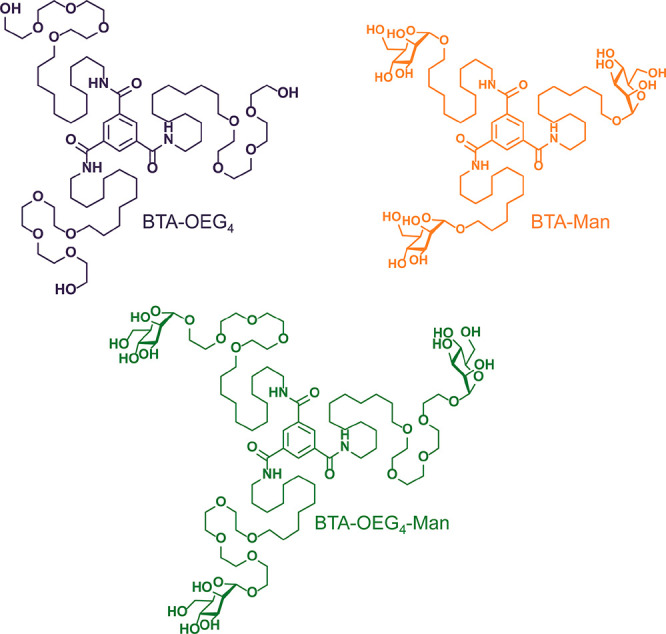
Scheme 1. Chemical Structure of the Water-Compatible BTA Monomers Selected for This Study
Figure 1
Figure 1
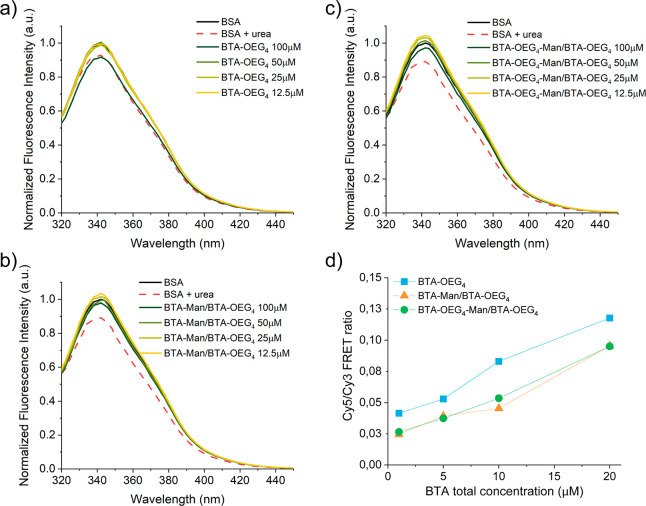
BSA tryptophan fluorescence emission showed interaction between BTA-OEG4 and physiological concentration of BSA at 37 °C (a). The introduction of mannose moieties at the fiber periphery reduced this interaction (b, c). FRET experiments (d) showed enhanced interaction between Cy3-labeled BTA fibers and Cy5-BSA increasing the fibers concentrations.
Figure 2
Figure 2
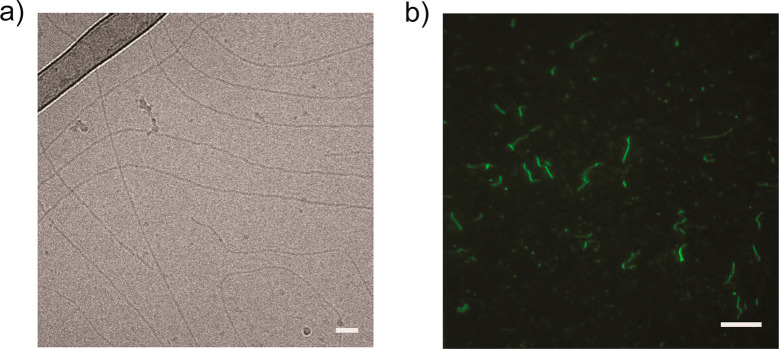
(a) CryoTEM of BTA-OEG4 incubated with BSA (scale bar: 50 nm) and (b) TIRF imaging of Cy3-BTA-OEG4 incubated with BSA (scale bar: 10 μm).
Figure 3
Figure 3
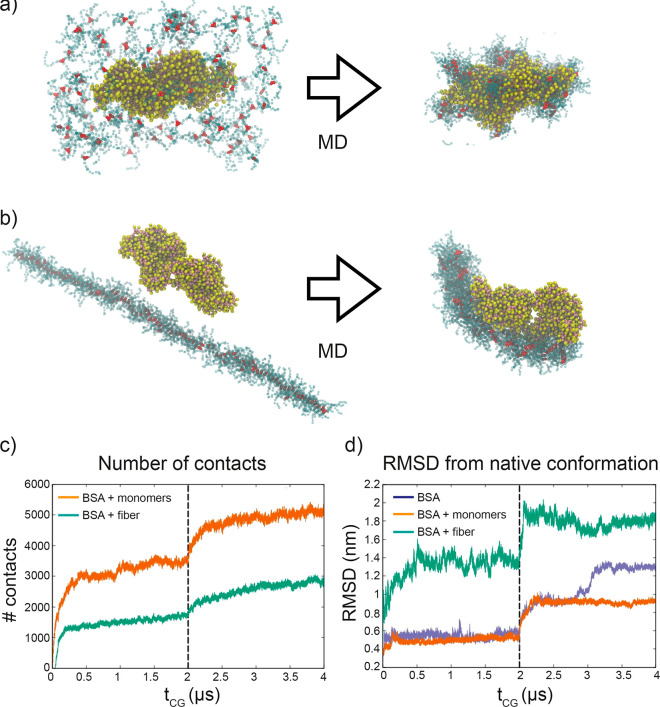
CG modeling of BSA interaction with BTA-OEG4. (a) BSA dimer (yellow and pink beads) interacting with 100 disassembled BTA-OEG4 monomers (red and blue beads) and (b) BSA dimer interacting with the BTA-OEG4 fiber composed of 100 monomers. The snapshots on the left show the initial configuration, while those on the right are taken after 2 μs of CG-MD. VMD was used for visualization and rendering of the systems. (c) Evolution of the number of contacts between BSA and BTA-OEG4 in the two systems (a) and (b). (d) Evolution of root-mean-square displacement (RMSD) of BSA conformation from the native structure, for the two systems (a) and (b) and for a control system with BSA in water. The first 2 μs of CG-MD in (c) and (d) employed an elastic network potential, which was removed after 2 μs (vertical dashed line).
Figure 4
Figure 4
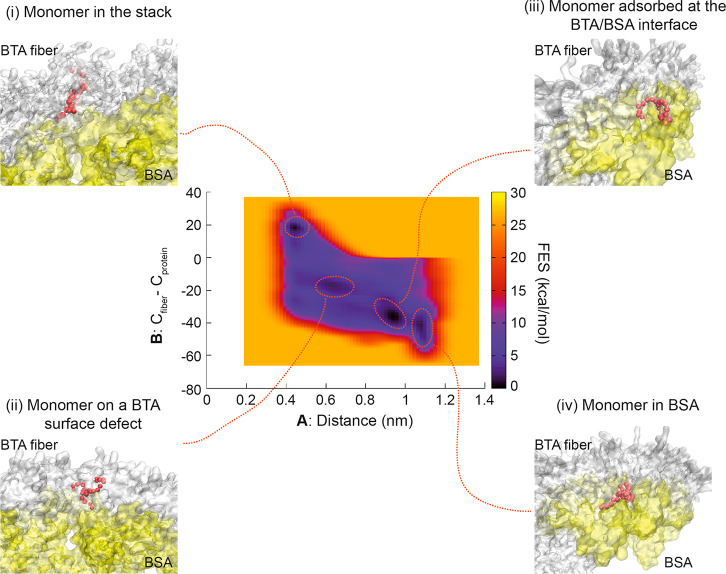
Free-energy surface (FES) for the event of monomer exchange from BTA-OEG4 fiber to BSA. In the center, the FES is represented as a function of the two variables A and B (defined in the methods section). Snapshots from the main free-energy minima are reported: (i) The monomer (red beads) is part of the backbone of the fiber; (ii) The monomer is in a defect configuration, interacting with the protein; (iii) The monomer is adsorbed at the interface between BSA and BTA-OEG4 fiber; (iv) The monomer detaches from the fiber and is sequestered inside the protein. VMD was used for visualization and rendering of the system.
Figure 5
Figure 5
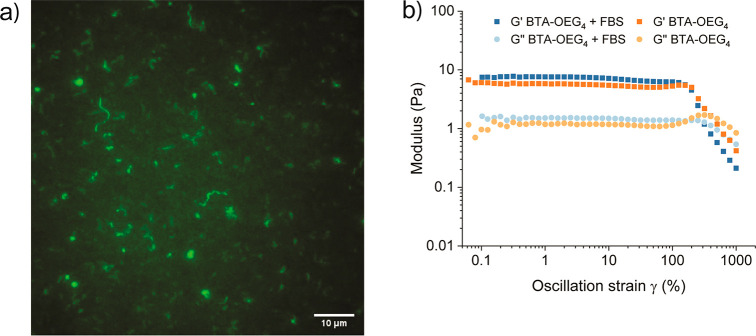
(a) TIRF imaging of BTA-OEG4 after overnight exposure to FBS. (b) Strain-dependent oscillatory rheology with a fixed angular frequency of 1 rad/s of a 2 wt % BTA-OEG4 hydrogel with and without the addition of FBS.
Figure 6
Figure 6
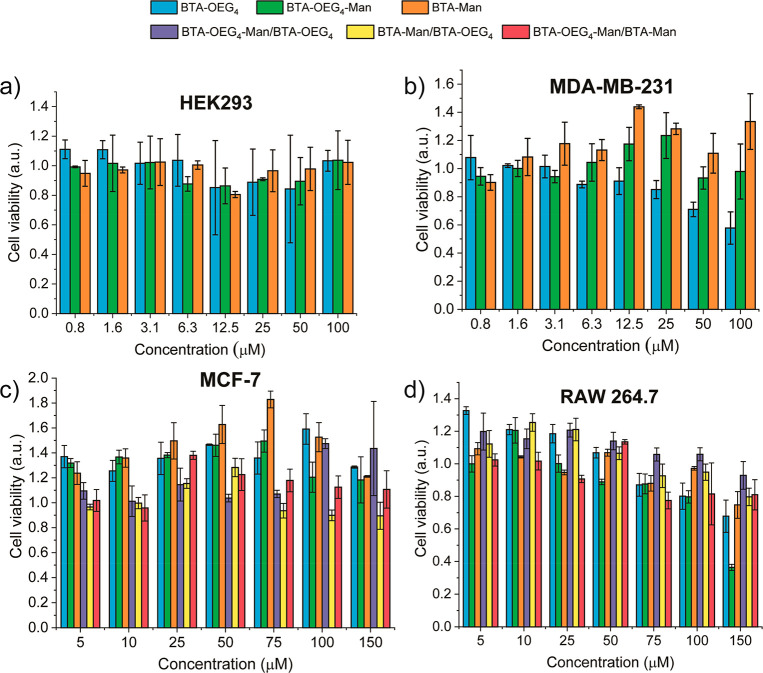
HEK293 (a), MDA-MB-231 (b), MCF-7 (c), and RAW 264.7 (d) viability after 24 h incubation with increasing concentrations of BTA homo- and coassemblies.

References

    1. Huebsch N.; Mooney D. J. Inspiration and application in the evolution of biomaterials. Nature 2009, 462 (7272), 426–432. 10.1038/nature08601. - DOI - PMC - PubMed
    1. Studart A. R. Biologically Inspired Dynamic Material Systems. Angew. Chem., Int. Ed. 2015, 54 (11), 3400–3416. 10.1002/anie.201410139. - DOI - PubMed
    1. Goor O. J. G. M.; Hendrikse S. I. S.; Dankers P. Y. W.; Meijer E. W. From supramolecular polymers to multi-component biomaterials. Chem. Soc. Rev. 2017, 46 (21), 6621–6637. 10.1039/C7CS00564D. - DOI - PubMed
    1. Webber M. J.; Appel E. A.; Meijer E. W.; Langer R. Supramolecular biomaterials. Nat. Mater. 2016, 15 (1), 13–26. 10.1038/nmat4474. - DOI - PubMed
    1. Krieg E.; Bastings M. M. C.; Besenius P.; Rybtchinski B. Supramolecular Polymers in Aqueous Media. Chem. Rev. 2016, 116 (4), 2414–2477. 10.1021/acs.chemrev.5b00369. - DOI - PubMed

Publication types