. 2020 Nov 9;12(1):1795492.
doi: 10.1080/19490976.2020.1791677.

Long-term effects of antimicrobial drugs on the composition of the human gut microbiota

Affiliations

Long-term effects of antimicrobial drugs on the composition of the human gut microbiota

M Mulder et al. Gut Microbes. .

Abstract

Introduction: Antimicrobial drugs are known to have effects on the human gut microbiota. We studied the long-term temporal relationship between several antimicrobial drug groups and the composition of the human gut microbiota determined in feces samples.

Methods: Feces samples were obtained from a community-dwelling cohort of middle-aged and elderly individuals (Rotterdam Study). Bacterial DNA was isolated and sequenced using V3/V4 16 S ribosomal RNA sequencing (Illumina MiSeq). The time between the last prescription of several antimicrobial drug groups and the day of sampling was categorized into 0-12, 12-24, 24-48 and >48 months. The effects of the antimicrobial drug groups on the Shannon alpha-diversity (diversity), the Bray-Curtis beta-diversity (community structure), the Firmicutes/Bacteroidetes (F/B) ratio and individual genera were determined.

Results: We studied the gut microbiota of 1413 individuals (57.5% female, median age 62.6 years). The alpha-diversity was significantly lower up to 4 years after prescriptions of macrolides and lincosamides. It was also lower in the first year after the use of beta-lactams. The community structure (beta-diversity) of the microbiota was significantly different up to 4 years for macrolides and lincosamides, the first year for beta-lactams and at least the first year for quinolones. For the F/B ratio, drugs with a high anaerobic activity shifted the ratio toward Firmicutes in the first year whereas other antimicrobial drugs shifted the ratio toward Bacteroidetes.

Conclusion: Use of antimicrobial drugs is associated with a shift in the composition of the gut microbiota.These effects differ in strength and duration, depending on the antimicrobial drug group used. These findings should be considered when prescribing antimicrobial drugs.

Keywords: Gut microbiota; antimicrobial use; beta-lactams; macrolides and lincosamides; nitrofuran derivatives; quinolones; sulfonamides and trimethoprim; tetracyclines.


Figures
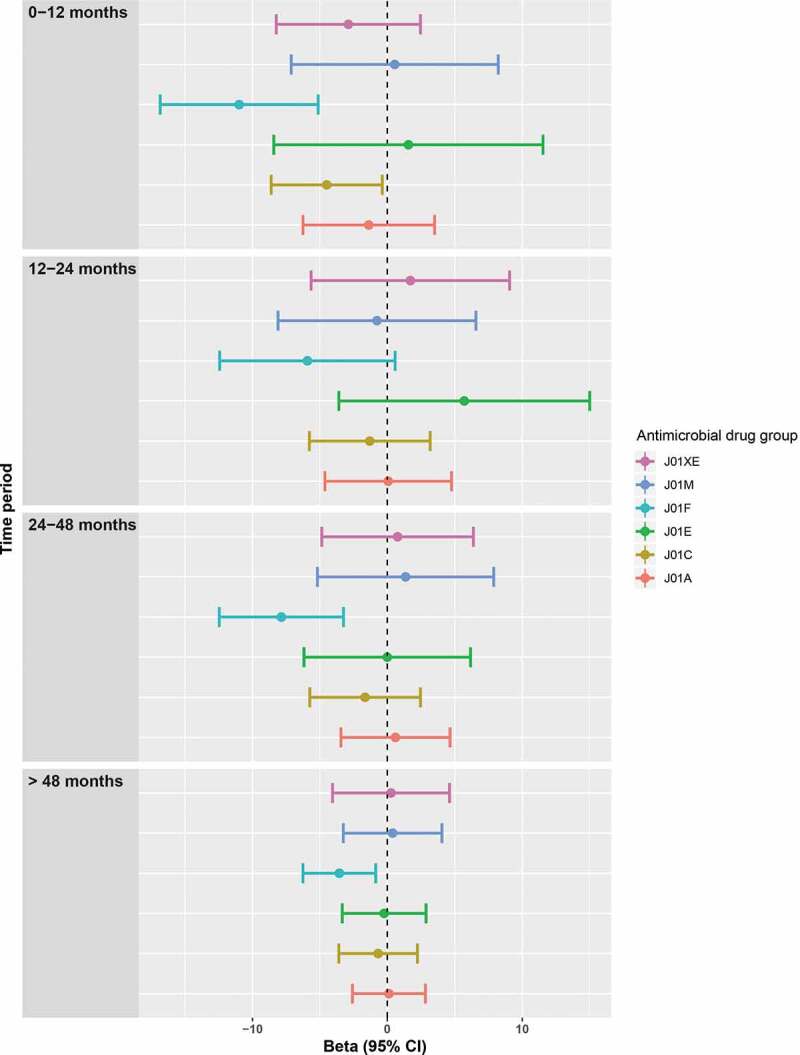
Figure 1.
Figure 1.
Diversity after antimicrobial drug use. Plots of the beta’s with 95% confidence intervals of the linear regression with as dependent variable the transformed (cube) Shannon alpha-diversity and as independent variables the different antimicrobial drug groups. All antimicrobial drug groups were analyzed with dummy variables with categories of use of 0–12, 12–24, 24–48 and >48 months compared to no use before sampling. The analyses were adjusted for age, sex, BMI, diabetes, time in mail, batch number, use of statins, PPIs, SSRIs, antipsychotics and systemic corticosteroids and (categorized) use of all other antimicrobial drugs.
Figure 2.
Figure 2.
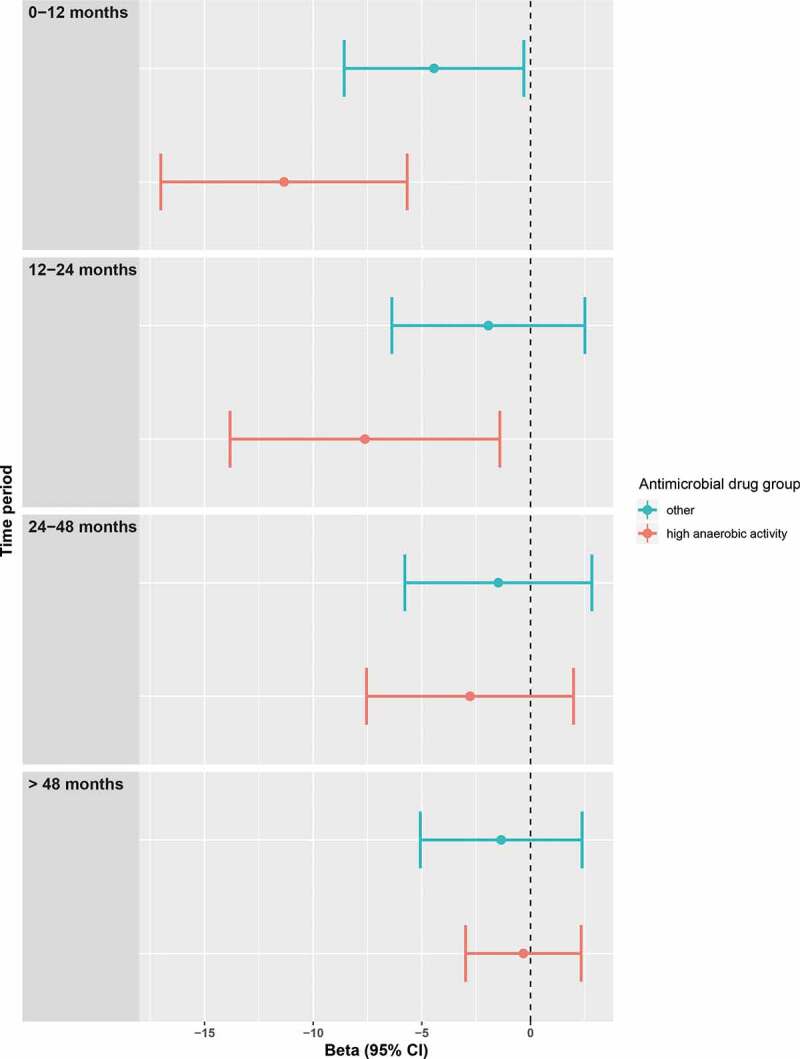
Diversity after using antimicrobial drugs with high anaerobic activity vs other antimicrobial drugs. Plots of the beta’s with 95% confidence intervals of the linear regression with as dependent variable the transformed (cube) Shannon alpha-diversity and as independent variables the combined antimicrobial drugs that have a strong anaerobic activity (anaerobic + drugs) and the combined remaining antimicrobial drugs (anaerobic- drugs). Both were analyzed with dummy variables with categories of 0–12, 12–24, 24–48 and >48 months compared to no use. The analyses were adjusted for age, sex, BMI, diabetes, time in mail, batch number, use of statins, PPIs, SSRIs, antipsychotics and systemic corticosteroids and (categorized) use of all other antimicrobial drugs.
Figure 3.
Figure 3.
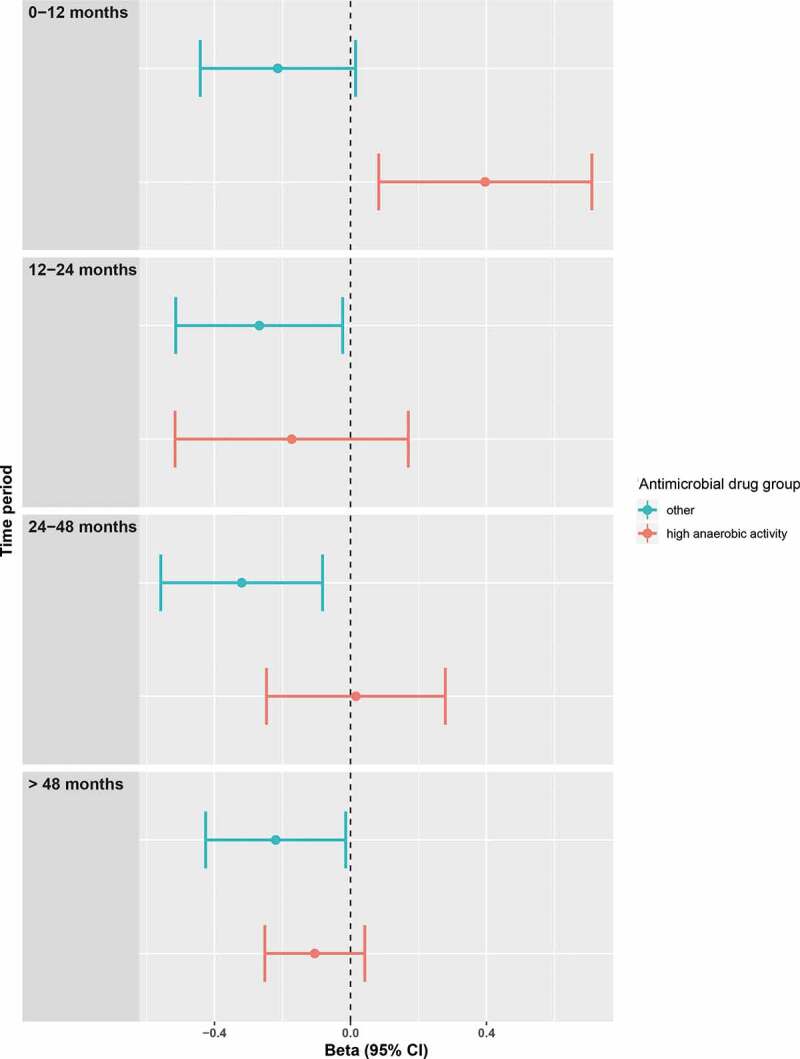
Firmicutes/Bacteroidetes ratio after using antimicrobial drugs with high anaerobic activity vs other antimicrobial drugs. Forest plots of the relative risks with 95% confidence intervals of the linear regression with as dependent variable the transformed (logarithmic) Firmicutes/Bacteroidetes ratio and as independent variables the combined antimicrobial drugs that have a strong anaerobic activity and the combined remaining antimicrobial drugs (“other”). Both were analyzed with dummy variables with categories of 0–12, 12–24, 24–48 and >48 months compared to no use. The analyses were adjusted for age, sex, BMI, diabetes, time in mail, batch number, use of statins, PPIs, SSRIs, antipsychotics and systemic corticosteroids and (categorized) use of all other antimicrobial drugs. A positive beta indicates a shift toward Firmicutes, whereas a negative beta indicates a shift toward Bacteroidetes.
Figure 4.
Figure 4.
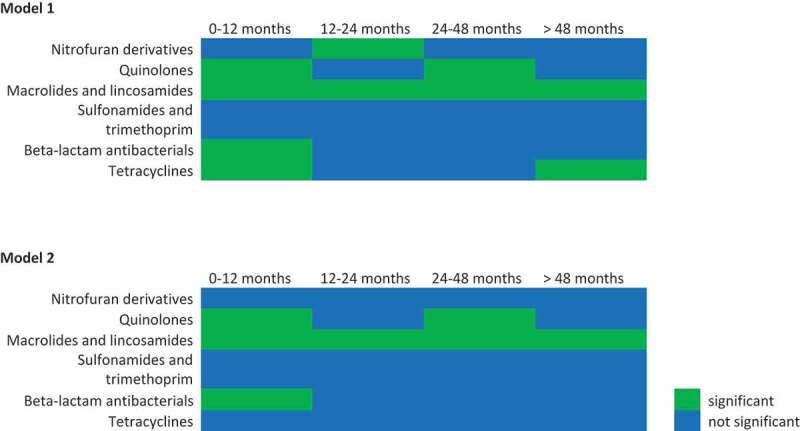
Effects of antimicrobial drug use on community structure. Significance table for all antimicrobial drug groups for all time categories studied in model 1, thus adjusted for age, sex, BMI, diabetes, time in mail, batch number, use of statins, PPIs, SSRIs, antipsychotics and systemic corticosteroids. (Top) Significance table for all antimicrobial drug groups for all time categories studied in model 2, thus adjusted for age, sex, BMI, diabetes, time in mail, batch number, use of statins, PPIs, SSRIs, antipsychotics and systemic corticosteroids and (categorized) use of all other antimicrobial drugs. (Bottom) In these significance tables green indicates significant (p < 0.05), blue indicates not significant.

References

    1. Lynch SV, Pedersen O.. The human intestinal microbiome in health and disease. N Engl J Med. 2016;375:2369–12. - PubMed
    1. den Besten G, van Eunen K, Groen AK, Venema K, Reijngoud DJ, Bakker BM. The role of short-chain fatty acids in the interplay between diet, gut microbiota, and host energy metabolism. J Lipid Res. 2013;54:2325–2340. doi: 10.1194/jlr.R036012. - DOI - PMC - PubMed
    1. Morrison DJ, Preston T. Formation of short chain fatty acids by the gut microbiota and their impact on human metabolism. Gut Microbes. 2016;7:189–200. doi: 10.1080/19490976.2015.1134082. - DOI - PMC - PubMed
    1. Saraswati S, Sitaraman R, Ge M-Y, Ibrahim M, Li B, Zhao W-J, Chen G-Y, Zhu B, Xie G-L. Aging and the human gut microbiota-from correlation to causality. Front Microbiol. 2014;5:764. doi: 10.3389/fmicb.2014.00547. - DOI - PMC - PubMed
    1. Haro C, Rangel-Zuniga OA, Alcala-Diaz JF, Gomez-Delgado F, Perez-Martinez P, Delgado-Lista J, Quintana-Navarro GM, Landa BB, Navas-Cortés JA, Tena-Sempere M, et al. Intestinal microbiota is influenced by gender and body mass index. PLoS One. 2016;11(5):e0154090. doi: 10.1371/journal.pone.0154090. - DOI - PMC - PubMed

Publication types

Substances