Review
. 2020 Sep 25;21(19):7057.
doi: 10.3390/ijms21197057.

New Insights into the Mechanisms of Pyroptosis and Implications for Diabetic Kidney Disease

Affiliations
Review

New Insights into the Mechanisms of Pyroptosis and Implications for Diabetic Kidney Disease

Jinwen Lin et al. Int J Mol Sci. .

Abstract

Pyroptosis is one special type of lytic programmed cell death, featured in cell swelling, rupture, secretion of cell contents and remarkable proinflammation effect. In the process of pyroptosis, danger signalling and cellular events are detected by inflammasome, activating caspases and cleaving Gasdermin D (GSDMD), along with the secretion of IL-18 and IL-1β. Pyroptosis can be divided into canonical pathway and non-canonical pathway, and NLRP3 inflammasome is the most important initiator. Diabetic kidney disease (DKD) is one of the most serious microvascular complications in diabetes. Current evidence reported the stimulatory role of hyperglycaemia-induced cellular stress in renal cell pyroptosis, and different signalling pathways have been shown to regulate pyroptosis initiation. Additionally, the inflammation and cellular injury caused by pyroptosis are tightly implicated in DKD progression, aggravating renal fibrosis, glomerular sclerosis and tubular injury. Some registered hypoglycaemia agents exert suppressive activity in pyroptosis regulation pathway. Latest studies also reported some potential approaches to target the pyroptosis pathway, which effectively inhibits renal cell pyroptosis and alleviates DKD in in vivo or in vitro models. Therefore, comprehensively compiling the information associated with pyroptosis regulation in DKD is the main aim of this review, and we try to provide new insights for researchers to dig out more potential therapies of DKD.

Keywords: cellular stress; diabetic; fibrosis; kidney disease; pyroptosis.


Conflict of interest statement

The authors declare no conflict of interest.

Figures
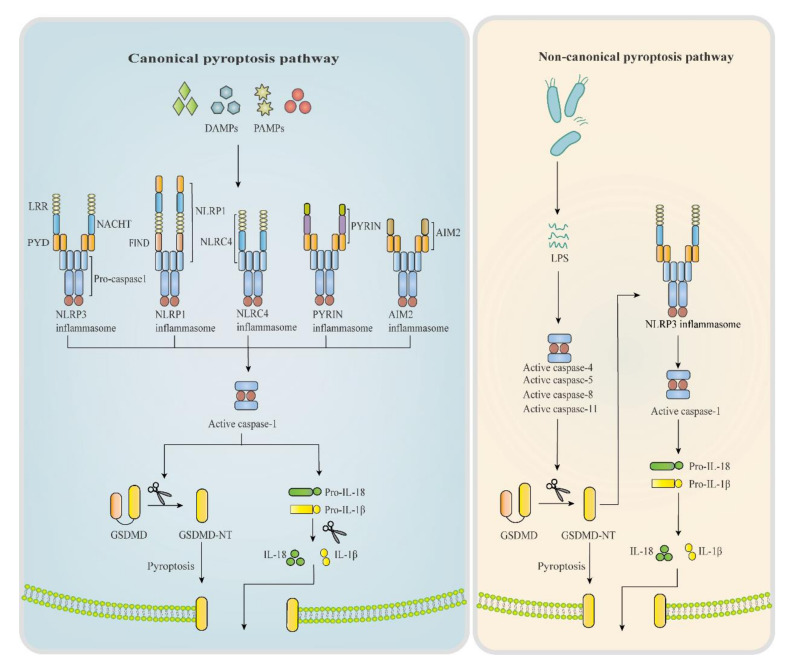
Figure 1
Figure 1
Pyroptosis canonical pathway and non-canonical pathway. Working as the molecular switch of pyroptosis, inflammasomes consist of a sensor PRRs, an adaptor ASC, and an effector pro-caspase-1. During pyroptosis canonical pathway, DAMPs and PAMPs are identified by PRRs, promoting the combination of PRR’s PYD with ASC, thus recruiting pro-caspase-1 and priming complete inflammasome. Activated inflammasome triggers caspase-1 and cleaves GSDMD into GSDMD-NT, which inserts into cell membrane and resulting pore formation, accompanied by the secretion of IL-1β, IL-18. Whereas in non-canonical pathway, it’s caspase-4/5/8/11 that are activated by intracellular LPS or toxins, leading to the same cascaded reactions. PRRs, pattern recognition receptors; ASC, apoptosis-associated speck-like protein; DAMPs, damage-associated molecular patterns; PAMPs, pathogen-associated molecular patterns; GSDMD, gasderminD; LPS, lipopolysaccharides; LRR, leucine rich repeat; PYD, pyrin domain; NACTH, NACTH domain; FIND, Function-to-find domain; GSDMD-NT, GSDMD-N-terminal.
Figure 2
Figure 2
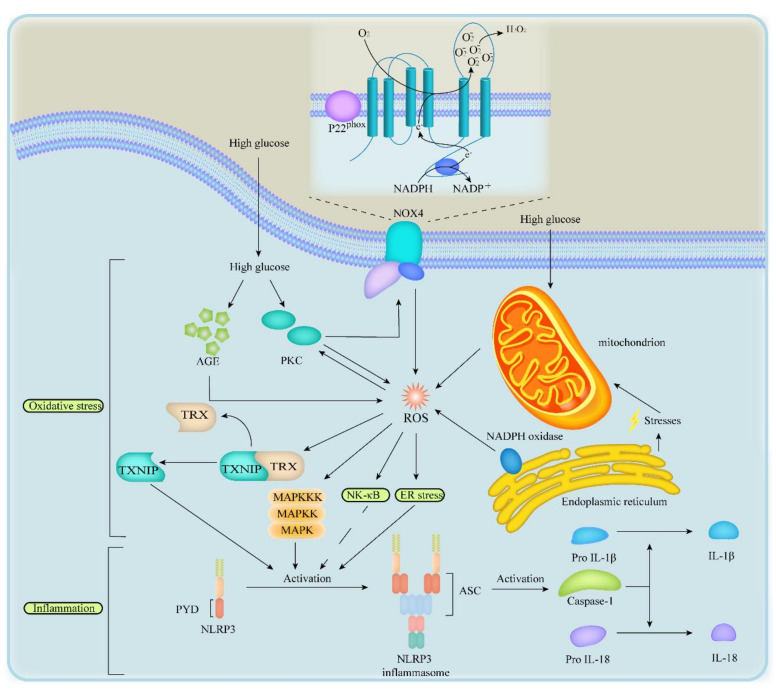
Oxidative stress and ER stress in inflammation in DKD. In oxidative stress, HG activates the overproduction of AGE and PKC, mitochondria damage and NOX4, which promotes the generation of ROS to induce inflammation by the upregulation of TXNIP, p38MAPK signalling pathway and NF-κB signalling pathway. In ER stress, disruption of homeostasis between the ER and mitochondria and NADPH oxidase in ER activates NF-κB signalling pathway by ROS overproduction. In inflammation, pathways above activate NLRP3 inflammasome and caspase-1 and induce secretion of IL-18 and IL-1β. PKC, protein kinase C; AGE, advanced glycosylation end product; NOX4, NADPH oxidases 4; ROS, reactive oxygen species; XNIP, thioredoxin interacting protein; TRX, thioredoxin; NF-κB, nuclear transcription factor; MAPK, mitogen-activated protein kinase.
Figure 3
Figure 3
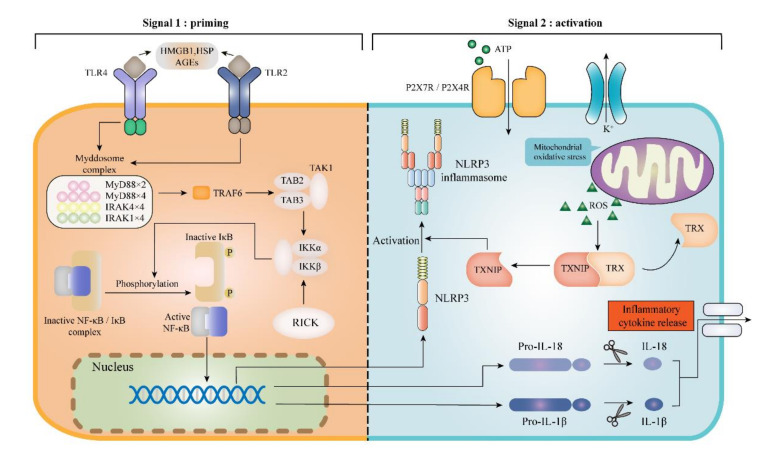
To activate NLRP3 inflammasome needs two signals. The signal 1 (priming; left) is provided by the activation of TLR2 and TLR4 through the stimulation of some DAMPs. Signal 2 (activation; right) is provided by any of numerous PAMPs or DAMPs, such as crystals and eATP. TLR, Toll-like receptor; DAMPs, danger-associated molecular patterns; PAMPs, pathogen-associated molecular patterns; HMGB1, high-mobility group protein box 1; HSP, heat shock protein; AGEs, advanced glycation end products; MyD88, myeloid differentiation factor 88; NF-κB, nuclear factor-κB; TRAF, tumour necrosis factor receptor-associated factor; TAK, transforming growth factor β-activated kinase; IKK, IκB kinase; ROS, reactive oxygen species; TXNIP, thioredoxin interacting protein; TRX, thioredoxin; RICK, Rip-like interactive CLARP kinase; eATP, extracellular ATP.
Figure 4
Figure 4
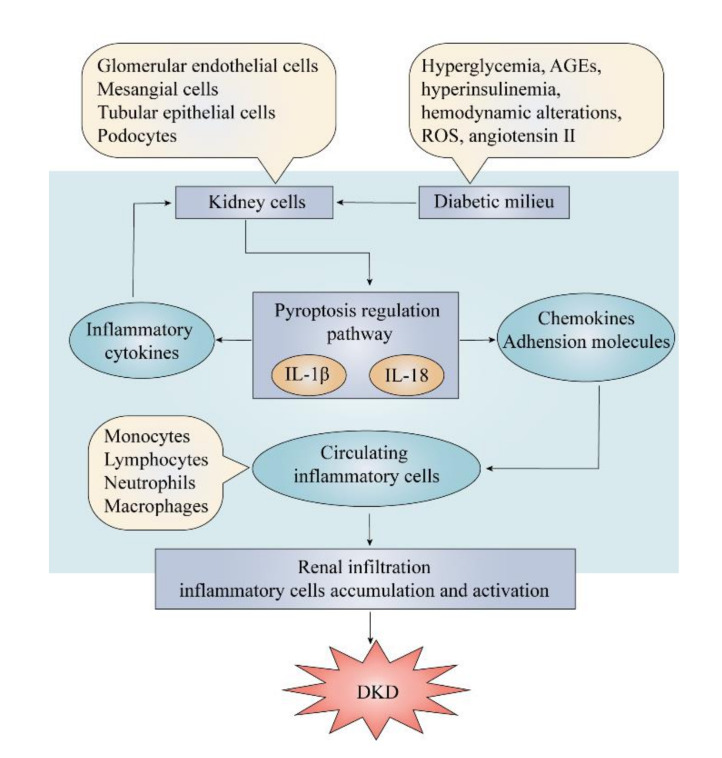
The vicious cycle of pro-inflammatory effect of pyroptosis in DKD. Components of the diabetic milieu act on kidney cells to activate pyroptosis regulation pathway, releasing the pro-inflammatory cytokines, IL-1β and IL-18. They result in renal infiltration by recruiting circulating inflammatory cells through chemokines and adhesion molecules, which amplifies the inflammatory process in the kidney, finally resulting in development and progression of DKD. AGEs, advanced glycosylation end products; ROS, reactive oxygen species; DKD, diabetic kidney disease.
Figure 5
Figure 5
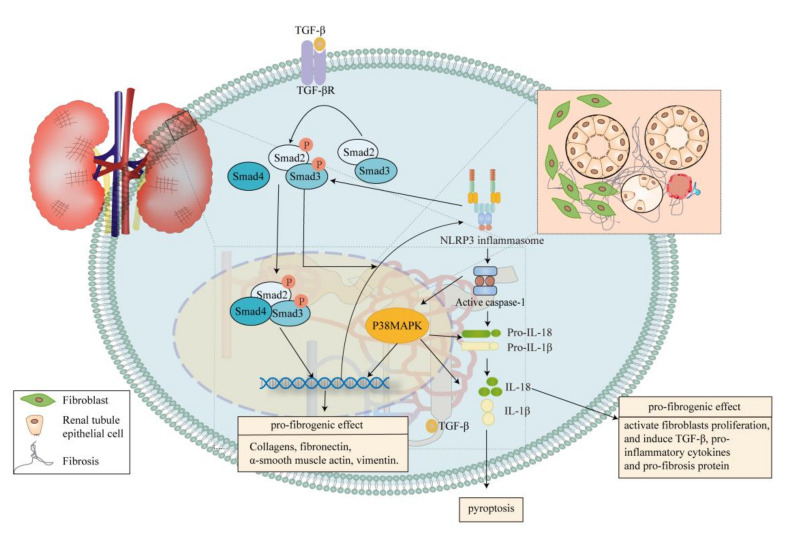
Pyroptosis contributes to interstitial fibrosis. Pyroptosis owing to chronic exposure to diabetic substrates results in cell death, renal inflammation and renal injury. The pathogenic cycle, consisting of the canonical pyroptosis pathway and the TGF-β/Smad signalling pathway, has been proved to stimulate the progress of renal fibrosis. Meanwhile, NLRP3 inflammasome mediates activation of the p38MAPK signalling pathway, regulating the accumulation of fibronectin. Eventually, the crosslink between these pathways increases the production α-SMA, collagen, fibronectin and vimentin, and the accumulation of the ECM, playing a pro-fibrogenic role. Pro-inflammatory cytokines IL-18 from pyroptosis pathway also shows the pro-fibrogenic effect in DKD. Smad, drosophila mothers against decapentaplegic; MAPK, mitogen-activated protein kinase; DKD, diabetic kidney disease; α-SMA, α-smooth muscle actin.

References

    1. Saeedi P., Petersohn I., Salpea P., Malanda B., Karuranga S., Unwin N., Colagiuri S., Guariguata L., Motala A.A., Ogurtsova K., et al. Global and regional diabetes prevalence estimates for 2019 and projections for 2030 and 2045: Results from the International Diabetes Federation Diabetes Atlas, 9 edition. Diabetes. Res. Clin. Pract. 2019;157:107843. doi: 10.1016/j.diabres.2019.107843. - DOI - PubMed
    1. Hutton H.L., Ooi J.D., Holdsworth S.R., Kitching A.R. The NLRP3 inflammasome in kidney disease and autoimmunity. Nephrology. 2016;21:736–744. doi: 10.1111/nep.12785. - DOI - PubMed
    1. Miao E.A., Leaf I.A., Treuting P.M., Mao D.P., Dors M., Sarkar A., Warren S.E., Wewers M.D., Aderem A. Caspase-1-induced pyroptosis is an innate immune effector mechanism against intracellular bacteria. Nat. Immunol. 2010;11:1136–1142. doi: 10.1038/ni.1960. - DOI - PMC - PubMed
    1. Zychlinsky A., Prevost M.C., Sansonetti P.J. Shigella flexneri induces apoptosis in infected macrophages. Nature. 1992;358:167–169. doi: 10.1038/358167a0. - DOI - PubMed
    1. Cookson B.T., Brennan M.A. Pro-inflammatory programmed cell death. Trends Microbiol. 2001;9:113–114. doi: 10.1016/S0966-842X(00)01936-3. - DOI - PubMed