Review
. 2020 Sep 25;12(10):2764.
doi: 10.3390/cancers12102764.

Under-Replicated DNA: The Byproduct of Large Genomes?

Affiliations
Review

Under-Replicated DNA: The Byproduct of Large Genomes?

Agustina P Bertolin et al. Cancers (Basel). .

Abstract

In this review, we provide an overview of how proliferating eukaryotic cells overcome one of the main threats to genome stability: incomplete genomic DNA replication during S phase. We discuss why it is currently accepted that double fork stalling (DFS) events are unavoidable events in higher eukaryotes with large genomes and which responses have evolved to cope with its main consequence: the presence of under-replicated DNA (UR-DNA) outside S phase. Particular emphasis is placed on the processes that constrain the detrimental effects of UR-DNA. We discuss how mitotic DNA synthesis (MiDAS), mitotic end joining events and 53BP1 nuclear bodies (53BP1-NBs) deal with such specific S phase DNA replication remnants during the subsequent phases of the cell cycle.

Keywords: 53BP1; DNA replication stress; RAD52; break-induced repair (BIR); common fragile sites (CFS); double fork stalling (DFS); genomic instability; mitotic DNA synthesis (MiDAS); under-replicated DNA (UR-DNA).


Conflict of interest statement

The authors declare no conflict of interest.

Figures
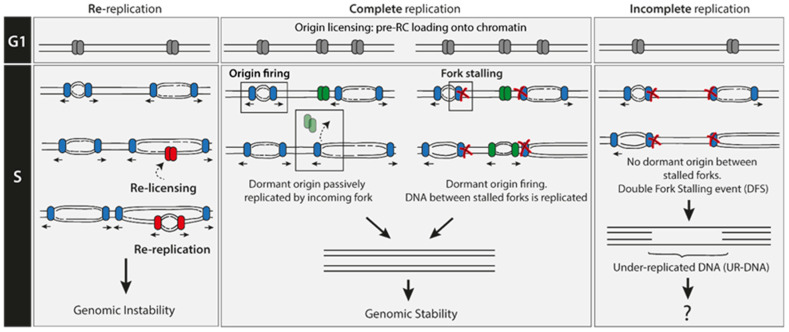
Figure 1
Figure 1
DNA replication must take place once per cell cycle. Such a scenario is represented by the middle panel. No genomic regions should be replicated more than once (left panel), and no regions should be left under-replicated (right panel).
Figure 2
Figure 2
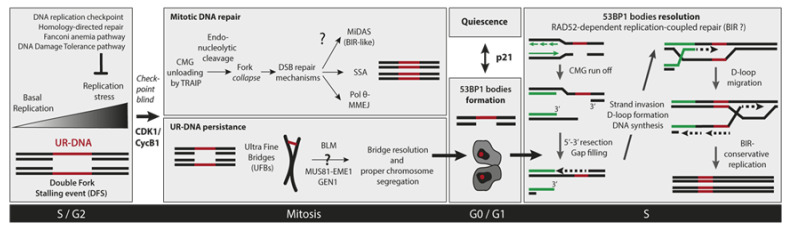
The journey of under-replicated DNA (UR-DNA) across the cell cycle phases. A hypothetical model consistent with the available data describing the fate of the genomic loci with UR-DNA. Low levels of UR-DNA outside S phase, a consequence of DFS events during S phase, seem to be an unavoidable byproduct of gigabase genomes proliferation. Even mild replicative stress greatly increases DFS probabilities. Post-replicative mechanisms can resolve UR-DNA in mitosis or G1/S phase of the next cell cycle. The pathways for mitotic resolution known so far involve either (i) a RAD52 dependent BIR-like synthesis mechanism termed MiDAS, (ii) SSA or (iii) Pol θ-dependent MMEJ. On the other hand, persistent UR-DNA manifests as UFBs in late mitosis and, once resolved by helicases or nucleases action, forms 53BP1-NBs in G1. The presence of mother UR-DNA is a decisive parameter for the proliferation-quiescence decision taken at the M/G1 boundary. The resolution of inherited UR-DNA seems to mainly take place in late S phase through a RAD52-dependent replication-coupled BIR like repair mechanism that is enabled by 53BP1-RIF1 (Rap1-interacting factor 1) coordinated action. Depicted in Figure 2 is a speculative model showing possible DNA transactions for 53BP1-NBs resolution.
Figure 3
Figure 3
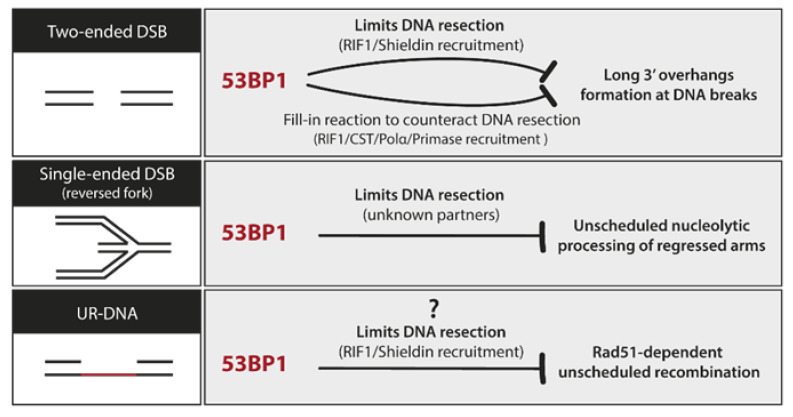
An overview of 53BP1 role in distinct DNA lesions. 53BP1 is a master regulator of the outcome of DNA repair mainly through its ability to control the processing of DNA ends.

References

    1. O’Donnell M., Langston L., Stillman B. Principles and concepts of DNA replication in bacteria, archaea, and eukarya. Cold Spring Harb. Perspect. Biol. 2013;5:a010108. doi: 10.1101/cshperspect.a010108. - DOI - PMC - PubMed
    1. Diffley J.F. Quality control in the initiation of eukaryotic DNA replication. Philos. Trans. R. Soc. B Biol. Sci. 2011;366:3545–3553. doi: 10.1098/rstb.2011.0073. - DOI - PMC - PubMed
    1. Davidson I.F., Li A., Blow J.J. Deregulated replication licensing causes DNA fragmentation consistent with head-to-tail fork collision. Mol. Cell. 2006;24:433–443. doi: 10.1016/j.molcel.2006.09.010. - DOI - PMC - PubMed
    1. Liu E., Lee A.Y., Chiba T., Olson E., Sun P., Wu X. The ATR-mediated S phase checkpoint prevents rereplication in mammalian cells when licensing control is disrupted. J. Cell Biol. 2007;179:643–657. doi: 10.1083/jcb.200704138. - DOI - PMC - PubMed
    1. Green B.M., Finn K.J., Li J.J. Loss of DNA replication control is a potent inducer of gene amplification. Science. 2010;329:943–946. doi: 10.1126/science.1190966. - DOI - PMC - PubMed