


The impact of triglyceride-glucose index on incident cardiovascular events during 16 years of follow-up: Tehran Lipid and Glucose Study
- PMID: 32993633
- PMCID: PMC7526412
- DOI: 10.1186/s12933-020-01121-5
The impact of triglyceride-glucose index on incident cardiovascular events during 16 years of follow-up: Tehran Lipid and Glucose Study
Abstract
Background: To investigate whether the Triglyceride-Glucose index (TyG-index) is associated with increased risk of cardiovascular diseases (CVD)/coronary heart disease (CHD).
Methods: A total of 7521 Iranians aged ≥ 30 years (male = 3367) were included in the study. Multivariate Cox regression analyses (adjusted for age, gender, waist circumference, body mass index, educational level, smoking status, physical activity, family history of CVD, type 2 diabetes, hypertension, low and high density lipoprotein cholesterol, and lipid lowering drugs) were used to assess the risk of incident CVD/CHD across quintiles and for 1-standard deviation (SD) increase in the TyG-index. The cut off point for TyG-index was assessed by the minimum value of [Formula: see text]. We also examined the added value of the TyG-index in addition to the Framingham risk score when predicting CVD.
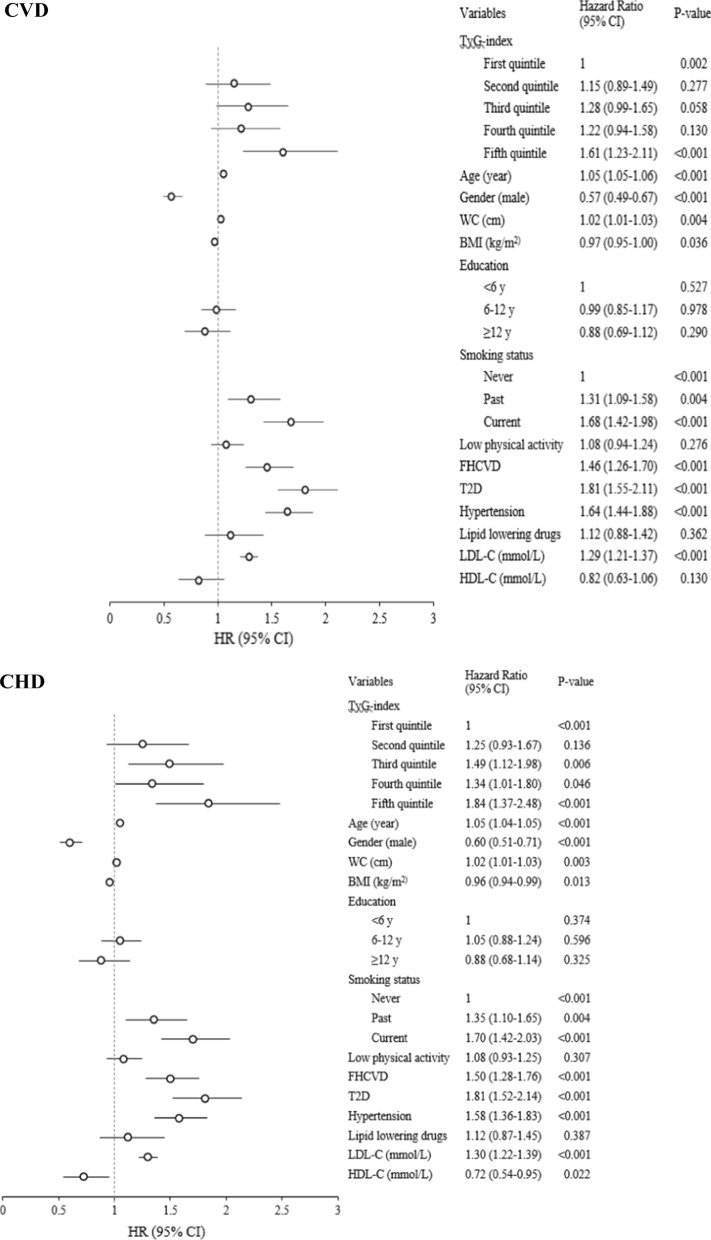
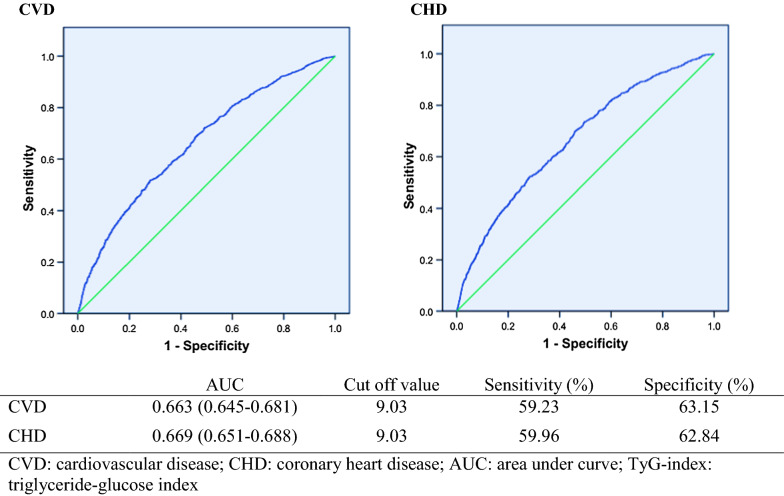
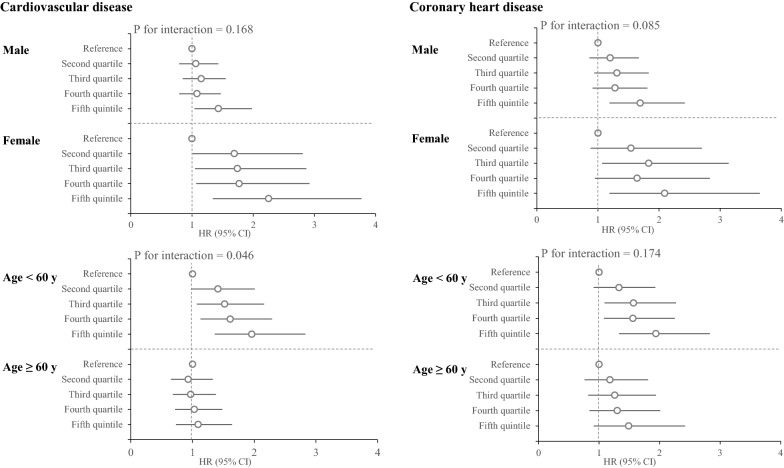
Results: During follow-up, 1084 cases of CVD (male = 634) were recorded. We found a significant trend of TyG-index for incident CVD/CHD in multivariate analysis (both Ps for tend ≤ 0.002). Moreover, a 1-SD increase in TyG-index was associated with significant risk of CVD/CHD in multivariate analysis [1.16 (1.07-1.25) and 1.19 (1.10-1.29), respectively]. The cut-off value of TyG-index for incident CVD was 9.03 (59.2% sensitivity and 63.2% specificity); the corresponding value of TyG-index for incident CHD was 9.03 (60.0% sensitivity and 62.8% specificity), respectively. Although no interaction was found between gender and TyG-index for CVD/CHD in multivariate analysis (both Ps for interaction > 0.085), the significant trend of TyG-index was observed only among females for incident CVD (P = 0.035). A significant interaction was found between age groups (i.e. ≥ 60 vs < 60 years) and TyG-index for CVD outcomes in the multivariate model (P-value for interaction = 0.046). Accordingly, a significant association between the TyG-index and outcomes was found only among the younger age group. Among the population aged < 60 the addition of TyG-index to the Framingham risk score (FRS) did not show improvement in the predictive ability of the FRS, using integrated discrimination improvement.
Conclusion: The TyG-index is significantly associated with increased risk of CVD/CHD incidence; this issue was more prominent among the younger population. However, adding TyG-index to FRS does not provide better risk prediction for CVD.
Keywords: Cardiovascular disease; Coronary heart disease; TyG-index.
Conflict of interest statement
The authors declare that they have no competing interests.
Figures
References
-
- Roth GA, Abate D, Abate KH, Abay SM, Abbafati C, et al. Global, regional, and national age-sex-specific mortality for 282 causes of death in 195 countries and territories, 1980–2017: a systematic analysis for the Global Burden of Disease Study 2017. Lancet. 2018;392:1736–1788. doi: 10.1016/S0140-6736(18)32203-7. - DOI - PMC - PubMed
Publication types
MeSH terms
Substances
LinkOut - more resources
Full Text Sources
Medical
