. 2020 Sep 29;39(1):203.
doi: 10.1186/s13046-020-01714-8.

RNA N6-methyladenosine reader IGF2BP3 regulates cell cycle and angiogenesis in colon cancer

Affiliations

RNA N6-methyladenosine reader IGF2BP3 regulates cell cycle and angiogenesis in colon cancer

Zhou Yang et al. J Exp Clin Cancer Res. .

Abstract

Background: N6-Methyladenosine (m6A) modification has been implicated in multiple processes for colon cancer development. IGF2BP3 was a newly reported m6A reader, whereas its role in colon cancer remains unclear.

Methods: The expression of m6A associated enzymes and total m6A level were measured by Western Blotting analysis and m6A RNA Methylation Quantification Kit respectively. Cell cycle was analyzed by flowcytometry. The interaction of IGF2BP3 and related targets was analyzed by RNA immunoprecipitation (RIP) and m6A RNA immunoprecipitation (MeRIP) assays.

Results: We investigated all m6A regulated enzymes in colon cancer and found only the overexpression of IGF2BP3 was associated with cancer progression and survival based on The Cancer Genome Atlas (TCGA) databases. Additionally, we also demonstrated IGF2BP3 was associated with DNA replication in the cell cycle. Knockdown of IGF2BP3 significantly repressed percentage of S phase of cell cycle as well as cell proliferation. Further research demonstrated IGF2BP3 bound to the mRNA of Cyclin D1 (CCND1, checkpoint of G1/S phase of cell cycle) and reduced its mRNA stability via reading m6A modification in the CDS region. Overexpression of Cyclin D1 in IGF2BP3 down-regulated cells completely rescued the inhibited percentage of S phase in cell cycle as well as cell proliferation. Additionally, we also demonstrated a similar role of IGF2BP3 at VEGF. IGF2BP3 bound to the mRNA of VEGF and reads m6A modification, thus regulated both expression and stability of VEGF mRNA. Knockdown of IGF2BP3 repressed angiogenesis in colon cancer via regulating VEGF.

Conclusion: Knockdown of IGF2BP3 repressed DNA replication in the S phase of cell cycle and angiogenesis via reading m6A modification of CCND1 and VEGF respectively. IGF2BP3 was a possible prognosis marker and potential therapeutic target of colon cancer.

Keywords: Angiogenesis; Cell cycle; DNA replication; IGF2BP3; N6-Methyladenosine.


Conflict of interest statement

The authors declare that they have no competing interests.

Figures
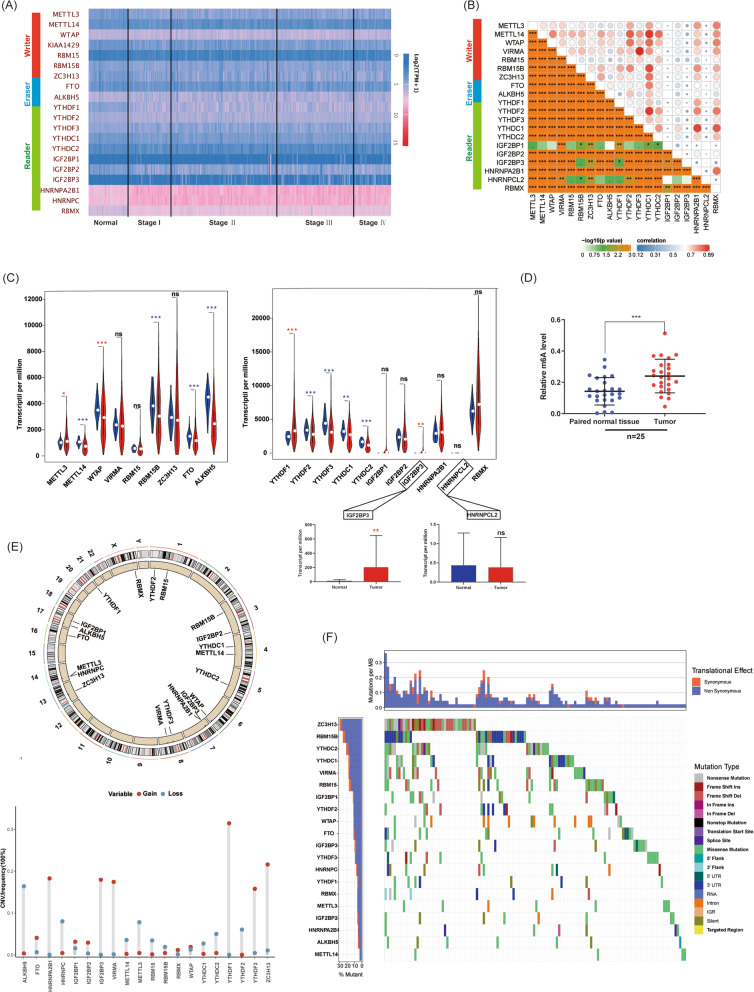
Fig. 1
Fig. 1
m6A modification was activated in colon cancer. a. Heatmap of all m6A associated enzymes in colon cancer analyzed based on TCGA database. b. Co-expression of m6A associated enzymes analyzed and visualized by R software based on Pearson Correlation Coefficient analysis. c. The mRNA expression of m6A associated enzymes in both colon cancer and normal bowel tissues analyzed (red asterisk: overexpressed in tumor; blue asterisk: downregulated in tumor). d. m6A level of total RNA in colon cancer and normal bowel tissues (n = 25, ns: no significance). e. Copy number variation of coding genes of m6A associated enzymes. f. Somatic mutations of coding genes of m6A associated enzymes. (ns: no significance, *P<0.05, **p < 0.01, ***P<0.001)
Fig. 2
Fig. 2
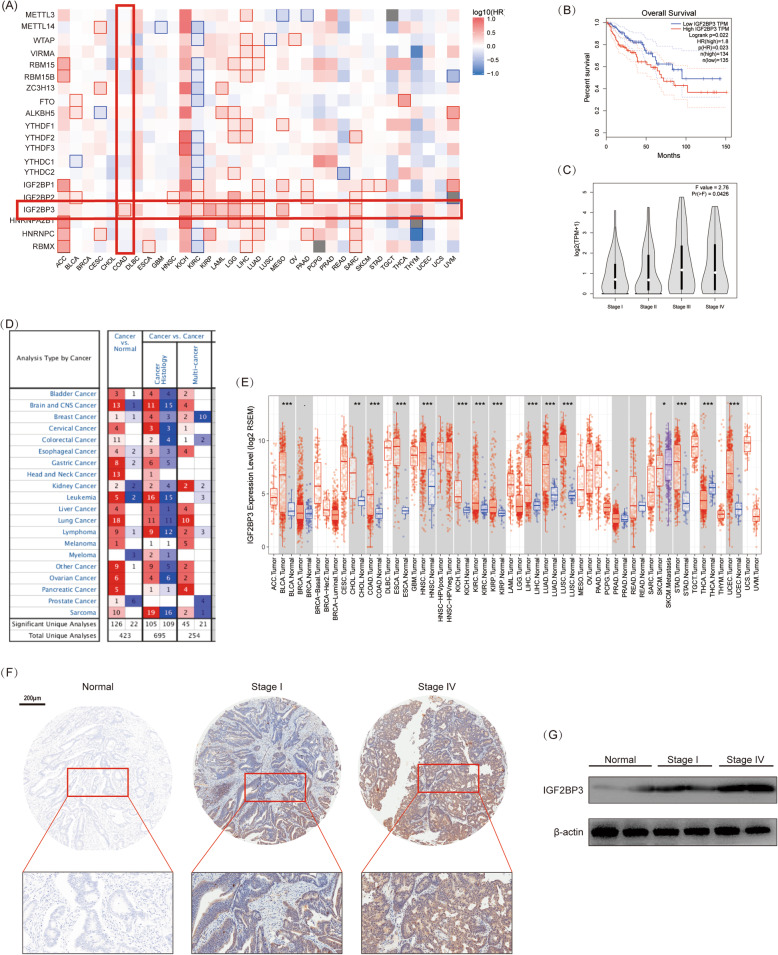
The expression of IGF2BP3 was related to survival and progression of colon cancer. a. The survival map for m6A associated enzymes (mRNA) in pan-cancer analyzed by GEPIA website tool (Mantel–Cox test) based on TCGA database. P < 0.05 was considered to be significant and framed. b. The association of IGF2BP3 and OS in colon cancer analyzed by GEPIA website tool based on TCGA database. c. The mRNA expression of IGF2BP3 in each pathological stage of colon cancer analyzed by GEPIA website tool based on TCGA. d. The expression of IGF2BP3 in pan-cancer and corresponding normal tissues derived from various datasets based on Oncomine database. e. The expression of IGF2BP3 in pan-cancer and corresponding normal tissues derived from TCGA databse. f. IHC of self-collected colon cancer and paired normal bowel tissues. G. Western Blotting analysis of self-collected colon cancer and paired normal bowel tissues (n = 6). (*P<0.05, **P<0.01, ***P<0.001)
Fig. 3
Fig. 3
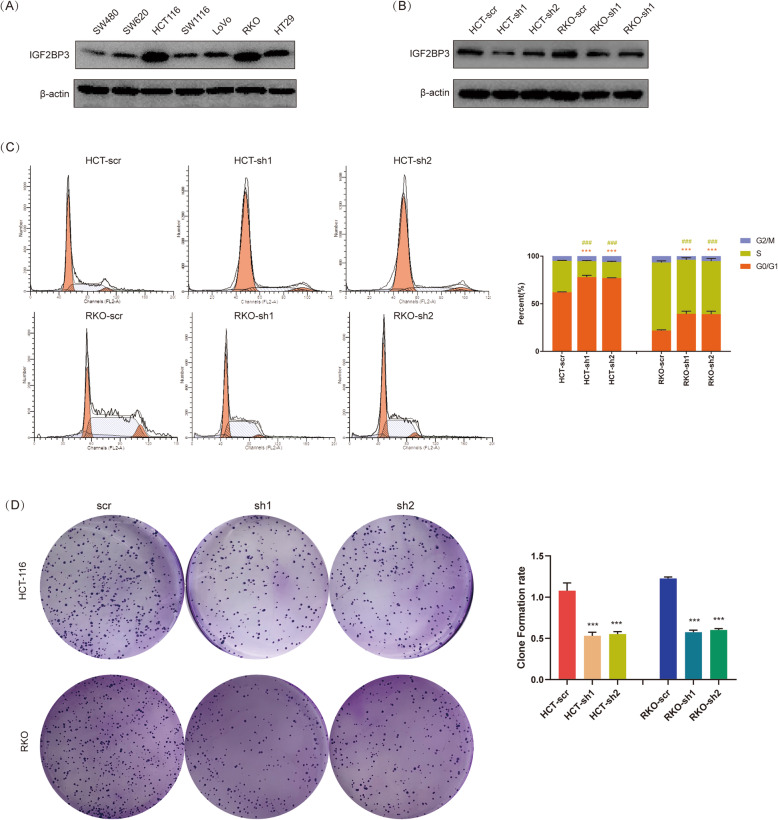
Knockdown of IGF2BP3 promoted cell cycle arrest and repressed proliferation of colon cancer cells. a. The expression of IGF2BP3 in various colon cancer cell lines performed by Western Blotting analysis. b. Knockdown of IGF2BP3 in HCT-116 and RKO confirmed by Western Blotting analysis. c. Knockdown of IGF2BP3 promoted cell cycle arrest in both HCT-116 and RKO. Cell cycle was measured by flowcytometry. (***Compare between percentage of G0/G1 phase, P<0.001; ###Compare between percentage of S phase, P<0.001). D. Knockdown of IGF2BP3 inhibited the clone formation ability of HCT-116 and RKO cells. (***P<0.001)
Fig. 4
Fig. 4
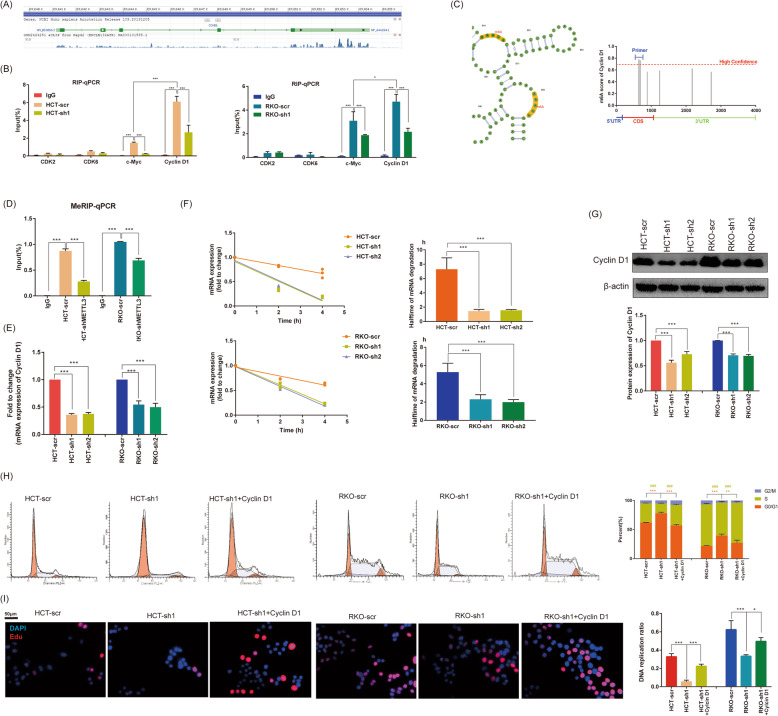
IGF2BP3 regulated cell cycle and proliferation via reading m6A modification of Cyclin D1. a. The enrichment of IGF2BP3 in the mRNA of Cyclin D1 (CCND1) derived from GSE92220 (crosslinking and immunoprecipitation of IGF2BP3). b. The enrichment of IGF2BP3 in the mRNA of CCND1, c-Myc, CDK2 and CDK6 performed by RIP-qPCR assay. c-Myc was a known target of IGF2BP3 and worked as positive control. c. The m6A modification site of CCND1 predicted by SRAMP website tools based on sequence-derived features, and primers designed for MeRIP-qPCR assay. d. Obvious m6A modification of CCND1 confirmed by MeRIP-qPCR, and knockdown of m6A reader METTL3 repressed its m6A modification. e. Knockdown of IGF2BP3 repressed mRNA expression of CCND1 confirmed by RT-qPCR. f. The mRNA stability and degradation halftime of CCND1 in HCT116 and RKO treated by Actinomycin D. g. Knockdown of IGF2BP3 repressed protein expression of Cyclin D1 confirmed by Western Blotting analysis. h. Overexpression of Cyclin D1 (transfection of pCDNA3.1-Cylin D1) in HCT-sh1 rescued cell cycle arrest. (***Compare between percentage of G0/G1 phase, P<0.001; ###Compare between percentage of S phase, P<0.001) (i). Overexpression of Cyclin D1 (transfection of pCDNA3.1-CCND1) in HCT-sh1 rescued inhibited DNA replication. (**P<0.01, ***P<0.001)
Fig. 5
Fig. 5
Knockdown of IGF2BP3 repressed angiogenesis via reading m6A modification of VEGF. a. The enrichment of IGF2BP3 in the mRNA of VEGF (VEGFA) derived from GSE92220 (crosslinking and immunoprecipitation of IGF2BP3). b. IGF2BP3 bound to VEGF transcript performed by RIP-qPCR assay. c. Obvious m6A modification of VEGF confirmed by MeRIP-qPCR, and knockdown of m6A reader METTL3 repressed its m6A modification. d. Knockdown of IGF2BP3 repressed mRNA expression of VEGF confirmed by RT-qPCR. e. The mRNA stability and degradation halftime of VEGF in HCT116 and RKO treated by Actinomycin D. f. Knockdown of IGF2BP3 repressed concentration of secreted VEGF in cell medium confirmed by ELISA analysis. g. Construction of m6A sites mutated VEGF vectors (VEGF-mut, + 2238 from the starting codon, A to C). VEGF-wt: VEGF-wild type. h. Mutation of m6A sites in VEGF abolished the binding of IGF2BP3. i. Mutation of m6A sites in VEGF (constructed in firefly reporter) repressed the luciferase expression of reporter. NC: negative control vector. j. Tube formation assay of HUVECs treated with HCT-scr, HCT-sh1, HCT-sh2, HCT-sh2 transfected pcDNA3.1-VEGF (HCT-sh2 + VEGF) derived conditional medium (CM). Quantification of tube formation assay via ImageJ (Version 1.8.0, National Institutes of Health). k. Cell invasion ability of HUVECs treated with HCT116 derived CM performed by Transwell assay. l. Cell proliferation of HUVECs treated with HCT116 derived CM performed by CCK8 assay. (**P<0.01, ***P<0.001)
Fig. 6
Fig. 6
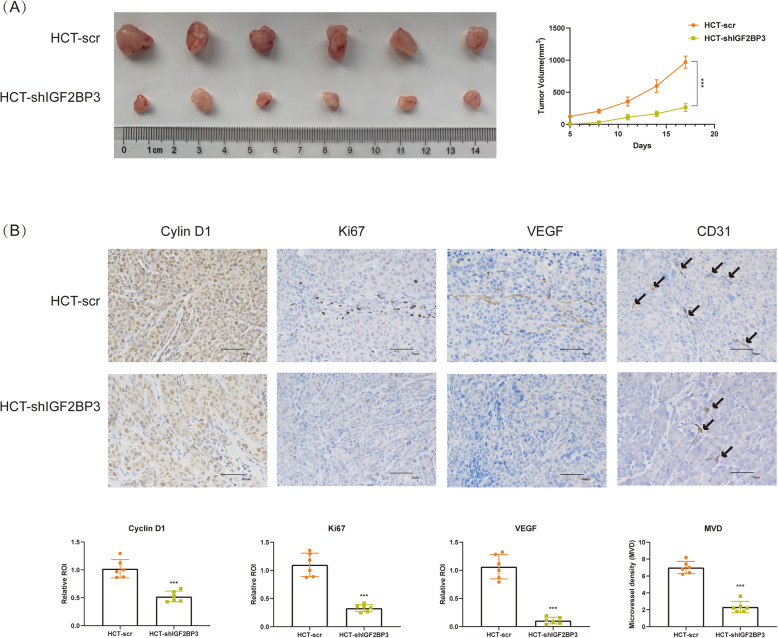
Knockdown of IGF2BP3 repressed tumor growth in vivo. a. Growth curve of xenografts of nude mice. b. The expression of Cyclin D1, Ki67 (marker for tumor proliferation), VEGF and CD31 (marker for tumor vessels) of xenografts in nude mice. Angiogenesis in xenografts was analyzed as microvascular density (MVD, marked by CD31). The expression of Cyclin D1, Ki67 and VEGF was analyzed as integrated optic density (IOD). (***P<0.001)

References

    1. Zhao BS, Roundtree IA, He C. Post-transcriptional gene regulation by mRNA modifications. Nat Rev Mol Cell Biol. 2017;18(1):31–42. doi: 10.1038/nrm.2016.132. - DOI - PMC - PubMed
    1. Cai X, Wang X, Cao C, Gao Y, Zhang S, Yang Z, Liu Y, Zhang X, Zhang W, Ye L. HBXIP-elevated methyltransferase METTL3 promotes the progression of breast cancer via inhibiting tumor suppressor let-7g. Cancer Lett. 2018;415:11–19. doi: 10.1016/j.canlet.2017.11.018. - DOI - PubMed
    1. Su R, Dong L, Li C, Nachtergaele S, Wunderlich M, Qing Y, Deng X, Wang Y, Weng X, Hu C, et al. R-2HG Exhibits Anti-tumor Activity by Targeting FTO/m(6)A/MYC/CEBPA Signaling. Cell. 2018;172(1–2):90–105.e123. doi: 10.1016/j.cell.2017.11.031. - DOI - PMC - PubMed
    1. Xiao W, Lu Z, Gomez A, Hon GC, Yue Y, Han D, Ye F, Parisien M, Dai Q, Jia G. m6A-dependent regulation of messenger RNA stability. Nature. 2014;505(7481):117–120. doi: 10.1038/nature12730. - DOI - PMC - PubMed
    1. Long AG, Lundsmith ET, Hamilton KE. Inflammation and colorectal Cancer. Curr Colorectal Cancer Rep. 2017;13(4):341–351. doi: 10.1007/s11888-017-0373-6. - DOI - PMC - PubMed

MeSH terms