Impact of overweight and obesity on life expectancy, quality-adjusted life years and lifetime costs in the adult population of Ghana
- PMID: 32994229
- PMCID: PMC7526271
- DOI: 10.1136/bmjgh-2020-003332
Impact of overweight and obesity on life expectancy, quality-adjusted life years and lifetime costs in the adult population of Ghana
Abstract
Introduction: Prior studies have revealed the increasing prevalence of obesity and its associated health effects among ageing adults in resource poor countries. However, no study has examined the long-term and economic impact of overweight and obesity in sub-Saharan Africa. Therefore, we quantified the long-term impact of overweight and obesity on life expectancy (LE), quality-adjusted life years (QALYs) and total direct healthcare costs.
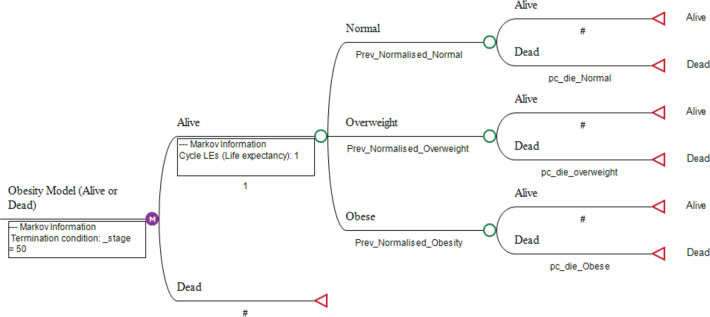
Methods: A Markov simulation model projected health and economic outcomes associated with three categories of body mass index (BMI): healthy weight (18.5≤BMI <25.0); overweight (25.0≤BMI < 30.0) and obese (BMI ≥30.0 kg/m2) in simulated adult cohorts over a 50-year time horizon from age fifty. Costs were estimated from government and patient perspectives, discounted 3% annually and reported in 2017 US$. Mortality rates from Ghanaian lifetables were adjusted by BMI-specific all-cause mortality HRs. Published input data were used from the 2014/2015 Ghana WHO Study on global AGEing and adult health data. Internal and external validity were assessed.
Results: From age 50 years, average (95% CI) remaining LE for females were 25.6 (95% CI: 25.4 to 25.8), 23.5 (95% CI: 23.3 to 23.7) and 21.3 (95% CI: 19.6 to 21.8) for healthy weight, overweight and obesity, respectively. In males, remaining LE were healthy weight (23.0; 95% CI: 22.8 to 23.2), overweight (20.7; 95% CI: 20.5 to 20.9) and obesity (17.6; 95% CI: 17.5 to 17.8). In females, QALYs for healthy weight were 23.0 (95% CI: 22.8 to 23.2), overweight, 21.0 (95% CI: 20.8 to 21.2) and obesity, 19.0 (95% CI: 18.8 to 19.7). The discounted total costs per female were US$619 (95% CI: 616 to 622), US$1298 (95% CI: 1290 to 1306) and US$2057 (95% CI: 2043 to 2071) for healthy weight, overweight and obesity, respectively. QALYs and costs were lower in males.
Conclusion: Overweight and obesity have substantial health and economic impacts, hence the urgent need for cost-effective preventive strategies in the Ghanaian population.
Keywords: health economics; health services research; nutritional and metabolic disorders.
© Author(s) (or their employer(s)) 2020. Re-use permitted under CC BY-NC. No commercial re-use. See rights and permissions. Published by BMJ.
Conflict of interest statement
Competing interests: None declared.
Figures
References
-
- Agyemang C, Boatemaa S, Frempong GA. Obesity in sub-Saharan Africa : Metabolic syndrome. Switzerland: Springer International Publishing, 2015: 1–13.
-
- Global Burden of Disease 2016 Disease and Injury Incidence and Prevalence Collaborators Global, regional, and national incidence, prevalence, and years lived with disability for 328 diseases and injuries for 195 countries, 1990–2016: a systematic analysis for the global burden of disease study 2016. The Lancet 2018;390:1211–59. - PMC - PubMed
Publication types
MeSH terms
Grants and funding
LinkOut - more resources
Full Text Sources
Medical