


Enhanced modulation of gut microbial dynamics affecting body weight in birds triggered by natural growth promoters administered in conventional feed
- PMID: 32994734
- PMCID: PMC7499368
- DOI: 10.1016/j.sjbs.2020.06.027
Enhanced modulation of gut microbial dynamics affecting body weight in birds triggered by natural growth promoters administered in conventional feed
Abstract
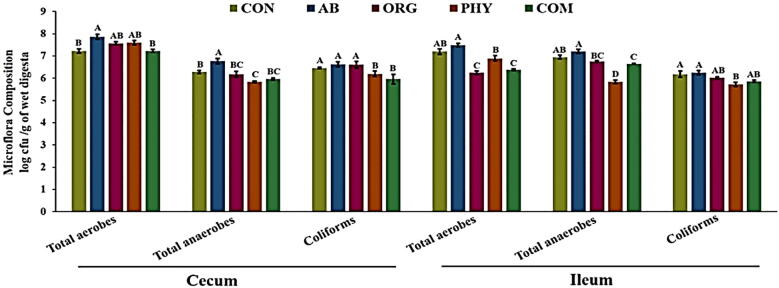
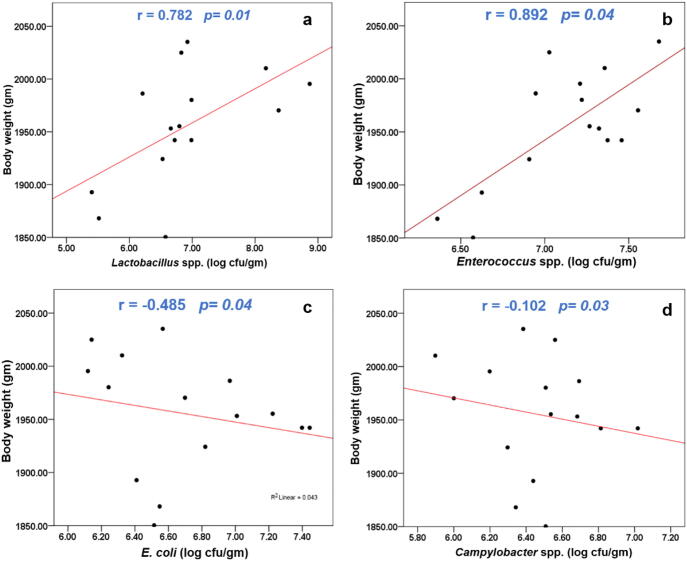
This study explored the effects of natural growth promoters (phytogenic feed additives and organic acids) on animal performance, carcass characteristics, blood parameters, gut microflora composition, and microbe-host interactions in broiler chickens over a 42-day feeding period. Two-hundred-fifty-day-old chicks were randomly assigned to one of five treatments: (i) control diets (CON); (ii) control diets + 40 g/tons antibiotic growth promoter (AB); (iii) control diets + 3 kg/tons organic acids (ORG); (iv) control diets + 3 kg/tons phytogenic feed additives (PHY); (v) control diets + 3 kg/tons organic acids + phytogenic feed additive combination (COM). A non-significant differences (p > 0.05) were observed in broiler performance among treatments at 21 days of age; however, a gradually increasing body weight gain and reduced feed conversion ratio were observed at 42 days in treatments versus control group. Biochemical indices were non-significant (p > 0.05) except for decreased cholesterol (p < 0.05) and increased A/G ratio (p < 0.05) recorded in the treatment groups. The addition of PHY and ORG improved total counts of Enterococcus spp. and Lactobacillus spp. (p < 0.05) as well as reduced caecal and ileal Campylobacter spp. and Escherichia coli (p < 0.05). Correlation analysis elucidated beneficial bacteria (Enterococcus spp. and Lactobacillus spp.) were positively and pathogenic bacteria (Campylobacter spp. and E. coli) were negatively correlated (p < 0.05) with host weight gain. The findings indicated that dietary supplementation of PHY and ORG sustained balanced gut microflora, which in turn improved body weight. This study broadens the significance of using PHY and ORG as safe alternatives to antibiotic growth promoters for achieving healthier and economical broiler production.
Keywords: Broiler; Dietary modulation; Gut microbiota; Organic acids; Phytogenic feed additives; Weight gain.
© 2020 The Author(s).
Conflict of interest statement
The authors declare that they have no known competing financial interests or personal relationships that could have appeared to influence the work reported in this paper.
Figures
References
-
- Andreopoulou M.V., Tsiouris I., Georogopoulou I. Effects of organic acids on the gut ecosystem and on the performance of broiler chickens. J. Hellenic Veterinary Med. Soc. 2014;65:289–302. doi: 10.1111/jpn.12858. - DOI
-
- Andrews, W., Jacobson, A., Hammack, T., 2014. Salmonella. In: Bacteriological Analytical Manual (BAM), 8th ed. Center for Food Safety and Applied Nutrition, U.S. FDA, College Park, MD.
-
- AOAC, 2005. Official Methods of Analysis. 18th rev. ed. Association of Official Analytical Chemists International. Gaithersburg, MD, USA.
-
- Aviagen . Aviagen; Midlothian, Scotland: 2014. Ross 308 – Broiler Nutrition Specification.
LinkOut - more resources
Full Text Sources
Miscellaneous
