


Role of androgen receptor expression in early stage ER+/PgR-/HER2- breast cancer
- PMID: 32994808
- PMCID: PMC7502860
- DOI: 10.1177/1758835920958355
Role of androgen receptor expression in early stage ER+/PgR-/HER2- breast cancer
Abstract
Background: Progesterone receptor (PgR) negative breast cancer (BC) is an aggressive subtype with poor prognosis and reduced response to endocrine treatments. Several studies have suggested that androgen receptor (AR) expression is associated with a favorable tumor biology, longer recurrence free survival (RFS), and overall survival. In the literature no data exist regarding the role of AR expression in early stage estrogen receptor (ER)+/PgR- BCs. The aim of this study was to evaluate the prognostic role of AR expression in this setting.
Patients and methods: This is a monocentric retrospective study in which 208 patients who underwent surgical intervention for ER+/PgR-/Human Epidermal growth factor Receptor 2 (HER2)- BC were included. The primary objective was to analyze the relationship between AR expression and RFS.
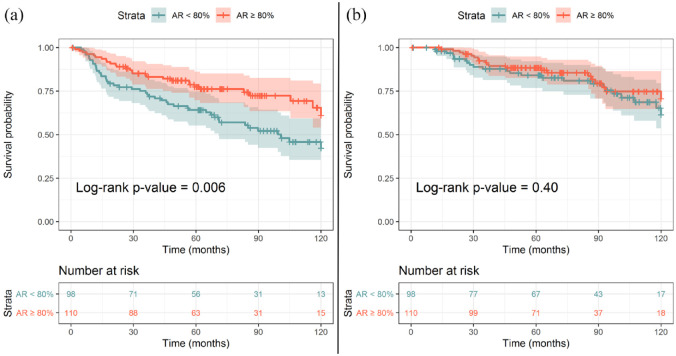
Results: At a median follow-up of 77 months, 75 patients (36%) had a disease relapse (all sites included). AR expression was significantly higher in patients who did not relapse compared with those who relapsed with an impact on RFS (hazard ratio [HR] = 0.99, p = 0.025). Patients with AR expression ⩾80% had a lower risk of relapse compared with those with AR <80% (HR = 0.53, p = 0.008). In addition, breast tumors with higher AR expression had good biological features (low ki67 and nuclear grade) compared with BCs with lower AR expression, at least partly explaining the different outcome.
Conclusions: The results of this study support the potential prognostic role of AR in patients with ER+/PgR- BCs and may contribute to the identification of subgroups of high-risk patients.
Keywords: androgen receptor; early breast cancer; immunohistochemistry; progesterone receptor negative; relapse-free survival.
© The Author(s), 2020.
Conflict of interest statement
Conflict of interest statement: The authors declare that there is no conflict of interest.
Figures
References
-
- Ades F, Zardavas D, Bozovic-Spasojevic I, et al. Luminal B breast cancer: molecular characterization, clinical management, and future perspectives. Clin Oncol 2011; 32: 2794–2803. - PubMed
-
- Bardou VJ, Arpino G, Elledge RM, et al. Progesterone receptor status significantly improves outcome prediction over estrogen receptor status alone for adjuvant endocrine therapy in two large breast cancer databases. J Clin Oncol 2003; 21: 1973–1979. - PubMed
-
- Rakha EA, El-Sayed ME, Green AR, et al. Biologic and clinical characteristics of breast cancer with single hormone receptor positive phenotype. J Clin Oncol 2007; 25: 4772–4778. - PubMed
LinkOut - more resources
Full Text Sources
Research Materials
Miscellaneous
