[Preprint]. 2020 Sep 16:2020.09.16.300459.
doi: 10.1101/2020.09.16.300459.

The flexibility of ACE2 in the context of SARS-CoV-2 infection

The flexibility of ACE2 in the context of SARS-CoV-2 infection

E P Barros et al. bioRxiv. .

Update in

  • The flexibility of ACE2 in the context of SARS-CoV-2 infection.
    Barros EP, Casalino L, Gaieb Z, Dommer AC, Wang Y, Fallon L, Raguette L, Belfon K, Simmerling C, Amaro RE. Barros EP, et al. Biophys J. 2021 Mar 16;120(6):1072-1084. doi: 10.1016/j.bpj.2020.10.036. Epub 2020 Nov 13. Biophys J. 2021. PMID: 33189680 Free PMC article.

Abstract

The COVID-19 pandemic has swept over the world in the past months, causing significant loss of life and consequences to human health. Although numerous drug and vaccine developments efforts are underway, many questions remain outstanding on the mechanism of SARS-CoV-2 viral association to angiotensin-converting enzyme 2 (ACE2), its main host receptor, and entry in the cell. Structural and biophysical studies indicate some degree of flexibility in the viral extracellular Spike glycoprotein and at the receptor binding domain-receptor interface, suggesting a role in infection. Here, we perform all-atom molecular dynamics simulations of the glycosylated, full-length membrane-bound ACE2 receptor, in both an apo and spike receptor binding domain (RBD) bound state, in order to probe the intrinsic dynamics of the ACE2 receptor in the context of the cell surface. A large degree of fluctuation in the full length structure is observed, indicating hinge bending motions at the linker region connecting the head to the transmembrane helix, while still not disrupting the ACE2 homodimer or ACE2-RBD interfaces. This flexibility translates into an ensemble of ACE2 homodimer conformations that could sterically accommodate binding of the spike trimer to more than one ACE2 homodimer, and suggests a mechanical contribution of the host receptor towards the large spike conformational changes required for cell fusion. This work presents further structural and functional insights into the role of ACE2 in viral infection that can be exploited for the rational design of effective SARS-CoV-2 therapeutics.

Statement of significance: As the host receptor of SARS-CoV-2, ACE2 has been the subject of extensive structural and antibody design efforts in aims to curtail COVID-19 spread. Here, we perform molecular dynamics simulations of the homodimer ACE2 full-length structure to study the dynamics of this protein in the context of the cellular membrane. The simulations evidence exceptional plasticity in the protein structure due to flexible hinge motions in the head-transmembrane domain linker region and helix mobility in the membrane, resulting in a varied ensemble of conformations distinct from the experimental structures. Our findings suggest a dynamical contribution of ACE2 to the spike glycoprotein shedding required for infection, and contribute to the question of stoichiometry of the Spike-ACE2 complex.


Figures

Figure 1.
Figure 1.
Model structure. (a) Full-length ACE2 homodimer protein structure in complex with spike protein RBDs. ACE2 peptidase, neck and transmembrane domains are shown with cartoons highlighted in blue, navy and magenta, respectively. Spike RBDs are depicted with pink cartoons. (b) Fully glycosylated and membrane-embedded model. ACE2 and RBDs are represented with gray and pink cartoons, respectively. Atoms of N-/O-glycans are shown with per-monosaccharide colored spheres, where GlcNAc is highlighted in blue, mannose in green, fucose in red, galactose in yellow, and sialic acid in purple. Lipid heads (P atoms) are represented with grey spheres, whereas lipid tails are depicted with a licorice representation using the following color scheme: POPC (navy), POPI (violet), POPE (silver), CHL (blue), PSM (magenta).
Figure 2.
Figure 2.
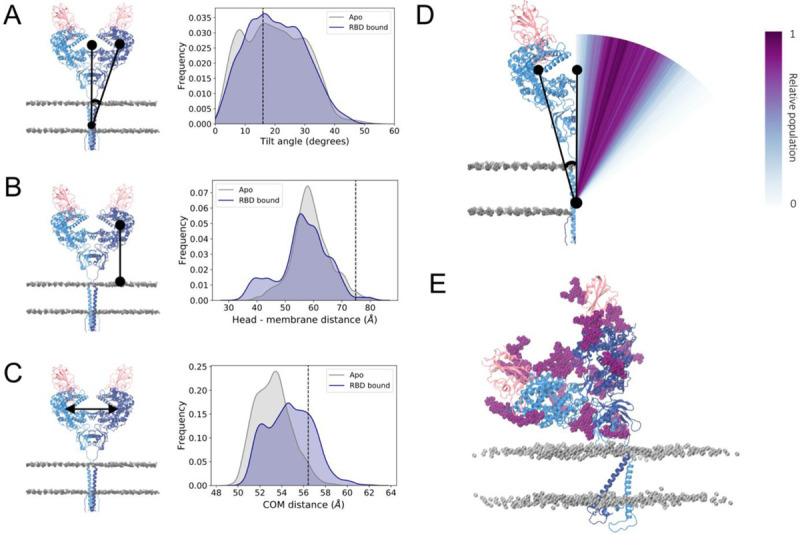
Tilt motion of ACE2. (a) Head tilt angle distribution relative to the transmembrane domain long axis for apo (grey) and RBD-bound (navy) simulations. The angle value corresponding to the cryo-EM conformation is indicated by a black line. Left panel shows a representation of the metric, with ACE2 monomers colored dark and light blue, RBDs colored pink and phosphorus atoms from membrane’s lipid heads shown in grey in van der Waals representation. (b) Distribution of minimum distance between PD’s center of mass and membrane. (c) Distribution of the ACE2 monomer heads’ center of mass distance. (d) Visual representation of the tilt angle distribution for the RBD-bound simulations with a color gradient according to the relative population. (e) Example of a highly-tilted ACE2 homodimer conformation sampled in the simulation. ACE2 and RBD glycans shown in dark purple.
Figure 3.
Figure 3.
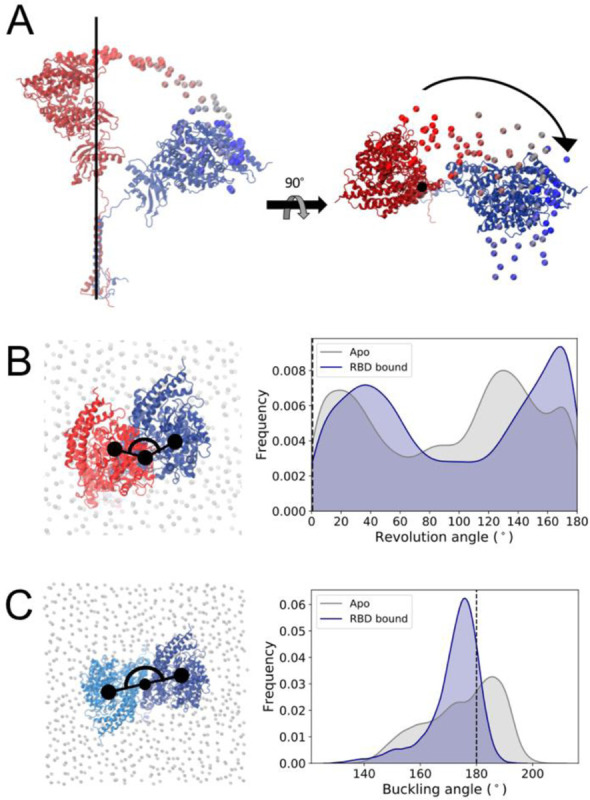
ACE2 revolution relative to a plane perpendicular to the transmembrane helix’s long axis. (a) Representation of a monomer’s degree of flexibility in one of the replicas, showing the time evolution of the position of the Cα atom of Gln325 colored from dark red (t=0) to dark blue (t=1000 ns). Conformations aligned to the cryo-EM’s reference TM domain Cα atoms shown in van der Waals representation, initial and final monomer conformations shown in cartoon representation. (b) Head revolution angle distribution for apo (grey) and RBD-bound (navy) simulations. The angle value corresponding to the cryo-EM conformation is indicated by a black line. Left panel shows representation of the metric, with monomer’s head initial position shown in red, the same monomer at a time t in dark blue, and phosphorus atoms from membrane’s lipid heads shown in grey in van der Waals representation. (c) Relative orientation of the monomer’s head in the heterodimer. ACE2 monomers colored dark and light blue.
Figure 4.
Figure 4.
Transmembrane helix dynamics. (a) Distance between the center of mass of each monomer’s TM helix. (b) TM helix tilt angle relative to the membrane’s normal. Values corresponding to cryo-EM conformation are indicated by a black line. Left panels show representation of the metric, with ACE2 monomers colored dark and light blue, RBDs colored pink and phosphorus atoms from membrane’s lipid heads shown in grey in van der Waals representation.
Figure 5.
Figure 5.
ACE2-RBD interactions. (a) Protein residue fraction of native contacts identified in the reference cryo-EM structure colored according to regions along the heterodimer interface (silver, magenta and cyan) and shown with licorice representation. ACE2 monomer shown with dark blue cartoons and RBD with pink cartoons. Glycans have been omitted from this panel for clarity. (b) Distribution of the fraction of native contacts in each of the interaction regions. Colors same as in (a). (c) Glycans in the ACE2-RBD interface, shown with surface representation with the following color scheme: N53 (cyan), N90 (orange), N103 (purple), N322 (yellow), N546 (lime) and N343 (dark red). (d) Box plot of number of glycan-protein contacts for the interface glycans shown in (c), using the same color scheme. Horizontal black lines indicate mean value, boxes extend to the lower and upper quartiles, and whiskers show the total range of the data.
Figure 6.
Figure 6.
ACE2 homodimer contacts for RBD-bound simulations. (a) Fraction of native contacts between ACE2 monomers, considering only protein components of the glycoprotein. Neck and peptidase domain (PD) interacting regions are depicted separately. (b) Total glycan-protein interactions formed within each ACE2 monomer, per glycan. Horizontal black lines indicate mean value, boxes extend to the lower and upper quartiles, and whiskers show the total range of the data. (c) Glycan-protein contacts between glycans in one of the monomer and protein residues in the opposite monomer. (d) Glycan-glycan contacts between glycan in one of the monomers (glycan A) and its copy in the other monomer (glycan A’). (e) ACE2 dimer with glycans in van der Waals representation colored according to figures b-d. ACE2 protein dimer colored grey and RBDs in light pink.
Figure 7.
Figure 7.
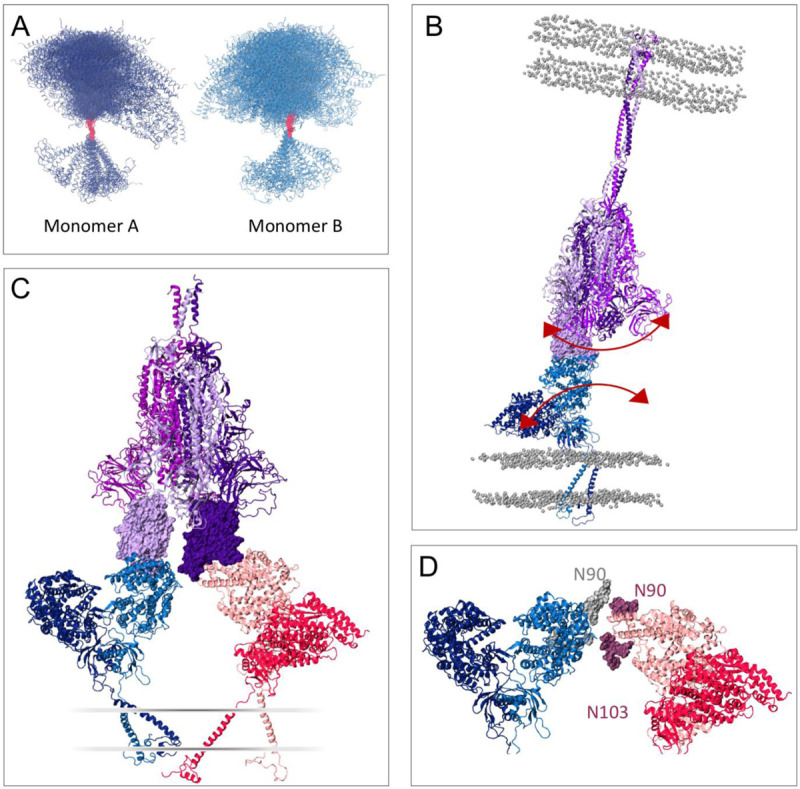
ACE2 flexibility’s impact on S interaction. (a) ACE2 monomer conformations taken from equally-spaced frames from the simulations, aligned via the flexible linker. (b) Proposed effect of ACE2’s flexibility on the spike’s dynamics, communicated through the ACE2-RBD complex. The three chains in the spike model are colored in different shades of purple, with the “up” RBD shown in light purple in surface representation. Phosphorus atoms from membrane’s lipid heads shown in grey in van der Waals representation. (c) Proposed complex of two ACE2 dimers bound to a single spike with two RBDs in the “up” conformation. ACE2 dimers shown in dark and light blue, and dark and light pink, respectively. RBDs shown in surface representation. A schematic of the membrane is indicated. (d) Detailed view of the ACE2 heads in (c), with N90 and N103 glycans highlighted.

References

    1. Hoffmann M., Kleine-Weber H., Schroeder S., Krüger N., Herrler T., Erichsen S., Schiergens T.S., Herrler G., Wu N.H., Nitsche A., Müller M.A., Drosten C., and Pöhlmann S.. 2020. SARS-CoV-2 Cell Entry Depends on ACE2 and TMPRSS2 and Is Blocked by a Clinically Proven Protease Inhibitor. Cell. 181:271–280.e8. - PMC - PubMed
    1. Zhou P., Lou Yang X., Wang X.G., Hu B., Zhang L., Zhang W., Si H.R., Zhu Y., Li B., Huang C.L., Chen H.D., Chen J., Luo Y., Guo H., Di Jiang R., Liu M.Q., Chen Y., Shen X.R., Wang X., Zheng X.S., Zhao K., Chen Q.J., Deng F., Liu L.L., Yan B., Zhan F.X., Wang Y.Y., Xiao G.F., and Shi Z.L.. 2020. A pneumonia outbreak associated with a new coronavirus of probable bat origin. Nature. 579:270–273. - PMC - PubMed
    1. Wang Q., Zhang Y., Wu L., Niu S., Song C., Zhang Z., Lu G., Qiao C., Hu Y., Yuen K.Y., Wang Q., Zhou H., Yan J., and Qi J.. 2020. Structural and Functional Basis of SARS-CoV-2 Entry by Using Human ACE2. Cell. 181:894–904. - PMC - PubMed
    1. Huang C., Wang Y., Li X., Ren L., Zhao J., Hu Y., Zhang L., Fan G., Xu J., Gu X., Cheng Z., Yu T., Xia J., Wei Y., Wu W., Xie X., Yin W., Li H., Liu M., Xiao Y., Gao H., Guo L., Xie J., Wang G., Jiang R., Gao Z., Jin Q., Wang J., and Cao B.. 2020. Clinical features of patients infected with 2019 novel coronavirus in Wuhan, China. Lancet. 395:497–506. - PMC - PubMed
    1. Wang C., Horby P.W., Hayden F.G., and Gao G.F.. 2020. A novel coronavirus outbreak of global health concern. Lancet. 395:470–473. - PMC - PubMed

Publication types