


Understanding the classics: the unifying concepts of transgressive segregation, inbreeding depression and heterosis and their central relevance for crop breeding
- PMID: 32996672
- PMCID: PMC7769232
- DOI: 10.1111/pbi.13481
Understanding the classics: the unifying concepts of transgressive segregation, inbreeding depression and heterosis and their central relevance for crop breeding
Abstract
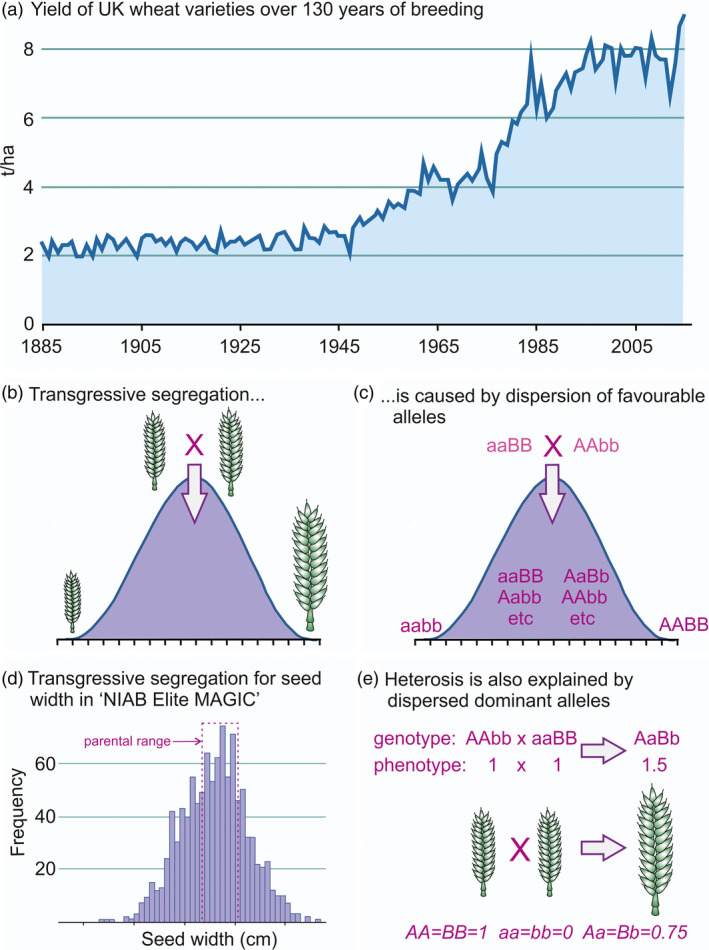
Transgressive segregation and heterosis are the reasons that plant breeding works. Molecular explanations for both phenomena have been suggested and play a contributing role. However, it is often overlooked by molecular genetic researchers that transgressive segregation and heterosis are most simply explained by dispersion of favorable alleles. Therefore, advances in molecular biology will deliver the most impact on plant breeding when integrated with sources of heritable trait variation - and this will be best achieved within a quantitative genetics framework. An example of the power of quantitative approaches is the implementation of genomic selection, which has recently revolutionized animal breeding. Genomic selection is now being applied to both hybrid and inbred crops and is likely to be the major source of improvement in plant breeding practice over the next decade. Breeders' ability to efficiently apply genomic selection methodologies is due to recent technology advances in genotyping and sequencing. Furthermore, targeted integration of additional molecular data (such as gene expression, gene copy number and methylation status) into genomic prediction models may increase their performance. In this review, we discuss and contextualize a suite of established quantitative genetics themes relating to hybrid vigour, transgressive segregation and their central relevance to plant breeding, with the aim of informing crop researchers outside of the quantitative genetics discipline of their relevance and importance to crop improvement. Better understanding between molecular and quantitative disciplines will increase the potential for further improvements in plant breeding methodologies and so help underpin future food security.
Keywords: crop breeding; crop genetics and genomics; genomic selection; heterosis; heterotic groups; hybrid vigour; molecular genetics; quantitative genetics; transgressive segregation.
© 2020 The Authors. Plant Biotechnology Journal published by Society for Experimental Biology and The Association of Applied Biologists and John Wiley & Sons Ltd.
Conflict of interest statement
The authors declare they have no conflict of interest.
Figures
References
-
- Bergelson, J. and Purrington, C.B. (1996) Surveying patterns in the cost of resistance in plants. Am. Nat. 148, 536–558.
-
- Bingham, E.T. (1998) Role of chromosome blocks in heterosis and estimates of dominance and overdominance. In Concepts and breeding of heterosis in crop plants, ( Larnkey, K.R. and Staub, J.E. , eds), pp. 71–87. Madison: CSSA.
-
- Bourguet, D. (1999) The evolution of dominance. Heredity, 83, 1–4. - PubMed
Publication types
MeSH terms
Grants and funding
LinkOut - more resources
Full Text Sources
Other Literature Sources
