Exploring multidimensional operationalizations of precarious employment in Swedish register data - a typological approach and a summative score approach
- PMID: 32997147
- PMCID: PMC8114571
- DOI: 10.5271/sjweh.3928
Exploring multidimensional operationalizations of precarious employment in Swedish register data - a typological approach and a summative score approach
Abstract
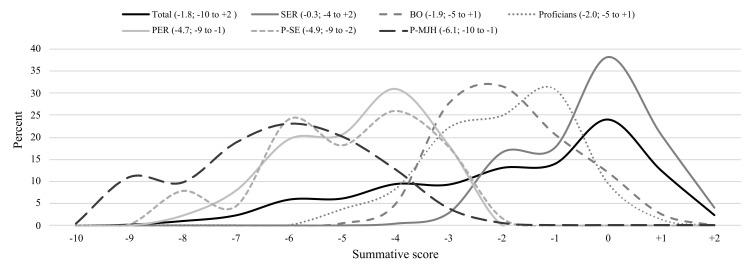
Objectives This study aimed to explore multidimensional operationalizations of precarious employment (PE) in Swedish register data using two approaches: (i) a typological approach and (ii) a dimensional, summative scale approach. It also examined the distribution of sociodemographic and occupational characteristics of precarious employees in Sweden. Method Register data was retrieved on individuals and their employers in the Swedish workforce. Five items corresponding to three dimensions of PE were operationalized: contractual relationship insecurity, contractual temporariness, multiple jobs/sectors, income level, and lack of unionization. First, latent class analysis was applied and a typology of six employment types emerged. Second, a summative scale was constructed by scoring all PE-items. Results Three types of PE were found using the typological approach, which were characterized by direct employment, solo self-employment and multiple job holding, respectively. The summative scale score ranged between -10 and +2 (average: -1.8). Particularly poor scores were seen for solo self-employed, multiple job holders/multiple sectors, and low income. Female gender, young age, low education and foreign origin were prone to precariousness. PE was more frequent among certain economic sectors and occupations. Conclusions Using an existing register of labor market data, two operationalizations of PE were constructed and rendered promising for exposure assessment. Hence, the operationalizations could be of interest for countries with similar data structure. Both approaches highlighted precarious combinations of employment conditions and pointed towards the existence of a wide continuum of precariousness on the labor market. Etiological studies and research assessing trends over time are needed to validate these findings.
Figures
References
-
- Burgess J, Campbell I. The nature and dimensions of precarious employment in Australia. Labour &Industry:a journal of the social and economic relations of work. 1998;8(3):5–21.
-
- Julià M, Vanroelen C, Bosmans K, Van Aerden K, Benach J. Precarious Employment and Quality of Employment in Relation to Health and Well-being in Europe. Int J Health Serv. 2017 Jul;47(3):389–409. https://doi.org/10.1177/0020731417707491. - PubMed
-
- Rodgers G, Rodgers J. Precarious jobs in labour market regulation:the growth of atypical employment in Western Europe: International Labour Organisation. 1989
-
- Vives A, Gonzalez F, Moncada S, Llorens C, Benach J. Measuring precarious employment in times of crisis:the revised Employment Precariousness Scale (EPRES) in Spain. Gaceta sanitaria / SESPAS. 2015;29(5):379–82. - PubMed
-
- Bodin T, Çağlayan Ç, Garde AH, Gnesi M, Jonsson J, Kiran S, et al. Precarious employment in occupational health - an OMEGA-NET working group position paper. Scand J Work Environ Health. 2020 May;46(3):321–9. https://doi.org/10.5271/sjweh.3860. - PubMed