


A New Synuclein-Transgenic Mouse Model for Early Parkinson's Reveals Molecular Features of Preclinical Disease
- PMID: 32997293
- PMCID: PMC8219584
- DOI: 10.1007/s12035-020-02085-z
A New Synuclein-Transgenic Mouse Model for Early Parkinson's Reveals Molecular Features of Preclinical Disease
Abstract
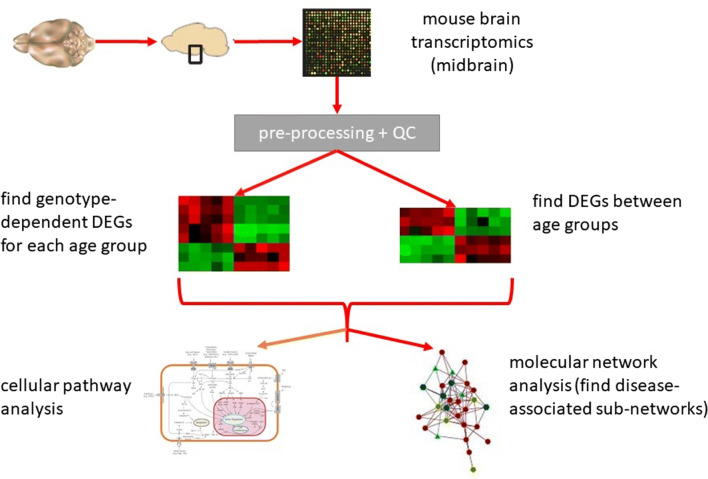
Understanding Parkinson's disease (PD), in particular in its earliest phases, is important for diagnosis and treatment. However, human brain samples are collected post-mortem, reflecting mainly end-stage disease. Because brain samples of mouse models can be collected at any stage of the disease process, they are useful in investigating PD progression. Here, we compare ventral midbrain transcriptomics profiles from α-synuclein transgenic mice with a progressive, early PD-like striatal neurodegeneration across different ages using pathway, gene set, and network analysis methods. Our study uncovers statistically significant altered genes across ages and between genotypes with known, suspected, or unknown function in PD pathogenesis and key pathways associated with disease progression. Among those are genotype-dependent alterations associated with synaptic plasticity and neurotransmission, as well as mitochondria-related genes and dysregulation of lipid metabolism. Age-dependent changes were among others observed in neuronal and synaptic activity, calcium homeostasis, and membrane receptor signaling pathways, many of which linked to G-protein coupled receptors. Most importantly, most changes occurred before neurodegeneration was detected in this model, which points to a sequence of gene expression events that may be relevant for disease initiation and progression. It is tempting to speculate that molecular changes similar to those changes observed in our model happen in midbrain dopaminergic neurons before they start to degenerate. In other words, we believe we have uncovered molecular changes that accompany the progression from preclinical to early PD.
Keywords: Disease-stage; Network analysis; Parkinson’s disease; Pathway analysis; Transgenic mouse model; α-Synuclein.
Conflict of interest statement
The authors declare that they have no conflict of interest.
Figures
References
-
- Albert R, Jeong H, Barabási AL. Error and attack tolerance of complex networks. Nature. 2000;406(6794):378. - PubMed
-
- Antony PM, Diederich NJ, Krüger R, Balling R. The hallmarks of Parkinson’s disease. The FEBS journal. 2013;280(23):5981–5993. - PubMed
-
- Ashrafi A, Garcia P, Kollmus H, Schughart K, Del Sol A, Buttini M, Glaab E. Absence of regulator of G-protein signaling 4 does not protect against dopamine neuron dysfunction and injury in the mouse 6-hydroxydopamine lesion model of Parkinson’s disease. Neurobiology of aging. 2017;58:30–33. - PubMed
MeSH terms
Substances
Grants and funding
LinkOut - more resources
Full Text Sources
Medical
