


Syndromic Surveillance Insights from a Symptom Assessment App Before and During COVID-19 Measures in Germany and the United Kingdom: Results From Repeated Cross-Sectional Analyses
- PMID: 32997640
- PMCID: PMC7561445
- DOI: 10.2196/21364
Syndromic Surveillance Insights from a Symptom Assessment App Before and During COVID-19 Measures in Germany and the United Kingdom: Results From Repeated Cross-Sectional Analyses
Abstract
Background: Unprecedented lockdown measures have been introduced in countries worldwide to mitigate the spread and consequences of COVID-19. Although attention has been focused on the effects of these measures on epidemiological indicators relating directly to the infection, there is increased recognition of their broader health implications. However, assessing these implications in real time is a challenge, due to the limitations of existing syndromic surveillance data and tools.
Objective: The aim of this study is to explore the added value of mobile phone app-based symptom assessment tools as real-time health insight providers to inform public health policy makers.
Methods: A comparative and descriptive analysis of the proportion of all self-reported symptoms entered by users during an assessment within the Ada app in Germany and the United Kingdom was conducted between two periods, namely before and after the implementation of "Phase One" COVID-19 measures. Additional analyses were performed to explore the association between symptom trends and seasonality, and symptom trends and weather. Differences in the proportion of unique symptoms between the periods were analyzed using a Pearson chi-square test and reported as log2 fold changes.
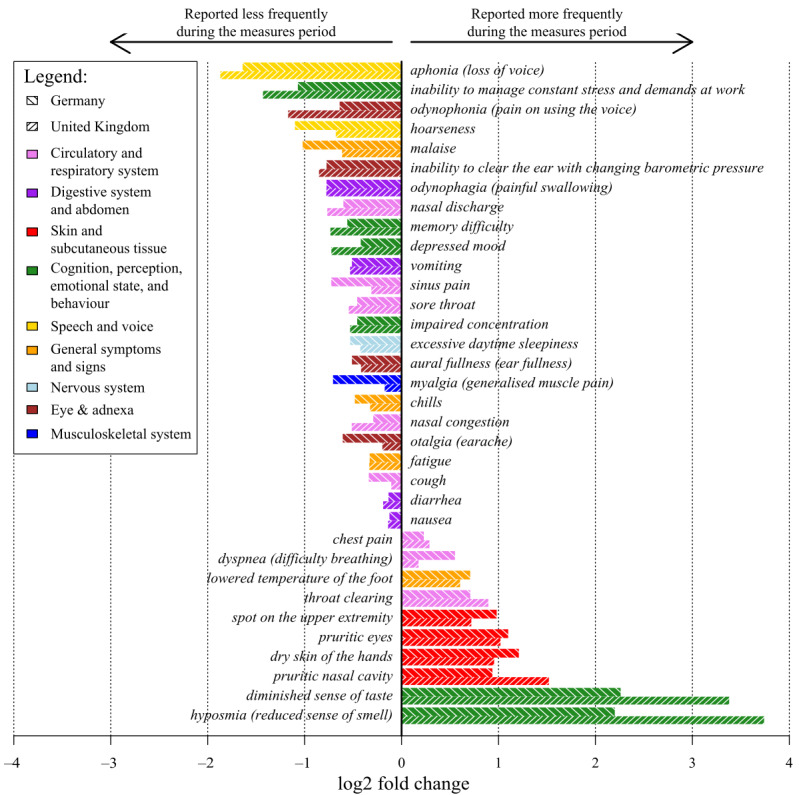
Results: Overall, 48,300-54,900 symptomatic users reported 140,500-170,400 symptoms during the Baseline and Measures periods in Germany. Overall, 34,200-37,400 symptomatic users in the United Kingdom reported 112,100-131,900 symptoms during the Baseline and Measures periods. The majority of symptomatic users were female (Germany: 68,600/103,200, 66.52%; United Kingdom: 51,200/71,600, 72.74%). The majority were aged 10-29 years (Germany: 68,500/100,000, 68.45%; United Kingdom: 50,900/68,800, 73.91%), and about one-quarter were aged 30-59 years (Germany: 26,200/100,000, 26.15%; United Kingdom: 14,900/68,800, 21.65%). Overall, 103 symptoms were reported either more or less frequently (with statistically significant differences) during the Measures period as compared to the Baseline period, and 34 of these were reported in both countries. The following mental health symptoms (log2 fold change, P value) were reported less often during the Measures period: inability to manage constant stress and demands at work (-1.07, P<.001), memory difficulty (-0.56, P<.001), depressed mood (-0.42, P<.001), and impaired concentration (-0.46, P<.001). Diminished sense of taste (2.26, P<.001) and hyposmia (2.20, P<.001) were reported more frequently during the Measures period. None of the 34 symptoms were found to be different between the same dates in 2019. In total, 14 of the 34 symptoms had statistically significant associations with weather variables.
Conclusions: Symptom assessment apps have an important role to play in facilitating improved understanding of the implications of public health policies such as COVID-19 lockdown measures. Not only do they provide the means to complement and cross-validate hypotheses based on data collected through more traditional channels, they can also generate novel insights through a real-time syndromic surveillance system.
Keywords: COVID-19 lockdown; COVID-19 measures; COVID-19 symptom assessment apps; digital public health; epidemiology; health effects of COVID-19 measures, infoveillance; participatory epidemiology; participatory surveillance; symptom checker apps; syndromic surveillance.
©Alicia Mehl, Francois Bergey, Caoimhe Cawley, Andreas Gilsdorf. Originally published in JMIR mHealth and uHealth (http://mhealth.jmir.org), 09.10.2020.
Conflict of interest statement
Conflicts of Interest: AM, FB, CC, and AG are employees or company directors of Ada Health GmbH.
Figures
References
-
- COVID-19 Map. Johns Hopkins Coronavirus Resource Center. [2020-05-11]. https://coronavirus.jhu.edu/map.html.
-
- EPPI-Mapper. [2020-05-13]. http://eppi.ioe.ac.uk/COVID19_MAP/covid_map_v10.html.
-
- Prem K, Liu Y, Russell TW, Kucharski AJ, Eggo RM, Davies N, Jit M, Klepac P, Flasche S, Clifford S, Pearson CAB, Munday JD, Abbott S, Gibbs H, Rosello A, Quilty BJ, Jombart T, Sun F, Diamond C, Gimma A, van Zandvoort K, Funk S, Jarvis CI, Edmunds WJ, Bosse NI, Hellewell J. The effect of control strategies to reduce social mixing on outcomes of the COVID-19 epidemic in Wuhan, China: a modelling study. The Lancet Public Health. 2020 May;5(5):e261–e270. doi: 10.1016/s2468-2667(20)30073-6. - DOI - PMC - PubMed
-
- Flaxman S, Mishra S, Gandy A, Unwin HJT, Coupland H, Mellan TA, Zhu H. Estimating the number of infections and the impact of nonpharmaceutical interventions on COVID-19 in 11 European countries. 2020. Mar 30, [2020-10-02]. https://www.imperial.ac.uk/media/imperial-college/medicine/mrc-gida/2020....
MeSH terms
LinkOut - more resources
Full Text Sources
Research Materials
