


Novel Approach to Support Rapid Data Collection, Management, and Visualization During the COVID-19 Outbreak Response in the World Health Organization African Region: Development of a Data Summarization and Visualization Tool
- PMID: 32997641
- PMCID: PMC7593858
- DOI: 10.2196/20355
Novel Approach to Support Rapid Data Collection, Management, and Visualization During the COVID-19 Outbreak Response in the World Health Organization African Region: Development of a Data Summarization and Visualization Tool
Abstract
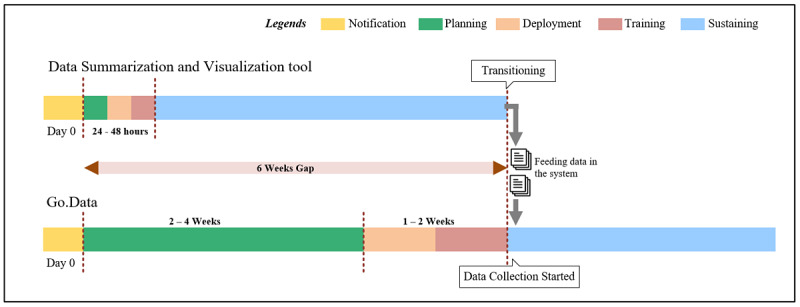
Background: The COVID-19 pandemic has created unprecedented challenges to the systematic and timely sharing of COVID-19 field data collection and management. The World Health Organization (WHO) is working with health partners on the rollout and implementation of a robust electronic field data collection platform. The delay in the deployment and rollout of this electronic platform in the WHO African Region, as a consequence of the application of large-scale public health and social measures including movement restrictions and geographical area quarantine, left a gap between data collection and management. This lead to the need to develop interim data management solutions to accurately monitor the evolution of the pandemic and support the deployment of appropriate public health interventions.
Objective: The aim of this study is to review the design, development, and implementation of the COVID-19 Data Summarization and Visualization (DSV) tool as a rapidly deployable solution to fill this critical data collection gap as an interim solution.
Methods: This paper reviews the processes undertaken to research and develop a tool to bridge the data collection gap between the onset of a COVID-19 outbreak and the start of data collection using a prioritized electronic platform such as Go.Data in the WHO African Region.
Results: In anticipation of the implementation of a prioritized tool for field data collection, the DSV tool was deployed in 18 member states for COVID-19 outbreak data management. We highlight preliminary findings and lessons learned from the DSV tool deployment in the WHO African Region.
Conclusions: We developed a rapidly deployable tool for COVID-19 data collection and visualization in the WHO African Region. The lessons drawn on this experience offer an opportunity to learn and apply these to improve future similar public health informatics initiatives in an outbreak or similar humanitarian setting, particularly in low- and middle-income countries.
Keywords: COVID-19; EWARS; Go.Data; WHO African region; data collection; health emergencies; health information management; outbreak; pandemic; visualization.
©Kamran Ahmed, Muhammad Arish Bukhari, Tamayi Mlanda, Jean Paul Kimenyi, Polly Wallace, Charles Okot Lukoya, Esther L Hamblion, Benido Impouma. Originally published in JMIR Public Health and Surveillance (http://publichealth.jmir.org), 14.10.2020.
Conflict of interest statement
Conflicts of Interest: None declared.
Figures
References
-
- Naming the coronavirus disease (COVID-19) and the virus that causes it. World Health Organization. 2020. https://www.who.int/emergencies/diseases/novel-coronavirus-2019/technica....
-
- COVID-19 dashboard by the Center for Systems Science and Engineering (CSSE) at Johns Hopkins University (JHU) Johns Hopkins Coronavirus Resource Center. 2020. [2020-05-19]. https://coronavirus.jhu.edu/map.html.
-
- WHO Director-General's opening remarks at the media briefing on COVID-19 - 11 March 2020. World Health Organization. 2020. Mar 11, [2020-05-19]. https://www.who.int/dg/speeches/detail/who-director-general-s-opening-re....
-
- Coronavirus disease (COVID-19) situation report– 120. World Health Organization. 2020. May 19, [2020-05-19]. https://www.who.int/docs/default-source/coronaviruse/situation-reports/2....
-
- COVID-19 situation update for the WHO African Region: external situation report 1. World Health Organization. 2020. Mar 04, [2020-05-19]. https://apps.who.int/iris/bitstream/handle/10665/331330/SITREP_COVID-19_....
MeSH terms
Grants and funding
LinkOut - more resources
Full Text Sources
Miscellaneous
