Physician Work Hours and the Gender Pay Gap - Evidence from Primary Care
- PMID: 32997909
- PMCID: PMC10854207
- DOI: 10.1056/NEJMsa2013804
Physician Work Hours and the Gender Pay Gap - Evidence from Primary Care
Abstract
Background: The gender gap in physician pay is often attributed in part to women working fewer hours than men, but evidence to date is limited by self-report and a lack of detail regarding clinical revenue and gender differences in practice style.
Methods: Using national all-payer claims and data from electronic health records, we conducted a cross-sectional analysis of 24.4 million primary care office visits in 2017 and performed comparisons between female and male physicians in the same practices. Our primary independent variable was physician gender; outcomes included visit revenue, visit counts, days worked, and observed visit time (interval between the initiation and the termination of a visit). We created multivariable regression models at the year, day, and visit level after adjustment for characteristics of the primary care physicians (PCPs), patients, and types of visit and for practice fixed effects.
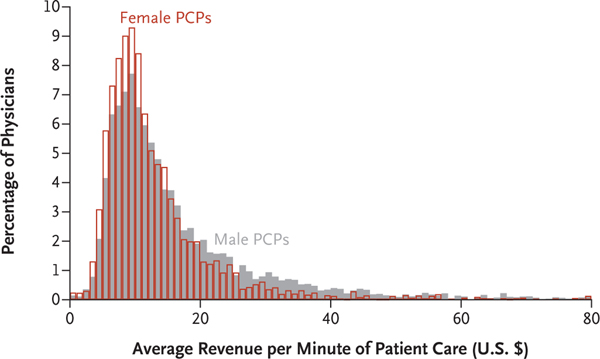
Results: In 2017, female PCPs generated 10.9% less revenue from office visits than their male counterparts (-$39,143.2; 95% confidence interval [CI], -53,523.0 to -24,763.4) and conducted 10.8% fewer visits (-330.5 visits; 95% CI, -406.6 to -254.3) over 2.6% fewer clinical days (-5.3 days; 95% CI, -7.7 to -3.0), after adjustment for age, academic degree, specialty, and number of sessions worked per week, yet spent 2.6% more observed time in visits that year than their male counterparts (1201.3 minutes; 95% CI, 184.7 to 2218.0). Per visit, after adjustment for PCP, patient, and visit characteristics, female PCPs generated equal revenue but spent 15.7% more time with a patient (2.4 minutes; 95% CI, 2.1 to 2.6). These results were consistent in subgroup analyses according to the gender and health status of the patients and the type and complexity of the visits.
Conclusions: Female PCPs generated less visit revenue than male colleagues in the same practices owing to a lower volume of visits, yet spent more time in direct patient care per visit, per day, and per year. (Funded in part by the Robert Wood Johnson Foundation.).
Copyright © 2020 Massachusetts Medical Society.
Figures
Comment in
-
Physician Work Hours and the Gender Pay Gap - Evidence from Primary Care.N Engl J Med. 2020 Dec 31;383(27):2688. doi: 10.1056/NEJMc2032395. N Engl J Med. 2020. PMID: 33382939 No abstract available.
-
Socioeconomic Factors, Urological Epidemiology and Practice Patterns.J Urol. 2021 Apr;205(4):1215-1217. doi: 10.1097/JU.0000000000001615. Epub 2021 Jan 21. J Urol. 2021. PMID: 33472374 No abstract available.
References
-
- Berthold HK, Gouni-Berthold I, Bestehorn KP, Böhm M, Krone W. Physician gender is associated with the quality of type 2 diabetes care. J Intern Med 2008; 264:340–50. - PubMed
-
- Andersen MR, Urban N. Physician gender and screening: do patient differences account for differences in mammography use? Women Health 1997;26: 29–39. - PubMed
Publication types
MeSH terms
Grants and funding
LinkOut - more resources
Full Text Sources
Miscellaneous