Comparison of Safety between Different Kinds of Heparins in Patients Receiving Intra-Aortic Balloon Counterpulsation
- PMID: 32998166
- PMCID: PMC8455177
- DOI: 10.1055/s-0040-1716390
Comparison of Safety between Different Kinds of Heparins in Patients Receiving Intra-Aortic Balloon Counterpulsation
Abstract
Background: The present study aimed to compare the effectiveness and safety of low molecular-weight-heparin (LMWH) and unfractionated heparin (UFH) in acute myocardial infarction (AMI) patients receiving intra-aortic balloon counterpulsation (IABP).
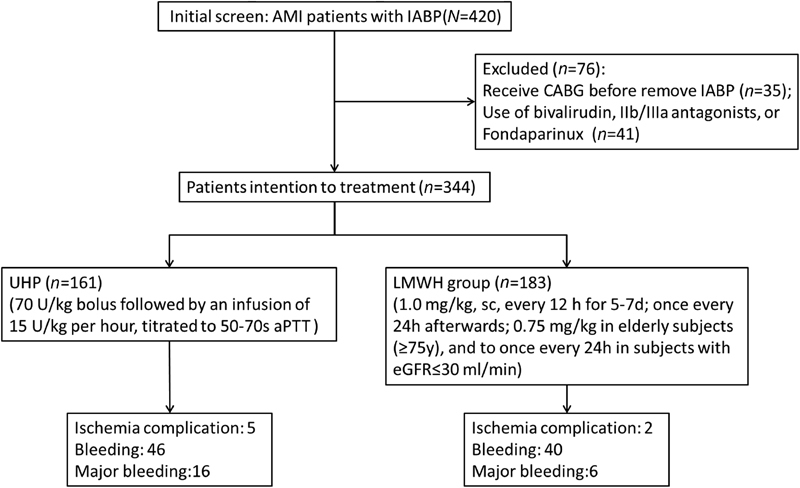
Materials and methods: We retrospectively analyzed a total of 344 patients receiving IABP for cardiogenic shock, severe heart failure, ventricular septal rupture, or mitral valve prolapse due to AMI. A total of 161 patients received UFH (a bolus injection 70 U/kg immediately after IABP, followed by infusion at a rate of 15 U/kg/hour and titration to for 50 to 70 seconds of activated partial thromboplastin time. A total of 183 patients received LMWH (subcutaneous injection of 1.0 mg/kg every 12 hours for 5 to 7 days and 1.0 mg/kg every 24 hours thereafter). Events of ischemia, arterial thrombosis or embolism, and bleeding during IABP were evaluated. Major bleeding was defined as a hemoglobin decrease by >50 g/L (vs. prior to IABP) or bleeding that caused hemodynamic shock or life-threatening or requiring blood transfusion.
Results: Subjects receiving UFH and LMWH did not differ in baseline characteristics. Ischemia was noted in five (3.1%) and two (1.1%) subjects in UFH and LMWH groups, respectively. Arterial thromboembolism occurred in three (1.9%) subjects in the UFH group, but not in the LMWH group. Logistic regression analysis failed to reveal an association between ischemia or bleeding with heparin type. Major bleeding occurred in 16 (9.9%) and six (3.3%) patients in the UFH and LWMH groups, respectively (p = 0.014). Regression analysis indicated that LMWH is associated with less major bleeding.
Conclusion: LMWH could reduce the risk of major bleeding in patients receiving IABP. Whether LMWH could reduce arterial thromboembolism needs further investigation.
The Author(s). This is an open access article published by Thieme under the terms of the Creative Commons Attribution-NonDerivative-NonCommercial-License, permitting copying and reproduction so long as the original work is given appropriate credit. Contents may not be used for commercial purposes, or adapted, remixed, transformed or built upon. (https://creativecommons.org/licenses/by-nc-nd/4.0/).
Conflict of interest statement
None declared.
References
-
- Goldberg R J, Spencer F A, Gore J M, Lessard D, Yarzebski J. Thirty-year trends (1975 to 2005) in the magnitude of, management of, and hospital death rates associated with cardiogenic shock in patients with acute myocardial infarction: a population-based perspective. Circulation. 2009;119(09):1211–1219. - PMC - PubMed
-
- Hasdai D, Harrington R A, Hochman J S. Platelet glycoprotein IIb/IIIa blockade and outcome of cardiogenic shock complicating acute coronary syndromes without persistent ST-segment elevation. J Am Coll Cardiol. 2000;36(03):685–692. - PubMed
-
- Intraaortic Balloon Pump in cardiogenic shock II (IABP-SHOCK II) trial investigators Thiele H, Zeymer U, Neumann F-J.Intra-aortic balloon counterpulsation in acute myocardial infarction complicated by cardiogenic shock (IABP-SHOCK II): final 12 month results of a randomised, open-label trial Lancet 2013382(9905):1638–1645. - PubMed
-
- Jacob A S, Steingart R H, Schweger M J. Heparin elimination following continuous infusion during intra-aortic balloon counterpulsation. Cathet Cardiovasc Diagn. 1985;11(04):389–392. - PubMed
-
- Harrington R A, Becker R C, Cannon C P.Antithrombotic therapy for non-ST-segment elevation acute coronary syndromes: American College of Chest Physicians Evidence-Based Clinical Practice Guidelines (8th edition) Chest 2008133(6, Suppl)670S–707S. - PubMed