


Development of Biodegradable Flame-Retardant Bamboo Charcoal Composites, Part II: Thermal Degradation, Gas Phase, and Elemental Analyses
- PMID: 32998464
- PMCID: PMC7599516
- DOI: 10.3390/polym12102238
Development of Biodegradable Flame-Retardant Bamboo Charcoal Composites, Part II: Thermal Degradation, Gas Phase, and Elemental Analyses
Abstract
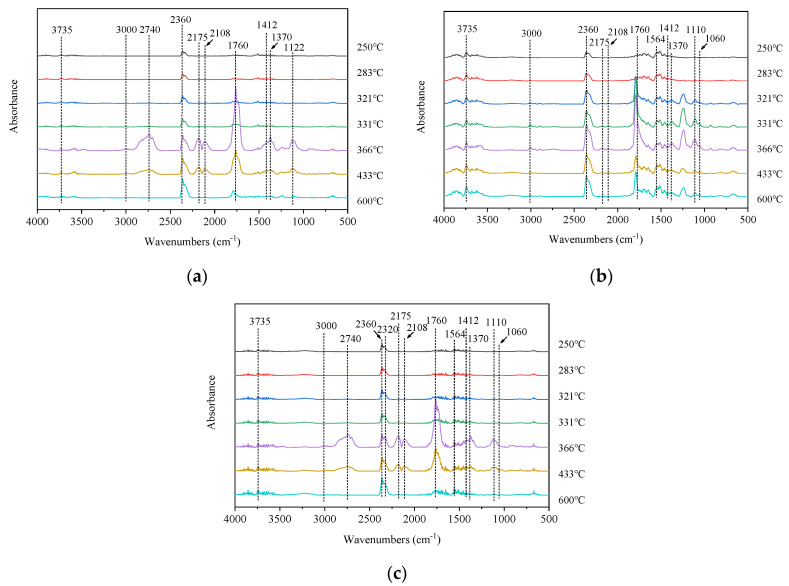
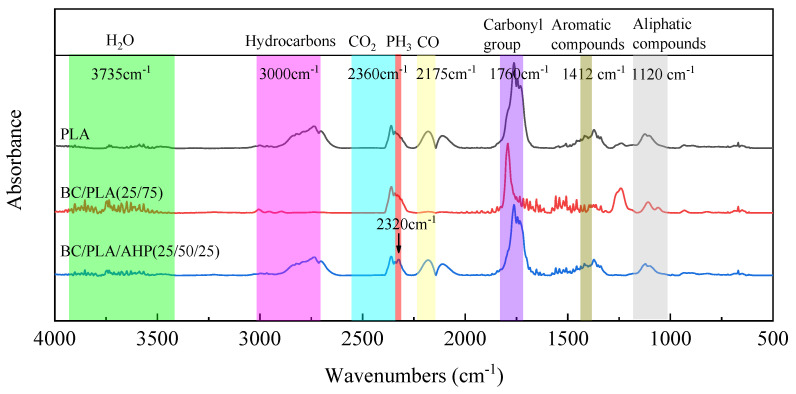
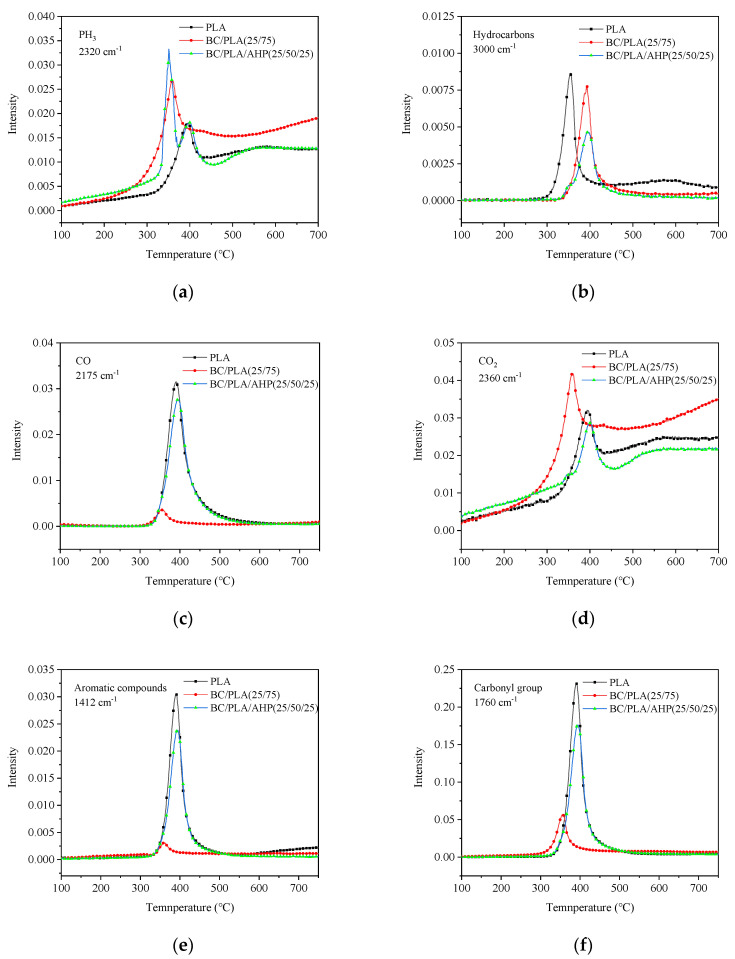
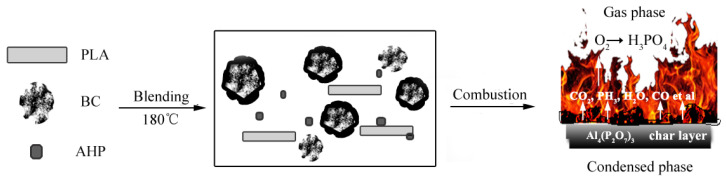
Bamboo charcoal (BC) and aluminum hypophosphite (AHP) singly and in combination were investigated as flame-retardant fillers for polylactic acid (PLA). A set of BC/PLA/AHP composites were prepared by melt-blending and tested for thermal and flame-retardancy properties in Part I. Here, in Part II, the results for differential scanning calorimetry (DSC), thermogravimetric analysis (TGA), Fourier transform infrared (FTIR), thermogravimetry-Fourier transform infrared spectrometry (TG-FTIR), X-ray diffraction (XRD), and X-ray photoelectron analysis (XPS) are presented. The fillers either singly or together promoted earlier initial thermal degradation of the surface of BC/PLA/AHP composites, with a carbon residue rate up to 40.3%, providing a protective layer of char. Additionally, BC promotes heterogeneous nucleation of PLA, while AHP improves the mechanical properties and machinability. Gaseous combustion products CO, aromatic compounds, and carbonyl groups were significantly suppressed in only the BC-PLA composite, but not pure PLA or the BC/PLA/AHP system. The flame-retardant effects of AHP and BC-AHP co-addition combine effective gas-phase and condensed-phase surface phenomena that provide a heat and oxygen barrier, protecting the inner matrix. While it generated much CO2 and smoke during combustion, it is not yet clear whether BC addition on its own contributes any significant gas phase protection for PLA.
Keywords: aluminum hypophosphite; bamboo charcoal; composites; flame retardancy; polylactic acid.
Conflict of interest statement
The authors declare no conflict of interest.
Figures
References
-
- Doan L., Lu Y., Karatela M., Phan V., Jeffryes C., Benson T., Wujcik E.K. Surface modifications of superparamagnetic iron oxide nanoparticles with polylactic acid-polyethylene glycol diblock copolymer and graphene oxide for a protein delivery vehicle. Eng. Sci. 2019;7:10–16. doi: 10.30919/es8d510. - DOI
-
- Dmytrów I., Szczepanik G., Kryża K., Mituniewicz-Małek A., Lisiecki S. Impact of polylactic acid packaging on the organoleptic and physicochemical properties of tvarog during storage. Int. J. Dairy Technol. 2011;64:569–577. doi: 10.1111/j.1471-0307.2011.00700.x. - DOI
-
- Li N., Li Y., Liu S. Rapid prototyping of continuous carbon fiber reinforced polylactic acid composites by 3D printing. J. Mater. Process. Technol. 2016;238:218–225. doi: 10.1016/j.jmatprotec.2016.07.025. - DOI
-
- Gu L., Qiu J., Qiu C., Yao Y., Sakai E., Yang L. Mechanical properties and degrading behaviors of aluminum Hypophosphite-Poly(Lactic Acid) (PLA) nanocomposites. Polym. Technol. Mater. 2018;58:126–138. doi: 10.1080/03602559.2018.1466169. - DOI
-
- Lou C.-W., Lin C.-W., Lei C.-H., Su K.-H., Hsu C.-H., Liu Z.-H., Lin J.-H. PET/PP blend with bamboo charcoal to produce functional composites. J. Mater. Process. Technol. 2007;192:428–433. doi: 10.1016/j.jmatprotec.2007.04.018. - DOI
Grants and funding
LinkOut - more resources
Full Text Sources
Miscellaneous
