. 2020 Sep 30;6(40):eaba1551.
doi: 10.1126/sciadv.aba1551. Print 2020 Sep.

ADHD, financial distress, and suicide in adulthood: A population study

Affiliations

ADHD, financial distress, and suicide in adulthood: A population study

Theodore P Beauchaine et al. Sci Adv. .

Abstract

Attention-deficit/hyperactivity disorder (ADHD) exerts lifelong impairment, including difficulty sustaining employment, poor credit, and suicide risk. To date, however, studies have assessed selected samples, often via self-report. Using mental health data from the entire Swedish population (N = 11.55 million) and a random sample of credit data (N = 189,267), we provide the first study of objective financial outcomes among adults with ADHD, including associations with suicide. Controlling for psychiatric comorbidities, substance use, education, and income, those with ADHD start adulthood with normal credit demand and default rates. However, in middle age, their default rates grow exponentially, yielding poor credit scores and diminished credit access despite high demand. Sympathomimetic prescriptions are unassociated with improved financial behaviors. Last, financial distress is associated with fourfold higher risk of suicide among those with ADHD. For men but not women with ADHD who suicide, outstanding debt increases in the 3 years prior. No such pattern exists for others who suicide.


Figures

Fig. 1
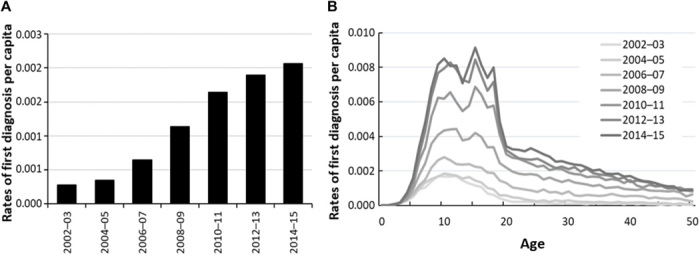
Fig. 1. Rates of ADHD diagnoses in the Swedish population (N = 11,549,190), including n = 177,336 ever diagnosed with ADHD and n = 11,371,854 never diagnosed with ADHD (15).
(A) Rates of new diagnoses per capita for biennia spanning 2002–2015. (B) Rates of new diagnoses per capita by age (years) across biennia spanning 2002–2015.
Fig. 2
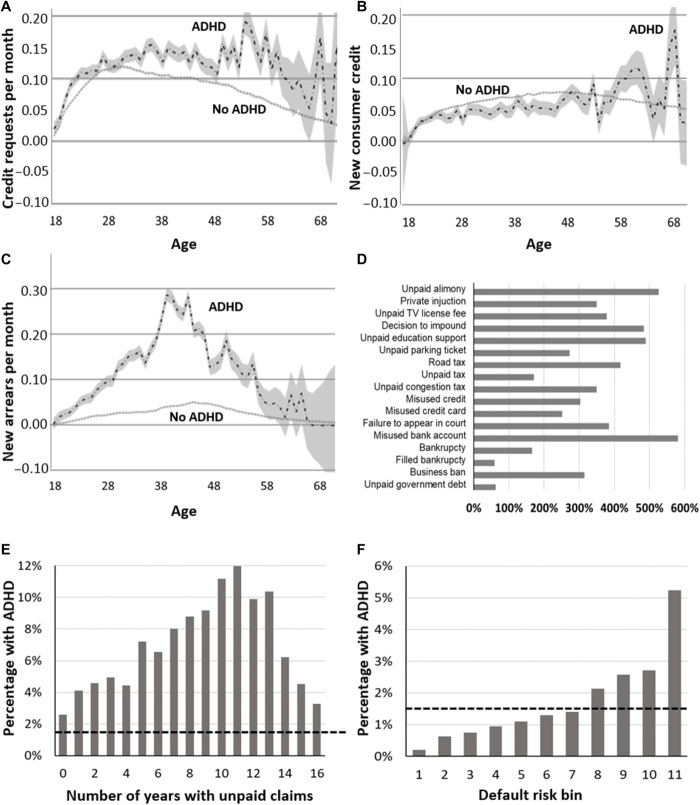
Fig. 2. Associations between ADHD and finances.
Credit and defaults for a random sample of Swedes (17) (n = 1970 ever diagnosed with ADHD; n = 187,297 never diagnosed from 2010 to 2013). (A) Credit requests per month by age. Widening 95% CIs at older ages indicate fewer ADHD cases. (B) New consumer credits per month. (C) New arrears per month. For (A) to (C), y axis values are estimated, adjusting for education, income, sex, psychiatric comorbidities, and physical health. (D) Elevation in arrears for those with ADHD versus the population for everyone registered at the Enforcement Agency in January 2018 (21) (n = 5736 ever diagnosed with ADHD; n = 63,216 never diagnosed). (E) Percentage of people with unpaid claims diagnosed with ADHD by years delinquent. (F) Percentage of people in successive default risk bins diagnosed with ADHD. Increasing x axis scores indicate higher default risk. Proportions of the population and percentage default risk are as follows: bin 1 (0.47; 0 to 0.1%), bin 2 (0.11; 0.1 to 0.2%), bin 3 (0.07; 0.2 to 0.3%), bin 4 (0.05; 0.3 to 0.4%), bin 5 (0.03; 0.4 to 0.5%), bin 6 (0.02; 0.5 to 0.6%), bin 7 (0.05; 0.6 to 0.9%), bin 8 (0.05; 0.9 to 1.4%), bin 9 (0.05; 1.4 to 2.7%), bin 10 (0.05; 2.7 to 30.9%), and bin 11 (0.05; 30.9 to 97.7%). Hatched horizontal lines (E and F) show the population base rate of ADHD.
Fig. 3
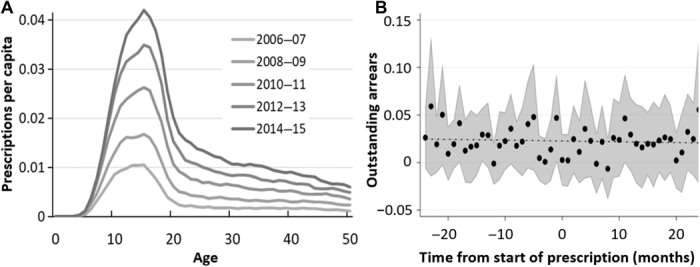
Fig. 3. Prescriptions for ADHD and associations between new prescriptions and arrears.
(A) Prescriptions per capita for the entire population, by age (years), across biennia spanning 2006–2015. Data are from the full Swedish population, including n = 177,336 individuals ever diagnosed with ADHD and n = 11,371,854 never diagnosed with ADHD (15). (B) Average number of new arrears in the 2 years preceding and following prescriptions for ADHD. No differences were found when data were analyzed separately for men versus women. Data are from the random sample on credit and defaults (17), including n = 1970 individuals ever diagnosed with ADHD and n = 187,297 never diagnosed with ADHD. Arrears are residualized, adjusting for education, income, sex, age, psychiatric comorbidities, and physical health, and can extend below zero.
Fig. 4
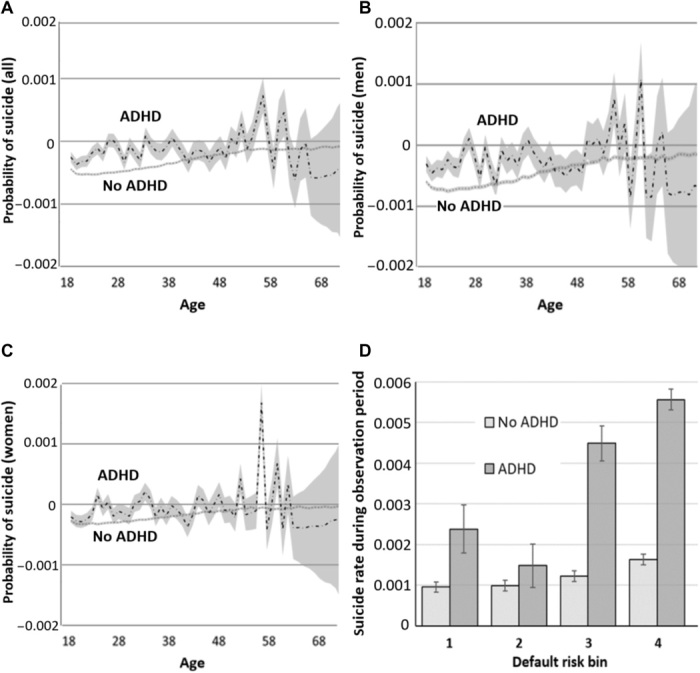
Fig. 4. Suicide outcomes by ADHD status.
(A) Probability of suicide during the observation period for all people with ADHD and without ADHD. (B) Probability of suicide for men diagnosed with ADHD versus without ADHD. (C) Probability of suicide for women with ADHD versus without ADHD. For (A) to (C), y axis values are estimated, adjusting for education, income, sex, psychiatric comorbidities, and physical health. No differences were found between men and women. Data are from the full Swedish population from 2002 to 2015 (n = 177,336 ever diagnosed with ADHD; n = 11,371,854 never diagnosed with ADHD) (15). Widening CIs above age 60 result from fewer ADHD cases. (D) Disparities in suicide rates for those with and without ADHD by default risk. Data are from a random sample of Swedes (17), collected between 2010 and 2013 (n = 1970 ever diagnosed with ADHD; n = 187,297 never diagnosed with ADHD). Increasing scores along the x axis indicate higher likelihood of default. We collapsed into four default risk bins to obtain stable estimates of suicide, given comparatively low base rates. Proportions of the population and percentage default risk are as follows: bin 1 (0.47; 0 to 0.1%), bin 2 (0.18; 0.1 to 0.3%), bin 3 (0.15; 0.3 to 0.9%), and bin 4 (0.20; 0.9 to 97.7%).
Fig. 5
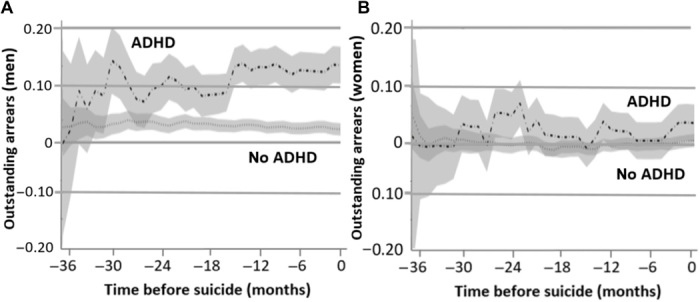
Fig. 5. Growth in debt in the 36 months preceding suicide for those diagnosed with ADHD and those without ADHD.
Suicide data for the full Swedish population are merged with credit data obtained from the Swedish National Enforcement Agency (Kronofogden) mål database (41). Time to event (suicide) is indicated in months. (A) Estimated growth in debt (with 95% CIs) for men diagnosed with ADHD who suicided (n = 131) versus men diagnosed with ADHD who did not suicide (n = 1496). (B) Estimated growth in debt (with 95% CIs) for women diagnosed with ADHD who suicided (n = 59) versus women diagnosed with ADHD who did not suicide (n = 620). Regressions use data from a January 2018 snapshot of everyone registered at the Enforcement Agency who died by suicide, including n = 190 ever diagnosed with ADHD and n = 2120 never diagnosed with ADHD (21).

References

    1. World Health Organization, ICD-10 Classification of Mental and Behavioural Disorders (Author, Geneva, Switzerland, 1992).
    1. Patros C. H. G., Alderson M., Kasper L. J., Tarle S. J., Lea S. E., Hudec K. L., Choice-impulsivity in children and adolescents with attention-deficit/hyperactivity disorder (ADHD): A meta-analytic review. Clin. Psychol. Rev. 43, 162–174 (2016). - PubMed
    1. Beauchaine T. P., Zisner A., Sauder C. L., Trait impulsivity and the externalizing spectrum. Annu. Rev. Clin. Psychol. 13, 343–368 (2017). - PubMed
    1. Loe I. M., Feldman H. M., Academic and educational outcomes of children with ADHD. J. Pediatr. Psychol. 32, 643–654 (2007). - PubMed
    1. Barkley R. A., Fischer M., Smallish L., Fletcher K., Young adult outcome of hyperactive children: Adaptive functioning in major life activities. J. Am. Acad. Child Adolesc. Psychiatry 45, 192–202 (2006). - PubMed

Publication types