


Variability in Zinc Concentration among Mueller-Hinton Broth Brands: Impact on Antimicrobial Susceptibility Testing of Metallo-β-Lactamase-Producing Enterobacteriaceae
- PMID: 32999009
- PMCID: PMC7685897
- DOI: 10.1128/JCM.02019-20
Variability in Zinc Concentration among Mueller-Hinton Broth Brands: Impact on Antimicrobial Susceptibility Testing of Metallo-β-Lactamase-Producing Enterobacteriaceae
Abstract
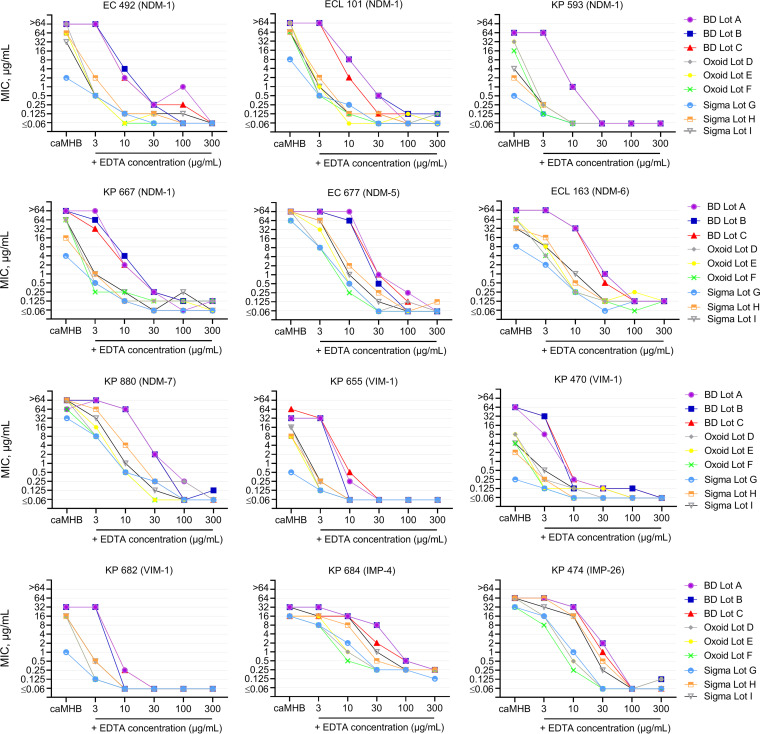
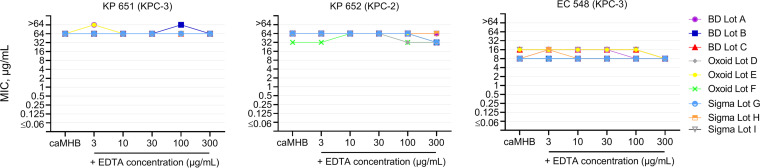
Zinc concentrations in cation-adjusted Mueller-Hinton broth (caMHB) from different manufacturers have been found to differ. Here, we evaluated the impact of utilizing different brands and lots of commercially available caMHB on the classification of the antimicrobial susceptibility of metallo-β-lactamase (MBL)-harboring Enterobacteriaceae We also evaluated the addition of EDTA to caMHB as a means of achieving zinc-limited media. Fifteen clinical Enterobacteriaceae isolates (harboring NDM [n = 7], VIM [n = 3], IMP [n = 2], or KPC [n = 3]) and nine different commercial lots from three caMHB manufacturers (Becton, Dickinson; Oxoid; and Sigma-Aldrich) were utilized. Zinc-limited media were prepared by the addition of EDTA at concentrations ranging from 3 to 300 μg/ml. Meropenem MICs were determined in triplicate for each lot of conventional caMHB and zinc-limited media by broth microdilution. The zinc concentration in each lot of conventional caMHB was determined by inductively coupled plasma mass spectrometry. Up to 8-fold differences in meropenem MICs were observed between the commercial lots, resulting in different classifications of susceptibility among MBL-harboring isolates. Mean zinc concentrations were highest among conventional Becton, Dickinson caMHB lots relative to those for Oxoid and Sigma-Aldrich broth. Among MBL-harboring isolates, the impact of EDTA on MICs was dependent on the lot, correlating with initial zinc availability (i.e., less MIC reduction with higher initial zinc concentrations), while MICs for KPC-harboring isolates were unchanged. In summary, zinc variability was observed among commercial lots of caMHB, resulting in different classifications of susceptibility among MBL-harboring Enterobacteriaceae The addition of EDTA at concentrations of ≥30 μg/ml was sufficient to provide a zinc-limited medium, resulting in MICs that reflect in vivo meropenem activity.
Keywords: Enterobacteriaceae; antimicrobial susceptibility testing; metallo-β-lactamase; zinc.
Copyright © 2020 American Society for Microbiology.
Figures
Comment in
-
Zinc Concentration Affects Metallo-Beta-Lactamase Susceptibility Testing of Enterobacterales.J Clin Microbiol. 2021 Aug 18;59(9):e0003921. doi: 10.1128/JCM.00039-21. Epub 2021 Aug 18. J Clin Microbiol. 2021. PMID: 34133888 Free PMC article. No abstract available.
-
Reply to Rennie, "Zinc Concentration Affects Metallo-Beta-Lactamase Susceptibility Testing of Enterobacterales".J Clin Microbiol. 2021 Aug 18;59(9):e0121121. doi: 10.1128/JCM.01211-21. Epub 2021 Aug 18. J Clin Microbiol. 2021. PMID: 34133890 Free PMC article. No abstract available.
References
-
- Puttaswamy S, Gupta SK, Regunath H, Smith LP, Sengupta S. 2018. A comprehensive review of the present and future antibiotic susceptibility testing (AST) systems. Arch Clin Microbiol 9(3):83. doi: 10.4172/1989-8436.100083. - DOI
-
- Doern GV, Brecher SM. 2011. The clinical predictive value (or lack thereof) of the results of in vitro antimicrobial susceptibility tests. J Clin Microbiol 49:S11–S14. doi: 10.1128/JCM.00580-11. - DOI
-
- van Belkum A, Bachmann TT, Lüdke G, Lisby JG, Kahlmeter G, Mohess A, Becker K, Hays JP, Woodford N, Mitsakakis K, Moran-Gilad J, Vila J, Peter H, Rex JH, Dunne WM Jr, JPIAMR AMR-RDT Working Group on Antimicrobial Resistance and Rapid Diagnostic Testing. 2019. Developmental roadmap for antimicrobial susceptibility testing systems. Nat Rev Microbiol 17:51–62. doi: 10.1038/s41579-018-0098-9. - DOI - PMC - PubMed
Publication types
MeSH terms
Substances
LinkOut - more resources
Full Text Sources
Miscellaneous
