. 2020 Aug;50(5):921-942.
doi: 10.1002/ejsp.2694. Epub 2020 Jun 30.

Subjective status and perceived legitimacy across countries

Mark J Brandt  1 Toon Kuppens  2 Russell Spears  2 Luca Andrighetto  3 Frederique Autin  4 Peter Babincak  5 Constantina Badea  6 Jaechang Bae  7 Anatolia Batruch  8 Julia C Becker  9 Konrad Bocian  10 Bojana Bodroža  11 David Bourguignon  12 Marcin Bukowski  13 Fabrizio Butera  8 Sarah E Butler  14 Xenia Chryssochoou  15 Paul Conway  16 Jarret T Crawford  17 Jean-Claude Croizet  18 Soledad de Lemus  19 Juliane Degner  20 Piotr Dragon  13 Federica Durante  21 Matthew J Easterbrook  22 Iniobong Essien  23 Joseph P Forgas  24 Roberto González  25 Sylvie Graf  26 Peter Halama  27 Gyuseog Han  28 Ryan Y Hong  29 Petr Houdek  30 Eric R Igou  31 Yoel Inbar  32 Jolanda Jetten  33 William Jimenez Leal  34 Gloria Jiménez-Moya  25 Jaya Kumar Karunagharan  35 Anna Kende  36 Maria Korzh  37 Simon M Laham  38 Joris Lammers  39 Li Lim  33 Antony S R Manstead  40 Janko Međedović  41 Zachary J Melton  42 Matt Motyl  43 Spyridoula Ntani  15 Chuma Kevin Owuamalam  35 Müjde Peker  44 Michael J Platow  45 J P Prims  42 Christine Reyna  46 Mark Rubin  47 Rim Saab  48 Sindhuja Sankaran  49 Lee Shepherd  50 Chris G Sibley  51 Agata Sobkow  52 Bram Spruyt  53 Pernille Stroebaek  54 Nebi Sümer  55 Joseph Sweetman  56 Catia P Teixeira  2 Claudia Toma  57 Adrienn Ujhelyi  36 Jojanneke van der Toorn  58 Alain van Hiel  59   60 Alejandro Vásquez-Echeverría  61 Alexandra Vazquez  62 Michelangelo Vianello  63 Marek Vranka  64 Vincent Yzerbyt  65 Jennifer L Zimmerman  46
Affiliations

Subjective status and perceived legitimacy across countries

Mark J Brandt et al. Eur J Soc Psychol. 2020 Aug.

Abstract

The relationships between subjective status and perceived legitimacy are important for understanding the extent to which people with low status are complicit in their oppression. We use novel data from 66 samples and 30 countries (N = 12,788) and find that people with higher status see the social system as more legitimate than those with lower status, but there is variation across people and countries. The association between subjective status and perceived legitimacy was never negative at any levels of eight moderator variables, although the positive association was sometimes reduced. Although not always consistent with hypotheses, group identification, self-esteem, and beliefs in social mobility were all associated with perceived legitimacy among people who have low subjective status. These findings enrich our understanding of the relationship between social status and legitimacy.

Keywords: legitimacy; social identity; status; system justification.


Conflict of interest statement

There are no conflicts of interest to report.

Figures

FIGURE 1
FIGURE 1
Correlations (above the diagonal) and density plots (below the diagonal) between subjective status, sense of power, and the outcome variables. All variables were country‐mean‐centered before calculating the correlations. Density plots for each individual variable are on the diagonal. Density plots are a variant of a histogram. The area below the diagonal uses density plots between two variables. SJ = System Justification, Trust = Trust in Government, Confid = Confidence in Societal Institutions, Legit = Legitimacy of the status hierarchy [Colour figure can be viewed at wileyonlinelibrary.com]
FIGURE 2
FIGURE 2
Estimated slopes of subjective status for each country from the multilevel model. Dots are randomly jittered horizontally to help show the data.
FIGURE 3
FIGURE 3
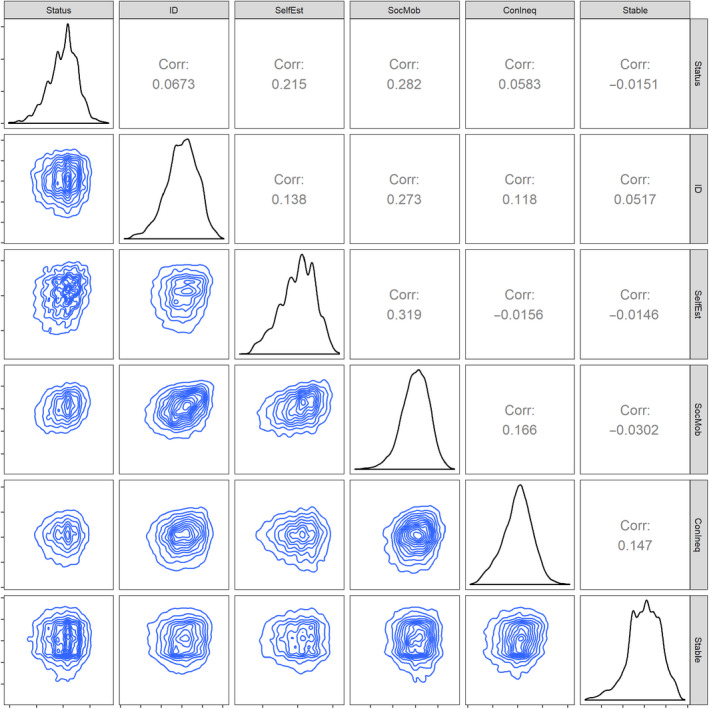
Correlations (above the diagonal) and density plots (below the diagonal) between primary predictor variables and the individual level variables. All variables were country‐mean centered before calculating the correlations. Density plots for each individual variable are on the diagonal. ID = Group identification; SelfEst = Self‐esteem; SocMob = Social mobility; ConInqu = Contribution to inequality; Stable = Stability of the status hierarchy [Colour figure can be viewed at wileyonlinelibrary.com]
FIGURE 4
FIGURE 4
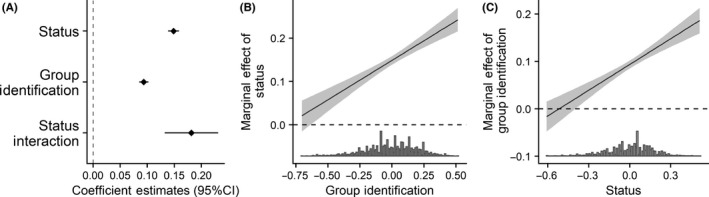
Panel A: Effects of subjective status and group identification on perceived legitimacy. Covariates are included in the model. Error bars are 95% confidence intervals. Panel B: Marginal effect of subjective status on perceived legitimacy (y‐axis) across the range of group identification (x‐axis). Panel C: Marginal effect of group identification on perceived legitimacy (y‐axis) across the range of subjective status (x‐axis). For both Panels B and C, the grey band around the slope is the 95% confidence interval. In all panels a null effect is highlighted with the dashed line
FIGURE 5
FIGURE 5
Effects of subjective status and self‐esteem on perceived legitimacy. Covariates are included in the model. Error bars are 95% confidence intervals. A null effect is highlighted with the dashed line
FIGURE 6
FIGURE 6
Effects of subjective status and contributing to inequality on perceived legitimacy. Covariates are included in the model. Error bars are 95% confidence intervals. A null effect is highlighted with the dashed line
FIGURE 7
FIGURE 7
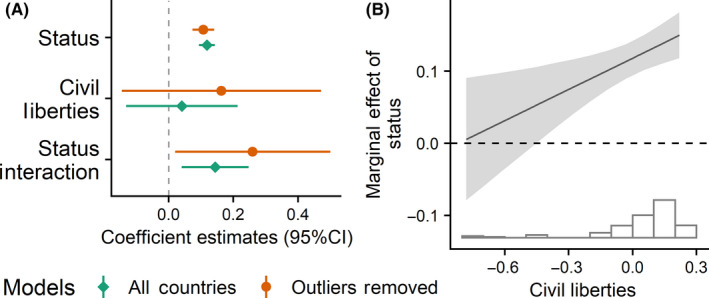
Panel A: Effects of subjective status and civil liberties on perceived legitimacy. Covariates are included in the model. Error bars are 95% confidence intervals. Panel B: Marginal effect of subjective status on perceived legitimacy (y‐axis) across the range of civil liberties (x‐axis). The grey band around the slope is the 95% confidence interval. In all panels a null effect is highlighted with the dashed line. See footnote 13 for outlier explanation [Colour figure can be viewed at wileyonlinelibrary.com]
FIGURE 8
FIGURE 8
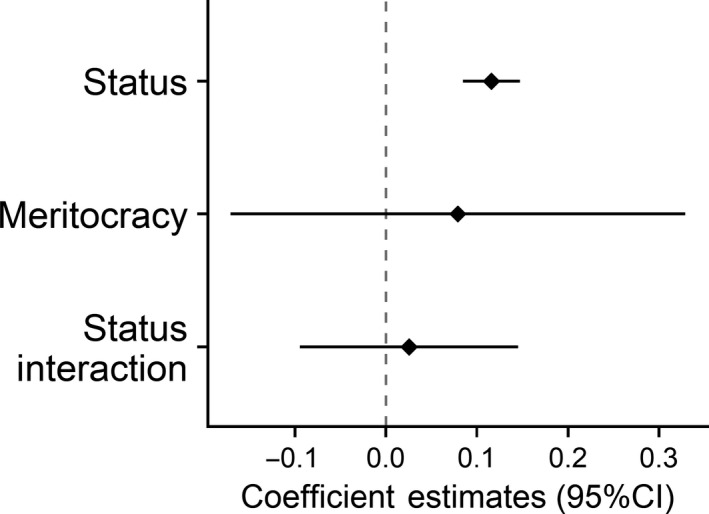
Effects of subjective status and meritocracy on perceived legitimacy. Covariates are included in the model. Error bars are 95% confidence intervals. A null effect is highlighted with the dashed line
FIGURE 9
FIGURE 9
Effects of subjective status and inequality on perceived legitimacy. Covariates are included in the model. Error bars are 95% confidence intervals. A null effect is highlighted with the dashed line. See footnote 13 for outlier explanation [Colour figure can be viewed at wileyonlinelibrary.com]
FIGURE 10
FIGURE 10
Panel A: Effects of subjective status and stability of the subjective status hierarchy on perceived legitimacy. Covariates are included in the model. Error bars are 95% confidence intervals. Panel B: Marginal effect of subjective status on perceived legitimacy (y‐axis) across the range of stability (x‐axis). Panel C: Marginal effect of stability on perceived legitimacy (y‐axis) across the range of subjective status (x‐axis). For Panels B and C the grey band around the slope is the 95% confidence interval. In all panels a null effect is highlighted with the dashed line
FIGURE 11
FIGURE 11
Panel A: Effects of subjective status and social mobility on perceived legitimacy. Covariates are included in the model. Error bars are 95% confidence intervals. Panel B: Marginal effect of social mobility on perceived legitimacy (y‐axis) across the range of subjective status (x‐axis). For Panel B, the grey band around the slope is the 95% confidence interval. In all panels a null effect is highlighted with the dashed line

References

    1. Adler, N. E. , Epel, E. S. , Castellazzo, G. , & Ickovics, J. R. (2000). Relationship of subjective and objective social status with psychological and physiological functioning: Preliminary data in healthy, White women. Health Psychology, 19, 586–592. 10.1037/0278-6133.19.6.586 - DOI - PubMed
    1. Aiken, L. S. , & West, S. G. (1991). Multiple regression: Testing and interpreting interactions. Newbury Park, CA: Sage.
    1. American National Election Studies (2015). Codebook for the time series cumulative data file 1948–2012. Retrieved from http://www.electionstudies.org/studypages/anes_timeseries_cdf/anes_times...
    1. Bates, D. , Mächler, M. , Bolker, B. , & Walker, S. (2015). Fitting linear mixed‐effects models using lme4. Journal of Statistical Software, 67, 1–48.
    1. Bettencourt, B. , Charlton, K. , Dorr, N. , & Hume, D. L. (2001). Status differences and in‐group bias: A meta‐analytic examination of the effects of status stability, status legitimacy, and group permeability. Psychological Bulletin, 127, 520–542. 10.1037/0033-2909.127.4.520 - DOI - PubMed