


Shitsu-taikan-sho (alexisomia): a historical review and its clinical importance
- PMID: 32999684
- PMCID: PMC7520027
- DOI: 10.1186/s13030-020-00193-9
Shitsu-taikan-sho (alexisomia): a historical review and its clinical importance
Abstract
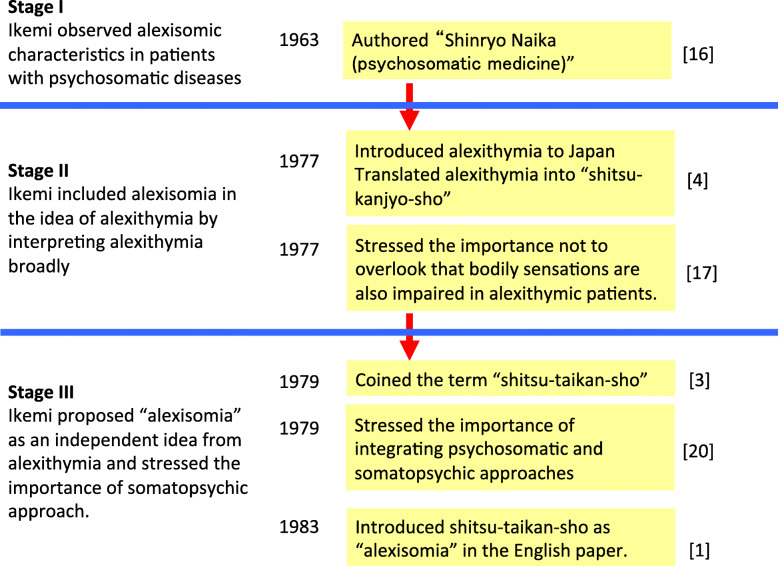
"Shitsu-taikan-sho" is a clinical concept that refers to characteristics of having difficulty in the awareness and expression of somatic feelings or sensations. This concept was first proposed in 1979 by Dr. Yujiro Ikemi, the founder of psychosomatic medicine in Japan, as a characteristic observed in patients with psychosomatic diseases, i.e. physical diseases in which psychosocial factors are closely involved in their onset and progress. Soon after Dr. Ikemi introduced to Japan the concept of alexithymia, coined by P. E. Sifneos in 1973, he noticed that patients with psychosomatic diseases have difficulty in describing not only their emotions, but also somatic feelings and sensations. Dr. Ikemi proposed naming the concept of the trait of lacking somatic awareness "shitsu-taikan-sho" in Japanese ("alexisomia" in English), meaning "shitsu" a lack, "taikan" bodily feelings/sensations, and "sho" condition/symptoms. Dr. Ikemi observed characteristics of both alexithymia and alexisomia in patients with psychosomatic diseases, but considered alexisomia to have a more fundamental pathophysiological role in the understanding of psychosomatic diseases. He also emphasized the importance of treating alexisomia when treating psychosomatic diseases. Recently, alexisomia has again come into focus for various reasons. One is the availability of the Shitsu-taikan-sho Scale (STSS), a self-rating questionnaire to evaluate alexisomic tendency. Another is recent advances in basic research on interoception. The former will facilitate clinical studies on alexisomia, and the latter will enable a deeper understanding of alexisomia. This article is an overview of the historical development of the concept of alexisomia which was conceptualized by Dr. Ikemi, introduces the STSS, and discusses the current understanding and clinical importance of alexisomia in psychosomatic medicine.
Keywords: Alexisomia; Alexithymia; Interoception; Shitsu-taikan-sho scale; Yujiro Ikemi.
© The Author(s) 2020.
Conflict of interest statement
Competing interestsThe author declares that he has no competing interests in relation to this article.
Figures
References
-
- Ikemi Y, Ikemi A. Psychosomatic medicine: a meeting ground of eastern and Western medicine. J Am Soc Psychosom Dent Med. 1983;30(1):3–16. - PubMed
-
- Ikemi Y. Psychosomatic medicine as a core of holistic medicine. Shinshin-igaku. 1990;30:251–260.
-
- Ikemi Y. Psychophysiology as the starting point of education. Jpn J Transactional Analysis. 1979;4:1–10.
-
- Ikemi Y. Psychosomatic medicine. Jpn Med J. 1977;2755:49–54.
-
- Kurokawa N, Sobajima J, Hirota Y, Hayashi Y, Kumai S, Takahashi K, Kaga M, Oshima K, Takaki R. Psychosomatic study of subjective complaints in patients with diabetes mellitus (written in Japanese) Shinshin-igaku. 1982;22(3):195–199.
Publication types
LinkOut - more resources
Full Text Sources
