Review
. 2021 Feb;58(2):631-646.
doi: 10.1007/s12035-020-02137-4. Epub 2020 Sep 30.

Heterogeneous Nuclear Ribonucleoproteins: Implications in Neurological Diseases

Affiliations
Review

Heterogeneous Nuclear Ribonucleoproteins: Implications in Neurological Diseases

Yi-Hua Low et al. Mol Neurobiol. 2021 Feb.

Abstract

Heterogenous nuclear ribonucleoproteins (hnRNPs) are a complex and functionally diverse family of RNA binding proteins with multifarious roles. They are involved, directly or indirectly, in alternative splicing, transcriptional and translational regulation, stress granule formation, cell cycle regulation, and axonal transport. It is unsurprising, given their heavy involvement in maintaining functional integrity of the cell, that their dysfunction has neurological implications. However, compared to their more established roles in cancer, the evidence of hnRNP implication in neurological diseases is still in its infancy. This review aims to consolidate the evidences for hnRNP involvement in neurological diseases, with a focus on spinal muscular atrophy (SMA), Alzheimer's disease (AD), amyotrophic lateral sclerosis (ALS), frontotemporal dementia (FTD), multiple sclerosis (MS), congenital myasthenic syndrome (CMS), and fragile X-associated tremor/ataxia syndrome (FXTAS). Understanding more about hnRNP involvement in neurological diseases can further elucidate the pathomechanisms involved in these diseases and perhaps guide future therapeutic advances.

Keywords: ALS; Alzheimer’s disease; FTD; Multiple sclerosis; hnRNPs.


Figures
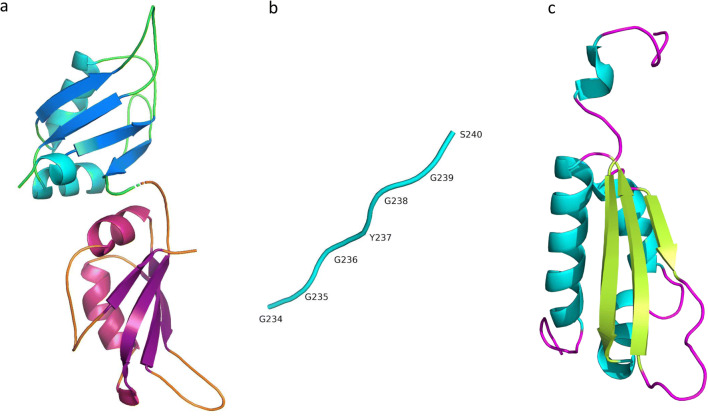
Fig. 1
Fig. 1
RNA binding domains in hnRNPs. RNA-binding domains in hnRNP include RRM (RNA Recognition Motif), KH (K-Homology), and RGG (Arginine-Glycine-Glycine). hnRNPA1 UP1, which spans the first 196 aa at the N-terminus, contains two RRM one in each subdomain of UP1. a RRM contains two α-helices (RRM1: cyan, RRM2: pink), four β-sheets (RRM1: blue, RRM2: purple), and five loops (RRM1: green, RRM2: orange) that order as βαββαβ. b The C-terminal of hnRNPA1 contains another RNA-binding motif known as RGG. The name reflects the abundance of Arg-Gly-Gly tripeptide repeats in the motif. c The KH domain of hnRNPK consists of three α-helices (cyan), three β-sheets (green), and five loops (purple) that fold in the order of βααββα [–11]
Fig. 2
Fig. 2
hnRNPs involvement in spinal muscular atrophy (SMA). Various hnRNPs have been implicated in regulating splicing of the SMA gene. Promoting the inclusion of exon 7 to produce a functional SMA protein or the exclusion of exon 7 which forms a truncated SMA protein.
Fig. 3
Fig. 3
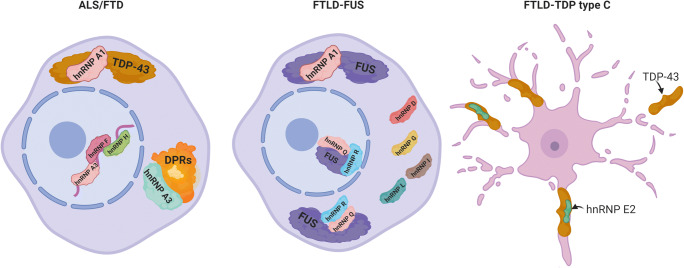
The involvement of hnRNPs in amyotrophic lateral sclerosis and frontotemporal dementia. hnRNPs have been shown to be involved in ALS and FTD in many ways. hnRNPs are able to bind to the hexanucleotide repeats within the nucleus, bind to the dipeptide repeat protein (DPRs) inclusions in the cytoplasm and also to the main pathological inclusions in both diseases TDP-43. In FTLD-FUS, hnRNP proteins have been found to co-localize with FUS in the nucleus and the cytoplasm. It has also been shown that other hnRNP proteins also form patholigcal inclusions without the presence of FUS. FTLD-TDP type C pathology shown distinct inclusions as long twisted neurites which have also been shown to co-localize with hnRNP E2

Comment in

References

    1. Dreyfuss G, Matunis MJ, Pinol-Roma S, Burd CG. hnRNP proteins and the biogenesis of mRNA. Anna Rev Biochem. 1993;62:289–321. doi: 10.1146/annurev.bi.62.070193.001445. - DOI - PubMed
    1. Piñol-Roma S, Choi YD, Matunis MJ, Dreyfuss G. Immunopurification of heterogeneous nuclear ribonucleoprotein particles reveals an assortment of RNA-binding proteins. Genes Dev. 1988;2:215–227. doi: 10.1101/gad.2.2.215. - DOI - PubMed
    1. Piñol-Roma S, Dreyfuss G. Shuttling of pre-mRNA binding proteins between nucleus and cytoplasm. Nature. 1992;355:730–732. doi: 10.1038/355730a0. - DOI - PubMed
    1. Maris C, Dominguez C, Allain FHT. The RNA recognition motif, a plastic RNA-binding platform to regulate post-transcriptional gene expression. FEBS J. 2005;272:2118–2131. doi: 10.1111/j.1742-4658.2005.04653.x. - DOI - PubMed
    1. Nagai K, Oubridge C, Jessen TH, Li J, Evans PR. Crystal structure of the RNA-binding domain of the U1 small nuclear ribonucleoprotein a. Nature. 1990;348:515–520. doi: 10.1038/348515a0. - DOI - PubMed

MeSH terms

Substances