


Understanding Medical Students' Attitudes Toward Learning eHealth: Questionnaire Study
- PMID: 33001034
- PMCID: PMC7563623
- DOI: 10.2196/17030
Understanding Medical Students' Attitudes Toward Learning eHealth: Questionnaire Study
Abstract
Background: Several publications on research into eHealth demonstrate promising results. Prior researchers indicated that the current generation of doctors is not trained to take advantage of eHealth in clinical practice. Therefore, training and education for everyone using eHealth are key factors to its successful implementation. We set out to review whether medical students feel prepared to take advantage of eHealth innovations in medicine.
Objective: Our objective was to evaluate whether medical students desire a dedicated eHealth curriculum during their medical studies.
Methods: A questionnaire assessing current education, the need for education about eHealth topics, and the didactical forms for teaching these topics was developed. Questionnaire items were scored on a scale from 1 (fully disagree with a topic) to 10 (fully agree with a topic). This questionnaire was distributed among 1468 medical students of Maastricht University in the Netherlands. R version 3.5.0 (The R Foundation) was used for all statistical procedures.
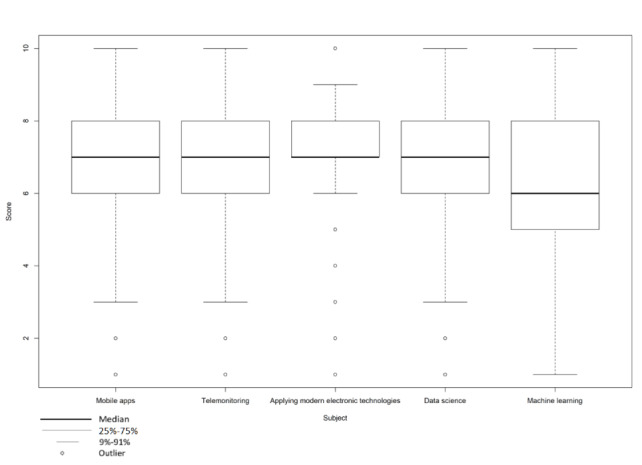
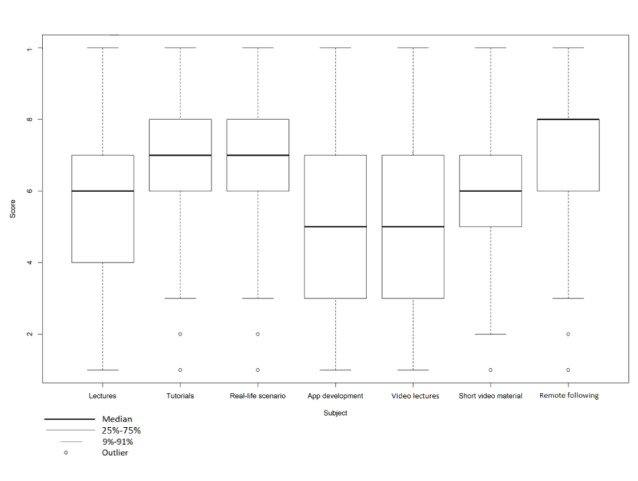
Results: A total of 303 students out of 1468, representing a response rate of 20.64%, replied to our questionnaire. The aggregate statement "I feel prepared to take advantage of the technological developments within the medical field" was scored at a mean value of 4.8 out of 10. Mean scores regarding the need for education about eHealth topics ranged from 6.4 to 7.3. Medical students did not favor creating their own health apps or mobile apps; the mean score was 4.9 for this topic. The most popular didactical option, with a mean score 7.2, was to remotely follow a real-life patient under the supervision of a doctor.
Conclusions: To the best of our knowledge, this is the largest evaluation of students' opinions on eHealth training in a medical undergraduate curriculum. We found that medical students have positives attitudes toward incorporating eHealth into the medical curriculum.
Keywords: curriculum; digital skills; eHealth; mHealth; medical education; medicine; student opinion; students.
©Kjeld Vossen, Jan-Joost Rethans, Sander M J van Kuijk, Cees P van der Vleuten, Pieter L Kubben. Originally published in JMIR Medical Education (http://mededu.jmir.org), 01.10.2020.
Conflict of interest statement
Conflicts of Interest: None declared.
Figures
Comment in
- JMIR Med Educ. 7:e24993. doi: 10.2196/24993
References
-
- WHO Global Observatory for eHealth . Atlas of eHealth Country Profiles: The Use of eHealth in Support of Universal Health Coverage: Based on the Findings of the Third Global Survey on eHealth 2015. Geneva, Switzerland: World Health Organization; 2015. [2020-09-06]. https://apps.who.int/iris/rest/bitstreams/908392/retrieve.
-
- Linn AJ, Vervloet M, van Dijk L, Smit EG, Van Weert JCM. Effects of eHealth interventions on medication adherence: A systematic review of the literature. J Med Internet Res. 2011 Dec 05;13(4):e103. doi: 10.2196/jmir.1738. https://www.jmir.org/2011/4/e103/ - DOI - PMC - PubMed
LinkOut - more resources
Full Text Sources
