Adapting and Extending a Typology to Identify Vaccine Misinformation on Twitter
- PMID: 33001737
- PMCID: PMC7532318
- DOI: 10.2105/AJPH.2020.305940
Adapting and Extending a Typology to Identify Vaccine Misinformation on Twitter
Abstract
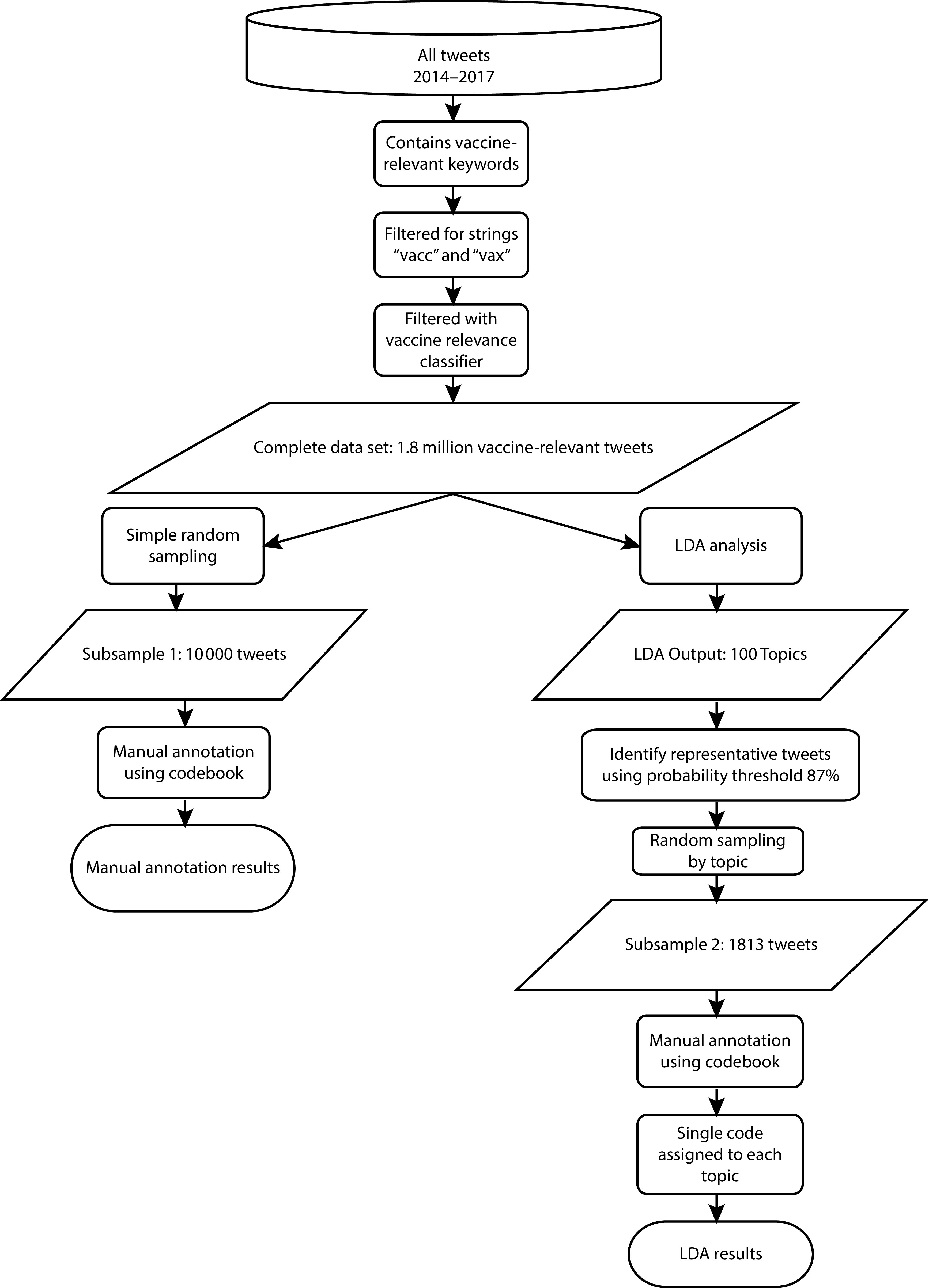
Objectives. To adapt and extend an existing typology of vaccine misinformation to classify the major topics of discussion across the total vaccine discourse on Twitter.Methods. Using 1.8 million vaccine-relevant tweets compiled from 2014 to 2017, we adapted an existing typology to Twitter data, first in a manual content analysis and then using latent Dirichlet allocation (LDA) topic modeling to extract 100 topics from the data set.Results. Manual annotation identified 22% of the data set as antivaccine, of which safety concerns and conspiracies were the most common themes. Seventeen percent of content was identified as provaccine, with roughly equal proportions of vaccine promotion, criticizing antivaccine beliefs, and vaccine safety and effectiveness. Of the 100 LDA topics, 48 contained provaccine sentiment and 28 contained antivaccine sentiment, with 9 containing both.Conclusions. Our updated typology successfully combines manual annotation with machine-learning methods to estimate the distribution of vaccine arguments, with greater detail on the most distinctive topics of discussion. With this information, communication efforts can be developed to better promote vaccines and avoid amplifying antivaccine rhetoric on Twitter.
Figures
References
-
- Pew Research Center. Vast majority of Americans say benefits of childhood vaccines outweigh risks. 2017. Available at: https://www.pewresearch.org/science/2017/02/02/vast-majority-of-american.... Accessed: June 25, 2019.
-
- World Health Organization. Ten threats to global health in 2019. 2019. Available at: https://www.who.int/emergencies/ten-threats-to-global-health-in-2019. Accessed January 4, 2019.
Publication types
MeSH terms
Substances
Grants and funding
LinkOut - more resources
Full Text Sources
Medical