


Diagnostic Accuracy of Web-Based COVID-19 Symptom Checkers: Comparison Study
- PMID: 33001828
- PMCID: PMC7541039
- DOI: 10.2196/21299
Diagnostic Accuracy of Web-Based COVID-19 Symptom Checkers: Comparison Study
Abstract
Background: A large number of web-based COVID-19 symptom checkers and chatbots have been developed; however, anecdotal evidence suggests that their conclusions are highly variable. To our knowledge, no study has evaluated the accuracy of COVID-19 symptom checkers in a statistically rigorous manner.
Objective: The aim of this study is to evaluate and compare the diagnostic accuracies of web-based COVID-19 symptom checkers.
Methods: We identified 10 web-based COVID-19 symptom checkers, all of which were included in the study. We evaluated the COVID-19 symptom checkers by assessing 50 COVID-19 case reports alongside 410 non-COVID-19 control cases. A bootstrapping method was used to counter the unbalanced sample sizes and obtain confidence intervals (CIs). Results are reported as sensitivity, specificity, F1 score, and Matthews correlation coefficient (MCC).
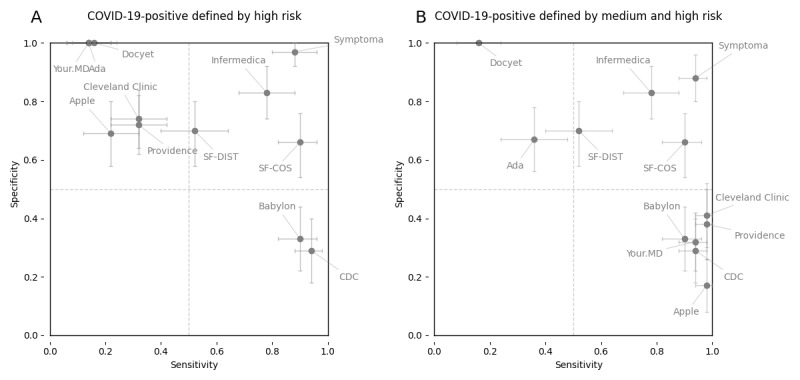
Results: The classification task between COVID-19-positive and COVID-19-negative for "high risk" cases among the 460 test cases yielded (sorted by F1 score): Symptoma (F1=0.92, MCC=0.85), Infermedica (F1=0.80, MCC=0.61), US Centers for Disease Control and Prevention (CDC) (F1=0.71, MCC=0.30), Babylon (F1=0.70, MCC=0.29), Cleveland Clinic (F1=0.40, MCC=0.07), Providence (F1=0.40, MCC=0.05), Apple (F1=0.29, MCC=-0.10), Docyet (F1=0.27, MCC=0.29), Ada (F1=0.24, MCC=0.27) and Your.MD (F1=0.24, MCC=0.27). For "high risk" and "medium risk" combined the performance was: Symptoma (F1=0.91, MCC=0.83) Infermedica (F1=0.80, MCC=0.61), Cleveland Clinic (F1=0.76, MCC=0.47), Providence (F1=0.75, MCC=0.45), Your.MD (F1=0.72, MCC=0.33), CDC (F1=0.71, MCC=0.30), Babylon (F1=0.70, MCC=0.29), Apple (F1=0.70, MCC=0.25), Ada (F1=0.42, MCC=0.03), and Docyet (F1=0.27, MCC=0.29).
Conclusions: We found that the number of correctly assessed COVID-19 and control cases varies considerably between symptom checkers, with different symptom checkers showing different strengths with respect to sensitivity and specificity. A good balance between sensitivity and specificity was only achieved by two symptom checkers.
Keywords: COVID-19; accuracy; benchmark; chatbot; digital health; symptom; symptom checkers.
©Nicolas Munsch, Alistair Martin, Stefanie Gruarin, Jama Nateqi, Isselmou Abdarahmane, Rafael Weingartner-Ortner, Bernhard Knapp. Originally published in the Journal of Medical Internet Research (http://www.jmir.org), 06.10.2020.
Conflict of interest statement
Conflicts of Interest: All authors are employees of Symptoma GmbH. JN holds shares in Symptoma.
Figures
Comment in
-
Screening Tools: Their Intended Audiences and Purposes. Comment on "Diagnostic Accuracy of Web-Based COVID-19 Symptom Checkers: Comparison Study".J Med Internet Res. 2021 May 21;23(5):e26148. doi: 10.2196/26148. J Med Internet Res. 2021. PMID: 33989169 Free PMC article. No abstract available.
References
-
- Chambers D, Cantrell A, Johnson M, Preston L, Baxter SK, Booth A, Turner J. Digital and online symptom checkers and assessment services for urgent care to inform a new digital platform: a systematic review. Health Services and Delivery Research. 2019;7(29):online. doi: 10.3310/hsdr07290. - DOI - PubMed
-
- Chu DK, Akl EA, Duda S, Solo K, Yaacoub S, Schünemann HJ, COVID-19 Systematic Urgent Review Group Effort (SURGE) study authors Physical distancing, face masks, and eye protection to prevent person-to-person transmission of SARS-CoV-2 and COVID-19: a systematic review and meta-analysis. Lancet. 2020 Jun 01;:1973–1987. doi: 10.1016/S0140-6736(20)31142-9. https://linkinghub.elsevier.com/retrieve/pii/S0140-6736(20)31142-9 - DOI - PMC - PubMed
-
- Kissler SM, Tedijanto C, Goldstein E, Grad YH, Lipsitch M. Projecting the transmission dynamics of SARS-CoV-2 through the postpandemic period. Science. 2020 May 22;368(6493):860–868. doi: 10.1126/science.abb5793. http://europepmc.org/abstract/MED/32291278 - DOI - PMC - PubMed
Publication types
MeSH terms
LinkOut - more resources
Full Text Sources
Research Materials
