


Clinical laboratory parameters associated with severe or critical novel coronavirus disease 2019 (COVID-19): A systematic review and meta-analysis
- PMID: 33002041
- PMCID: PMC7529271
- DOI: 10.1371/journal.pone.0239802
Clinical laboratory parameters associated with severe or critical novel coronavirus disease 2019 (COVID-19): A systematic review and meta-analysis
Abstract
Background: To date, several clinical laboratory parameters associated with Coronavirus disease 2019 (COVID-19) severity have been reported. However, these parameters have not been observed consistently across studies. The aim of this review was to assess clinical laboratory parameters which may serve as markers or predictors of severe or critical COVID-19.
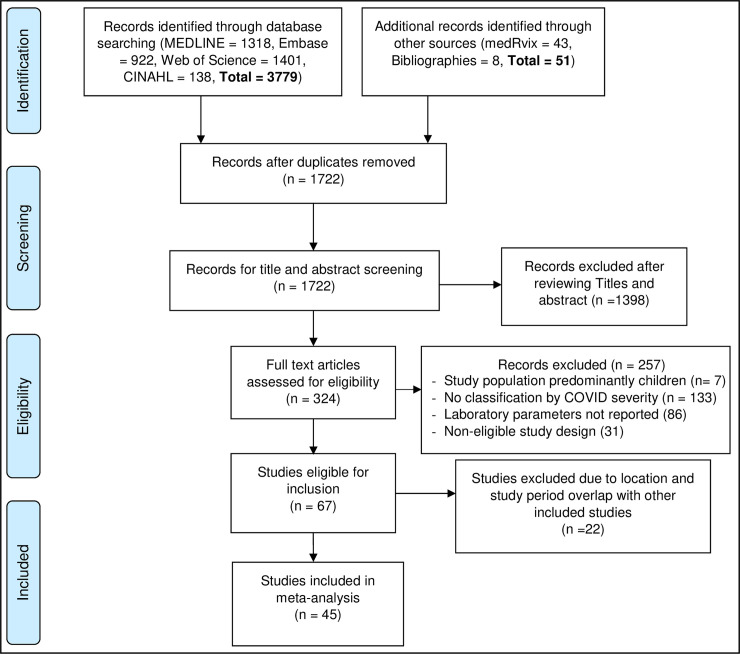
Methods and findings: We conducted a systematic search of MEDLINE, Embase, Web of Science, CINAHL and Google Scholar databases from 2019 through April 18, 2020, and reviewed bibliographies of eligible studies, relevant systematic reviews, and the medRxiv pre-print server. We included hospital-based observational studies reporting clinical laboratory parameters of confirmed cases of COVID-19 and excluded studies having large proportions (>10%) of children and pregnant women. Two authors independently carried out screening of articles, data extraction and quality assessment. Meta-analyses were done using random effects model. Meta-median difference (MMD) and 95% confidence interval (CI) was calculated for each laboratory parameter. Forty-five studies in 6 countries were included. Compared to non-severe COVID-19 cases, severe or critical COVID-19 was characterised by higher neutrophil count (MMD: 1.23 [95% CI: 0.58 to 1.88] ×109 cells/L), and lower lymphocyte, CD4 and CD8 T cell counts with MMD (95% CI) of -0.39 (-0.47, -0.31) ×109 cells/L, -204.9 (-302.6, -107.1) cells/μl and -123.6 (-170.6, -76.6) cells/μl, respectively. Other notable results were observed for C-reactive protein (MMD: 36.97 [95% CI: 27.58, 46.35] mg/L), interleukin-6 (MMD: 17.37 [95% CI: 4.74, 30.00] pg/ml), Troponin I (MMD: 0.01 [0.00, 0.02] ng/ml), and D-dimer (MMD: 0.65 [0.45, 0.85] mg/ml).
Conclusions: Relative to non-severe COVID-19, severe or critical COVID-19 is characterised by increased markers of innate immune response, decreased markers of adaptive immune response, and increased markers of tissue damage and major organ failure. These markers could be used to recognise severe or critical disease and to monitor clinical course of COVID-19.
Conflict of interest statement
The authors have declared that no competing interests exist.
Figures
References
Publication types
MeSH terms
Substances
LinkOut - more resources
Full Text Sources
Research Materials
Miscellaneous
