At the Heart of Neurological Dimensionality: Cross-Nosological and Multimodal Cardiac Interoceptive Deficits
- PMID: 33003072
- PMCID: PMC7647435
- DOI: 10.1097/PSY.0000000000000868
At the Heart of Neurological Dimensionality: Cross-Nosological and Multimodal Cardiac Interoceptive Deficits
Abstract
Objective: Neurological nosology, based on categorical systems, has largely ignored dimensional aspects of neurocognitive impairments. Transdiagnostic dimensional approaches of interoception (the sensing of visceral signals) may improve the descriptions of cross-pathological symptoms at behavioral, electrophysiological, and anatomical levels. Alterations of cardiac interoception (encompassing multidimensional variables such as accuracy, learning, sensibility, and awareness) and its neural correlates (electrophysiological markers, imaging-based anatomical and functional connectivity) have been proposed as critical across disparate neurological disorders. However, no study has examined the specific impact of neural (relative to autonomic) disturbances of cardiac interoception or their differential manifestations across neurological conditions.
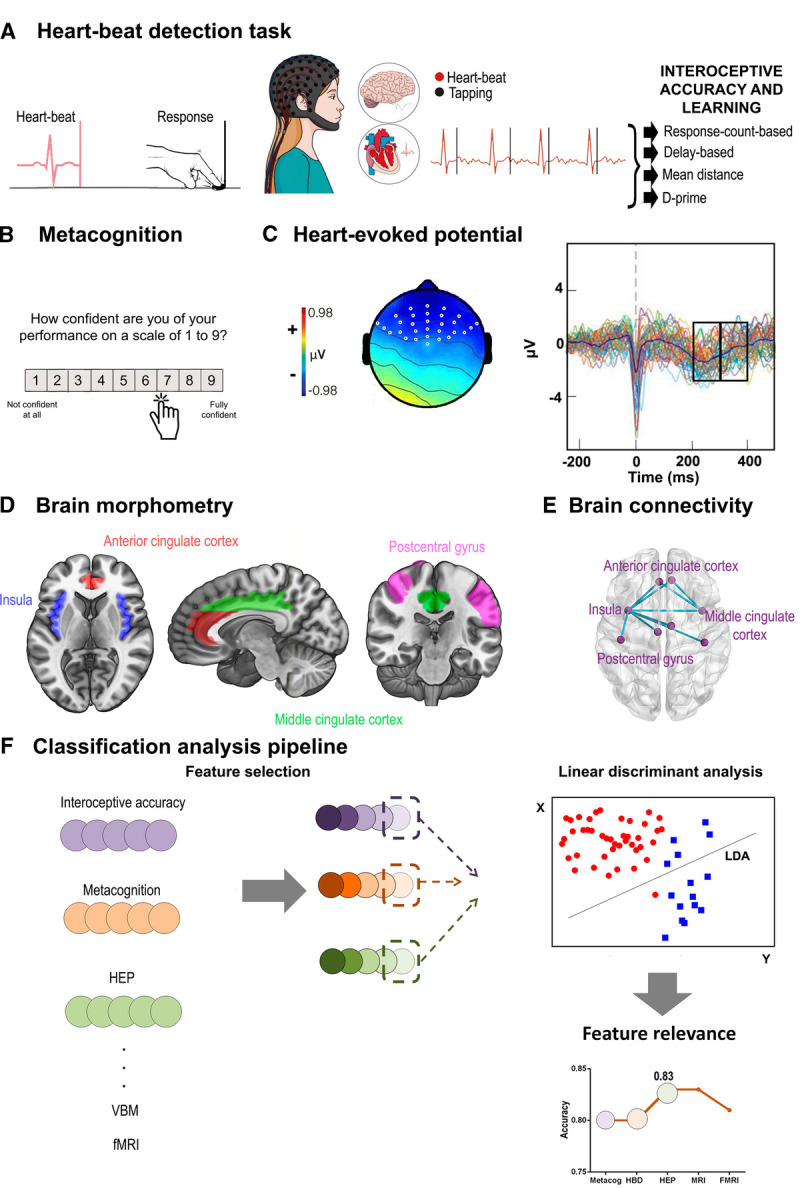
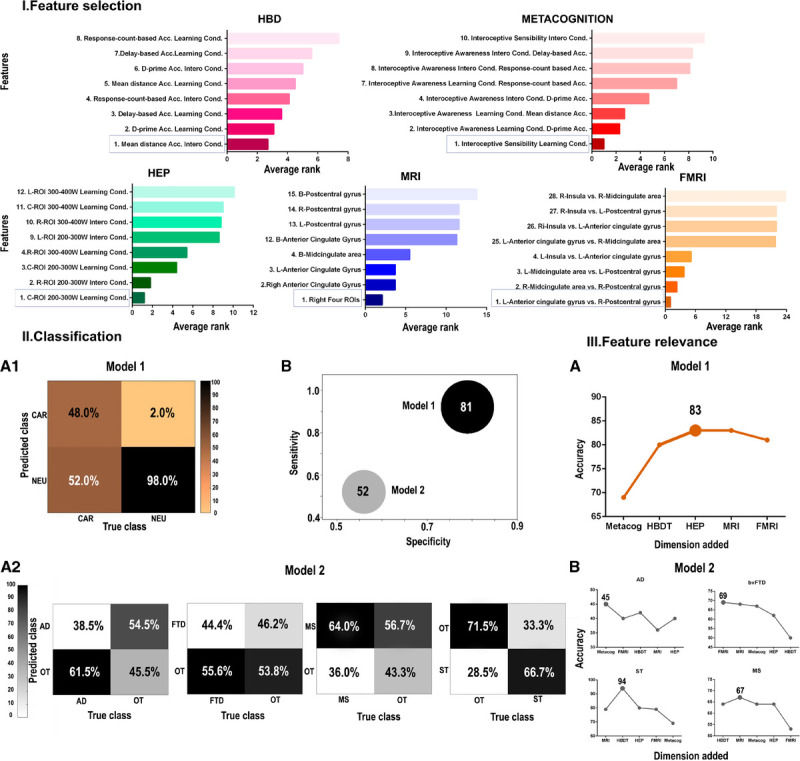
Methods: Here, we used a computational approach to classify and evaluate which markers of cardiac interoception (behavioral, metacognitive, electrophysiological, volumetric, or functional) offer the best discrimination between neurological conditions and cardiac (hypertensive) disease (model 1), and among neurological conditions (Alzheimer's disease, frontotemporal dementia, multiple sclerosis, and brain stroke; model 2). In total, the study comprised 52 neurological patients (mean [standard deviation] age = 55.1 [17.3] years; 37 women), 25 cardiac patients (age = 66.2 [9.1] years; 13 women), and 72 healthy controls (age = 52.65 [17.1] years; 50 women).
Results: Cardiac interoceptive outcomes successfully classified between neurological and cardiac conditions (model 1: >80% accuracy) but not among neurological conditions (model 2: 53% accuracy). Behavioral cardiac interoceptive alterations, although present in all conditions, were powerful in differentiating between neurological and cardiac diseases. However, among neurological conditions, cardiac interoceptive deficits presented more undifferentiated and unspecific disturbances across dimensions.
Conclusions: Our result suggests a diffuse pattern of interoceptive alterations across neurological conditions, highlighting their potential role as dimensional, transdiagnostic markers.
Figures
References
-
- Insel TR. The NIMH Research Domain Criteria (RDoC) Project: precision medicine for psychiatry. Am J Psychiatry 2014;171:395–7. - PubMed
-
- Insel T, Cuthbert B, Garvey M, Heinssen R, Pine DS, Quinn K, Sanislow C, Wang P. Research domain criteria (RDoC): toward a new classification framework for research on mental disorders. Am J Psychiatry 2010;167:748–51. - PubMed
-
- Kraemer HC, Noda A, O’Hara R. Categorical versus dimensional approaches to diagnosis: methodological challenges. J Psychiatr Res 2004;38:17–25. - PubMed
-
- Brugger P, Lenggenhager B. The bodily self and its disorders: neurological, psychological and social aspects. Curr Opin Neurol 2014;27:644–52. - PubMed
Publication types
MeSH terms
Grants and funding
LinkOut - more resources
Full Text Sources