Review
. 2020 Sep 29;8(10):389.
doi: 10.3390/biomedicines8100389.

Revisiting Traumatic Brain Injury: From Molecular Mechanisms to Therapeutic Interventions

Affiliations
Review

Revisiting Traumatic Brain Injury: From Molecular Mechanisms to Therapeutic Interventions

Abbas Jarrahi et al. Biomedicines. .

Abstract

Studying the complex molecular mechanisms involved in traumatic brain injury (TBI) is crucial for developing new therapies for TBI. Current treatments for TBI are primarily focused on patient stabilization and symptom mitigation. However, the field lacks defined therapies to prevent cell death, oxidative stress, and inflammatory cascades which lead to chronic pathology. Little can be done to treat the mechanical damage that occurs during the primary insult of a TBI; however, secondary injury mechanisms, such as inflammation, blood-brain barrier (BBB) breakdown, edema formation, excitotoxicity, oxidative stress, and cell death, can be targeted by therapeutic interventions. Elucidating the many mechanisms underlying secondary injury and studying targets of neuroprotective therapeutic agents is critical for developing new treatments. Therefore, we present a review on the molecular events following TBI from inflammation to programmed cell death and discuss current research and the latest therapeutic strategies to help understand TBI-mediated secondary injury.

Keywords: apoptosis; brain injury; edema; excitotoxicity; neuroinflammation; neurotrauma; oxidative stress; therapeutic strategies.


Conflict of interest statement

Authors declare no financial or competing conflict of interest. The funders had no role in the design of the study; in the collection, analyses, or interpretation of data; in the writing of the manuscript, or in the decision to publish the results.

Figures
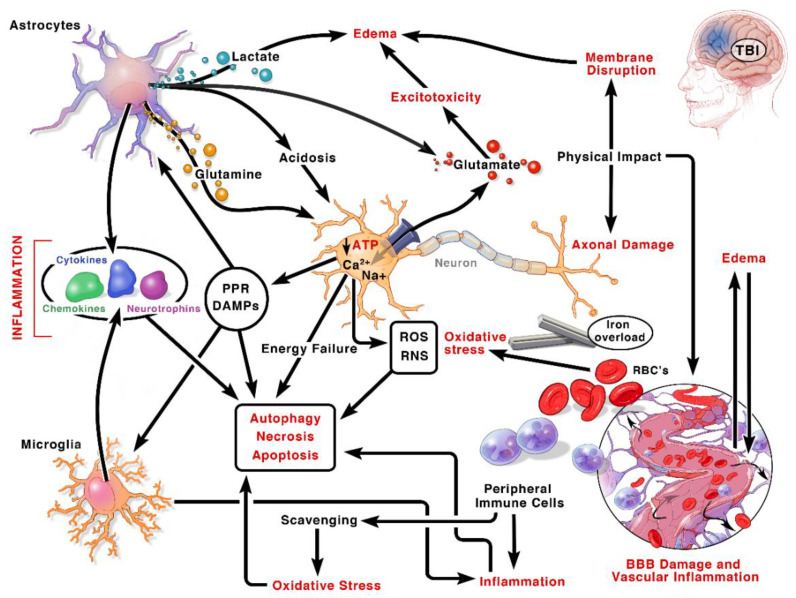
Figure 1
Figure 1
Pathophysiology of TBI. A schematic flow chart of the pathological changes after TBI that lead to acute and chronic neurovascular damage and immune activation. Immediately after the insult neurovascular damage occurs, and large amounts of DAMPs are released causing gliosis and peripheral immune cell infiltration. The initial function of these immune cells is to contain the injury and remove debris and dead cells. However, unregulated immune cells cause enhanced inflammation and injury progression. Furthermore, energy failure, oxidative stress, prolonged inflammation, and excitotoxicity lead to progressive injury with white matter damage and chronic behavioral deficits. Abbreviations: DAMP: Damage associated molecular patterns; PRR: Pattern recognition receptors; ROS: Reactive oxygen species; RNS: Reactive nitrogen species; RBC: Red blood cells; Na+: Sodium ion; Ca2+: Calcium ion; ATP: Adenosine triphosphate; TBI: Traumatic brain injury.
Figure 2
Figure 2
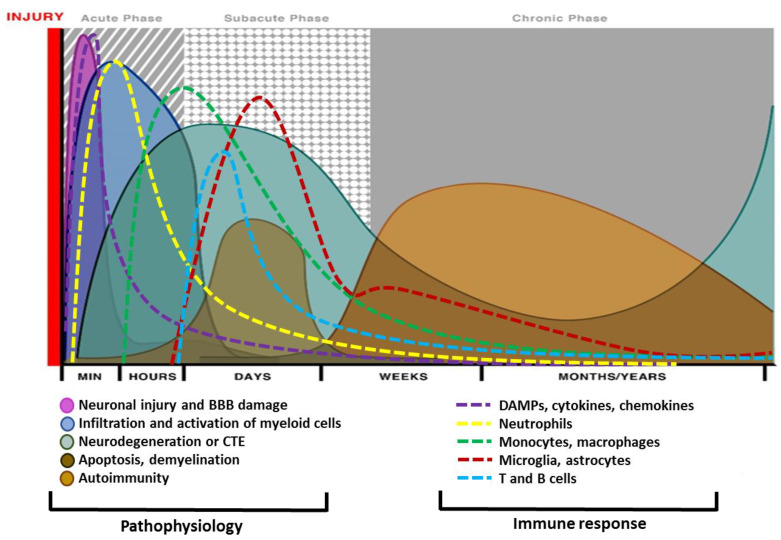
Different phases of traumatic brain injury (TBI) pathophysiology and relative immune response. Mechanical insult leads to acute neuronal injury and blood-brain barrier (BBB) damage, which initiates gliosis and glial injury minutes after TBI and continues for days after injury. Necrotic and apoptotic cell death start immediately after the insult and peak within h to days. Axonal shearing is another event that leads to demyelination and white matter injury. Neurodegeneration, traumatic encephalopathy, and axonal injury may sustain for years after a single TBI. Acute insult and neurovascular damage lead to myeloid accumulation and recruitment of T-cells that last for years and may cause chronic neurodegeneration and neuropathology. Immune cells respond to trauma in a timely manner and a differential pattern of activations has been observed by various studies. An impact to the head leads to cellular damage and results in the rapid release of damage-associated molecular patterns (DAMPs). DAMPs stimulate local cells to release inflammatory mediators such as cytokines and chemokines. These mediators recruit myeloid cells specifically neutrophils as first responders, which phagocytize debris and damaged cells promoting the containment of the injury site. As neutrophil numbers begin to decline, infiltrated monocytes and glia get activated and accumulate around the site of injury to perform further phagocytic or repair functions. Depending on the severity of the brain injury, myeloid cells can recruit T and B cells. T and B cells appear at the sites of brain pathology at later time points in the response (3–7 days post-injury) and may persist for weeks to months. Other abbreviation is as CTE: Chronic traumatic encephalopathy.

References

    1. Dewan M.C., Rattani A., Gupta S., Baticulon R.E., Hung Y.C., Punchak M., Agrawal A., Adeleye A.O., Shrime M.G., Rubiano A.M., et al. Estimating the global incidence of traumatic brain injury. J. Neurosurg. 2018 doi: 10.3171/2017.10.JNS17352. - DOI - PubMed
    1. Hutchinson P.J., O’Connell M.T., Rothwell N.J., Hopkins S.J., Nortje J., Carpenter K.L., Timofeev I., Al-Rawi P.G., Menon D.K., Pickard J.D. Inflammation in human brain injury: Intracerebral concentrations of IL-1alpha, IL-1beta, and their endogenous inhibitor IL-1ra. J. Neurotrauma. 2007;24:1545–1557. doi: 10.1089/neu.2007.0295. - DOI - PubMed
    1. Langlois J.A., Rutland-Brown W., Thomas K.E. Traumatic Brain Injury in the United States: Emergency Department Visits, Hospitalizations, and Deaths. [(accessed on 1 September 2020)]; Available online: http://www.ncdsv.org/images/CDC_TBIintheUSEDVisitsHospitalizationsAndDea....
    1. Teasdale G., Jennett B. Assessment of coma and impaired consciousness. A practical scale. Lancet (Lond. Engl.) 1974;2:81–84. doi: 10.1016/S0140-6736(74)91639-0. - DOI - PubMed
    1. Wijdicks E.F., Bamlet W.R., Maramattom B.V., Manno E.M., McClelland R.L. Validation of a new coma scale: The FOUR score. Ann. Neurol. 2005;58:585–593. doi: 10.1002/ana.20611. - DOI - PubMed

LinkOut - more resources