Review
. 2020 Sep 29;12(10):2797.
doi: 10.3390/cancers12102797.

Role of Oral Bacteria in the Development of Oral Squamous Cell Carcinoma

Affiliations
Review

Role of Oral Bacteria in the Development of Oral Squamous Cell Carcinoma

Qinyang Li et al. Cancers (Basel). .

Abstract

Oral squamous cell carcinoma (OSCC) is an invasive epithelial neoplasm that is influenced by various risk factors, with a low survival rate and an increasing death rate. In the past few years, with the verification of the close relationship between different types of cancers and the microbiome, research has focused on the compositional changes of oral bacteria and their role in OSCC. Generally, oral bacteria can participate in OSCC development by promoting cell proliferation and angiogenesis, influencing normal apoptosis, facilitating invasion and metastasis, and assisting cancer stem cells. The study findings on the association between oral bacteria and OSCC may provide new insight into methods for early diagnosis and treatment development.

Keywords: Oral squamous cell carcinoma; inflammation; oral bacteria.


Conflict of interest statement

The authors declare no conflict of interest.

Figures
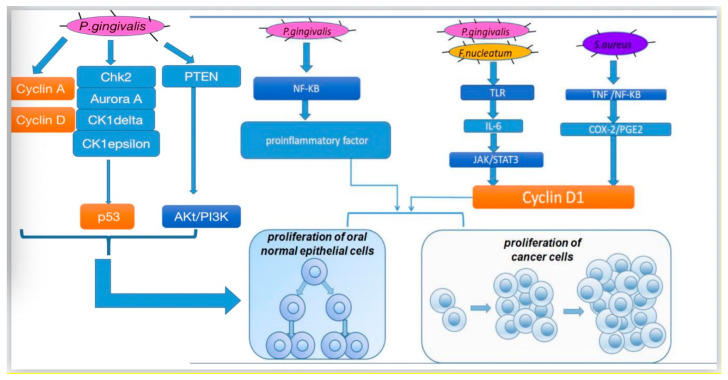
Figure 1
Figure 1
Mechanisms for how oral bacteria promote cell proliferation.
Figure 2
Figure 2
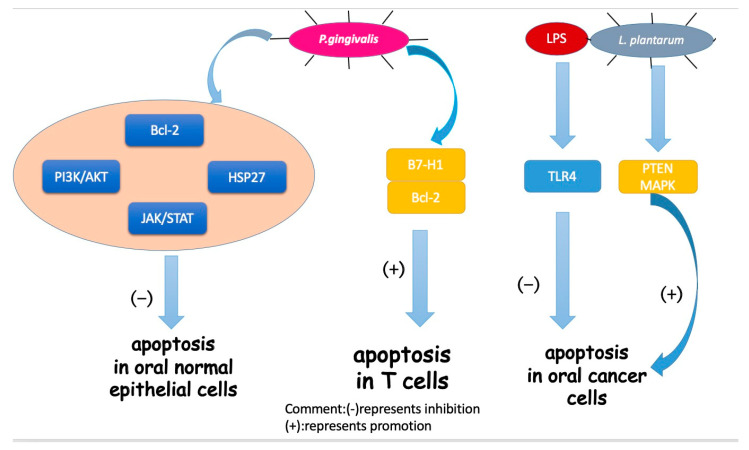
Mechanisms for how oral bacteria influence cell apoptosis.
Figure 3
Figure 3
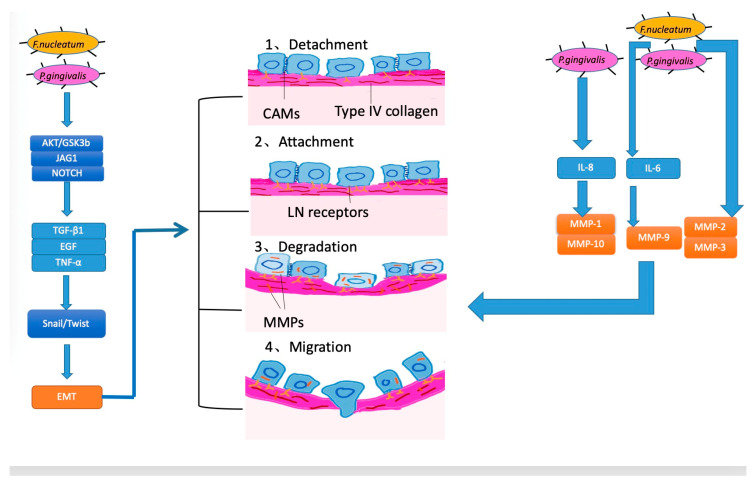
Mechanisms for how oral bacteria promote invasion and metastasis.
Figure 4
Figure 4
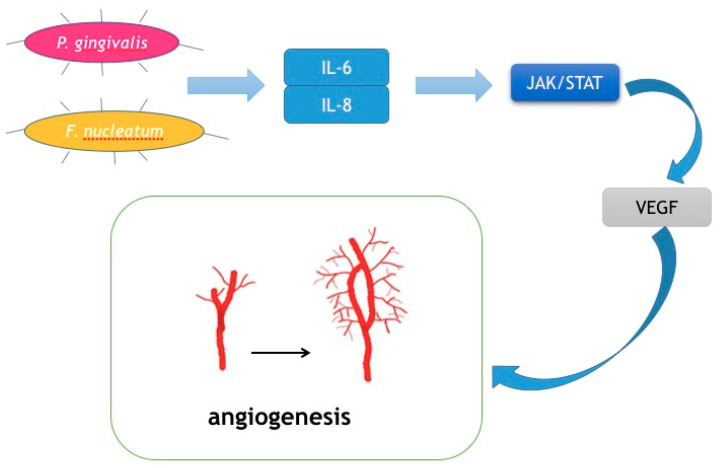
Mechanism for how oral bacteria stimulate angiogenesis.

References

    1. Warnakulasuriya S. Global epidemiology of oral and oropharyngeal cancer. Oral Oncol. 2009;45:309–316. doi: 10.1016/j.oraloncology.2008.06.002. - DOI - PubMed
    1. Seethala R.R. Update from the 4th Edition of the World Health Organization Classification of Head and Neck Tumours: Preface. Head Neck Pathol. 2017;11:1–2. doi: 10.1007/s12105-017-0785-2. - DOI - PMC - PubMed
    1. Ali J., Sabiha B., Jan H.U., Haider S.A., Khan A.A., Ali S.S. Genetic etiology of oral cancer. Oral Oncol. 2017;70:23–28. doi: 10.1016/j.oraloncology.2017.05.004. - DOI - PubMed
    1. Thomson P.J., Potten C.S., Appleton D.R. Mapping dynamic epithelial cell proliferative activity within the oral cavity of man: A new insight into carcinogenesis? Br. J. Oral Maxillofac. Surg. 1999;37:377–383. doi: 10.1054/bjom.1999.0130. - DOI - PubMed
    1. Goodson M.L., Sloan P., Robinson C.M., Cocks K., Thomson P.J. Oral precursor lesions and malignant transformation—Who, where, what, and when? Br. J. Oral Maxillofac. Surg. 2015;53:831–835. doi: 10.1016/j.bjoms.2015.08.268. - DOI - PubMed

LinkOut - more resources