Review
. 2020 Sep 29;9(10):935.
doi: 10.3390/antiox9100935.

Cardiovascular and Metabolic Protection by Vitamin E: A Matter of Treatment Strategy?

Affiliations
Review

Cardiovascular and Metabolic Protection by Vitamin E: A Matter of Treatment Strategy?

Melanie Ziegler et al. Antioxidants (Basel). .

Abstract

Cardiovascular diseases (CVD) cause about 1/3 of global deaths. Therefore, new strategies for the prevention and treatment of cardiovascular events are highly sought-after. Vitamin E is known for significant antioxidative and anti-inflammatory properties, and has been studied in the prevention of CVD, supported by findings that vitamin E deficiency is associated with increased risk of cardiovascular events. However, randomized controlled trials in humans reveal conflicting and ultimately disappointing results regarding the reduction of cardiovascular events with vitamin E supplementation. As we discuss in detail, this outcome is strongly affected by study design, cohort selection, co-morbidities, genetic variations, age, and gender. For effective chronic primary and secondary prevention by vitamin E, oxidative and inflammatory status might not have been sufficiently antagonized. In contrast, acute administration of vitamin E may be more translatable into positive clinical outcomes. In patients with myocardial infarction (MI), which is associated with severe oxidative and inflammatory reactions, decreased plasma levels of vitamin E have been found. The offsetting of this acute vitamin E deficiency via short-term treatment in MI has shown promising results, and, thus, acute medication, rather than chronic supplementation, with vitamin E might revitalize vitamin E therapy and even provide positive clinical outcomes.

Keywords: cardiovascular disease; myocardial infarction; risk factors; treatment strategy; vitamin E.


Conflict of interest statement

The authors declare no conflict of interest.

Figures
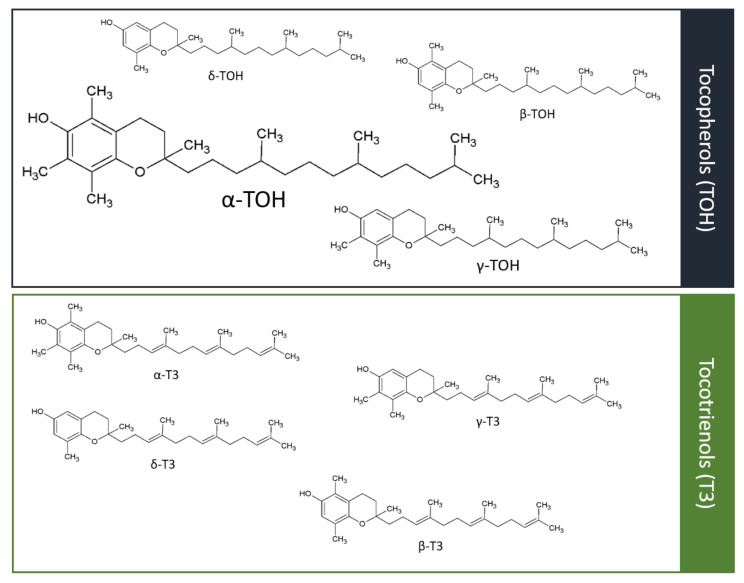
Figure 1
Figure 1
Different forms of vitamin E. The vitamin E group consists of eight different forms, α-, β-, γ-, δ-tocopherol (TOH) and their respective tocotrienols (T3), α-TOH being the most prominent form in human nutrition and in the human body. Other forms of vitamin E, such as tocomonoenols, are known, but are not relevant in human nutrition, and are therefore not addressed in this review.
Figure 2
Figure 2
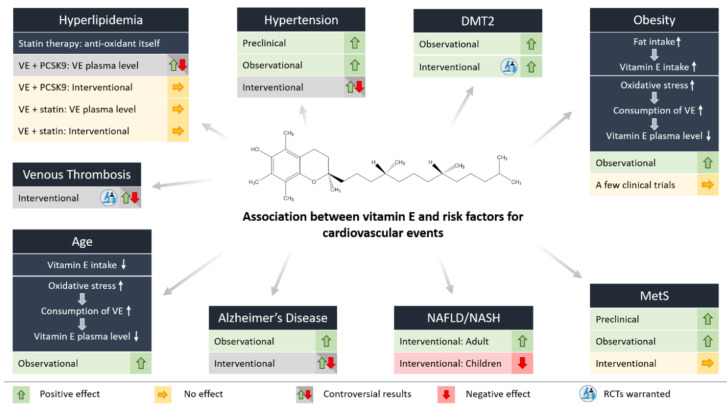
Association between vitamin E and risk factors for cardiovascular events. Correlations between vitamin E plasma level and effects of vitamin E supplementation on single risk factors for cardiovascular events are shown. Risk factors presented here are either dependent (hyperlipidemia, diabetes mellitus type 2 (DMT2), obesity, age, Alzheimer’s disease, non-alcoholic fatty liver disease (NAFLD), non-alcoholic steatohepatitis (NASH), metabolic syndrome (MetS)) or independent (hypertension, venous thrombosis) of oxidative processes and inflammation. Most of the risk factors are positively affected by vitamin E, showing the beneficial potential of vitamin E in cardiovascular events. However, randomized clinical trials have revealed controversial results or no effect. Abbreviations used in the figure: vitamin E, VE.
Figure 3
Figure 3
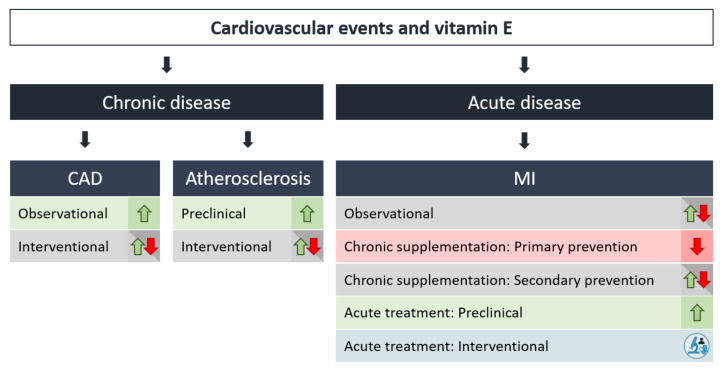
Correlation of plasma level and supplementation of vitamin E with incidence of cardiovascular events. Relevance of vitamin E to the risk of cardiovascular diseases (CVD) depends on the inflammation grade resulting from chronic and acute cardiovascular events. Increased vitamin E plasma levels correlate with decreased risk of chronic CVD, ischemic heart disease (IHD), and atherosclerosis, whereas supplementation of vitamin E has revealed controversial results. In acute cardiovascular events, such as myocardial infarction (MI), acute treatment of vitamin E is most promising in balancing a deficiency of antioxidants. Abbreviations used in the figure: vitamin E, VE.
Figure 4
Figure 4
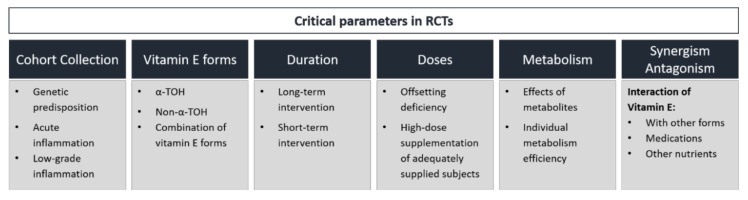
Critical parameters in randomized controlled trials (RCTs) investigating beneficial effects of vitamin E supplementation on CVD. Vitamin E is the most prominent lipid-soluble antioxidant additionally possessing anti-inflammatory capacity. However, in randomized controlled trials (RCTs) supplementation of vitamin E has revealed controversial effects on the risk of cardiovascular events. The reasons for these findings are diverse. The most common reasons discussed are: cohort selection, the form of vitamin E used for treatment and the treatment durations and doses of vitamin E, the relevance of hepatically formed metabolites, and the synergistic or antagonistic effects of different vitamin E forms on each other or on nutritional factors and medications.

References

    1. Libby P., Ridker P.M., Maseri A. Inflammation and atherosclerosis. Circulation. 2002;105:1135–1143. doi: 10.1161/hc0902.104353. - DOI - PubMed
    1. Marchio P., Guerra-Ojeda S., Vila J.M., Aldasoro M., Victor V.M., Mauricio M.D. Targeting early atherosclerosis: A focus on oxidative stress and inflammation. Oxid. Med. Cell. Longev. 2019;2019:1–32. doi: 10.1155/2019/8563845. - DOI - PMC - PubMed
    1. Baratchi S., Khoshmanesh K., Woodman O.L., Potocnik S., Peter K., McIntyre P. Molecular sensors of blood flow in endothelial cells. Trends Mol. Med. 2017;23:850–868. doi: 10.1016/j.molmed.2017.07.007. - DOI - PubMed
    1. Halliwell B. Biochemistry of oxidative stress. Biochem. Soc. Trans. 2007;35:1147–1150. doi: 10.1042/BST0351147. - DOI - PubMed
    1. Murr C., Winklhofer-Roob B.M., Schroecksnadel K., Maritschnegg M., Mangge H., Böhm B.O., Winkelmann B.R., März W., Fuchs D. Inverse association between serum concentrations of neopterin and antioxidants in patients with and without angiographic coronary artery disease. Atherosclerosis. 2009;202:543–549. doi: 10.1016/j.atherosclerosis.2008.04.047. - DOI - PubMed