Review
. 2020 Sep 29;9(10):936.
doi: 10.3390/antiox9100936.

Oxidative Stress and Inflammation in COVID-19-Associated Sepsis: The Potential Role of Anti-Oxidant Therapy in Avoiding Disease Progression

Affiliations
Review

Oxidative Stress and Inflammation in COVID-19-Associated Sepsis: The Potential Role of Anti-Oxidant Therapy in Avoiding Disease Progression

Jesús Beltrán-García et al. Antioxidants (Basel). .

Abstract

Since the severe acute respiratory syndrome coronavirus 2 (SARS-CoV-2) outbreak emerged, countless efforts are being made worldwide to understand the molecular mechanisms underlying the coronavirus disease 2019 (COVID-19) in an attempt to identify the specific clinical characteristics of critically ill COVID-19 patients involved in its pathogenesis and provide therapeutic alternatives to minimize COVID-19 severity. Recently, COVID-19 has been closely related to sepsis, which suggests that most deceases in intensive care units (ICU) may be a direct consequence of SARS-CoV-2 infection-induced sepsis. Understanding oxidative stress and the molecular inflammation mechanisms contributing to COVID-19 progression to severe phenotypes such as sepsis is a current clinical need in the effort to improve therapies in SARS-CoV-2 infected patients. This article aims to review the molecular pathogenesis of SARS-CoV-2 and its relationship with oxidative stress and inflammation, which can contribute to sepsis progression. We also provide an overview of potential antioxidant therapies and active clinical trials that might prevent disease progression or reduce its severity.

Keywords: ACE2; NETosis; SARS-CoV-2; cytokine storm; pyroptosis; sepsis.


Conflict of interest statement

The authors declare no conflict of interest.

Figures
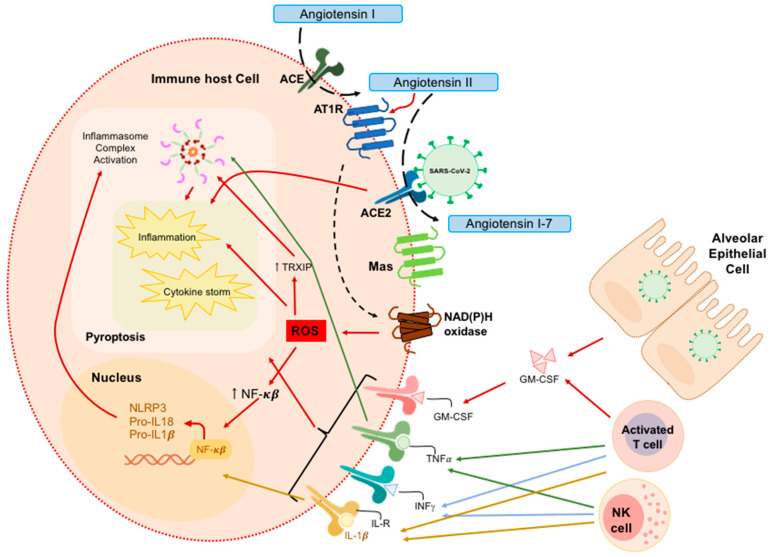
Figure 1
Figure 1
Molecular pathogenesis of SARS-CoV-2. SARS-CoV-2 virus can bind to specific receptors in host cells, such as alveolar epithelial cells or immune cells, by mediating an inflammatory cascade through inflammasome activation, usually through NLRP3, and by damaging, or even killing, host cells. Immune host cells, like macrophages and monocytes, are activated by the virus on a direct or indirect pathway, and contribute to the host response by causing inflammation and a cytokine storm. Other immune cells, such as NK cells and T-cells, can contribute to the immune response. On the other hand, Ang II is processed by ACE2 into Ang I-7. Ang II contributes to ROS production in an NAD(P)H-dependent mechanism thanks to the ACE2–Ang-(1–7)–Mas axis. AT1R mediates the production of ROS through a mechanism dependent on NADH and NADPH oxidases. ROS contributes to nuclear factor-kB (NF-κB) and TXNIP overexpression. NF-κB increases the expression of NLRP3, pro-IL-18, and pro-IL-1β whilst TXNIP modulates the structure of NLRP3, thereby allowing NLRP3 inflammasome assembly and facilitating pro-caspase-1 (pro-casp-1) autocleavage. Arrows denote activation. ACE2: angiotensin-converting enzyme 2; GM-CSF: Granulocyte-macrophage colony-stimulating factor; TNF: Tumor Necrosis Factor; INFγ: Interferon gamma; IL-R: Interleukin Receptor; AT1R: Angiotensin type 1; NADPH oxidase: nicotinamide adenine dinucleotide phosphate oxidase; ROS: reactive oxygen species. TXNIP: thioredoxin interacting/inhibiting protein. This figure is adapted from the work of Merad et al. [33].
Figure 2
Figure 2
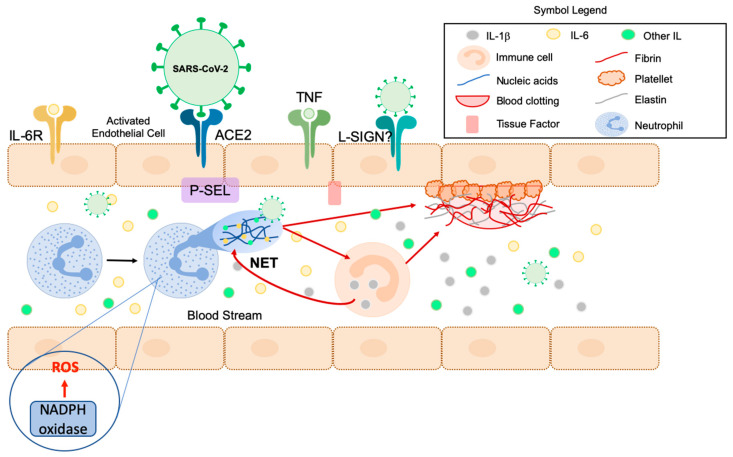
NETosis activated by SARS-CoV-2. SARS-CoV-2 and cytokines activate endothelial cells, which are able to produce adhesion molecules (e.g., P-SEL) and recruit neutrophils, which release NETs composed of nucleic acids, histones, and other proteins. NETs can bind to the SARS-CoV-2 present in the bloodstream and neutralize it. NETs can induce different immune cells to secrete IL-1β, which enhances NET formation in several diseases by providing positive feedback and accelerating thrombus formation. In addition, NADPH oxidase can produce ROS which activates NETosis. At the same time, the IL-6 receptor binds to IL-6, which enters the bloodstream and interacts with NETs. IL-1β is able to induce IL-6 expression which, in turn, is able to induce fibrinogen expression by increasing fibrin release. The virus’ endothelial damage can expose a tissue factor in activated endothelial cells capable of stimulating the coagulation pathway, which consists in fibrin deposition and blood clotting. At the same time, NETs also activate the coagulation contact pathway and bind activated platelets to contribute to amplify blood clotting. ACE2: angiotensin-converting enzyme 2; TNF: tumor necrosis factor; NET: neutrophil extracellular trap; IL-6R: Interleukin 6 receptor; P-SEL: P-Selectin. This figure is adapted from the work of Merad et al. [33].

References

    1. Lippi G., Sanchis-Gomar F., Henry B.M. Coronavirus disease 2019 (COVID-19): The portrait of a perfect storm. Ann. Transl. Med. 2020;8:497. doi: 10.21037/atm.2020.03.157. - DOI - PMC - PubMed
    1. Adhanom Ghebreyesus T. Alocución de apertura del Director General de la OMS en la rueda de prensa sobre la COVID-19 celebrada el 11 de marzo de 2020. [(accessed on 11 March 2020)]; Available online: https://www.who.int/es/dg/speeches/detail/who-director-general-s-opening....
    1. World Health Organization . Coronavirus disease (COVID-19) Situation Report–108. WHO; Geneva, Switzerland: 2020.
    1. Beltrán-García J., Osca-Verdegal R., Pallardó F.V., Ferreres J., Rodríguez M., Mulet S., Ferrando-Sánchez C., Carbonell N., García-Giménez J.L. Sepsis and Coronavirus Disease 2019. Crit. Care Med. 2020 doi: 10.1097/CCM.0000000000004625. in press. - DOI - PMC - PubMed
    1. Li H., Liu L., Zhang D., Xu J., Dai H., Tang N., Su X., Cao B. SARS-CoV-2 and viral sepsis: Observations and hypotheses. Lancet. 2020;2019:8–11. doi: 10.1016/S0140-6736(20)30920-X. - DOI - PMC - PubMed

LinkOut - more resources