Review
. 2020 Sep 29;9(10):937.
doi: 10.3390/antiox9100937.

Royal Jelly as an Intelligent Anti-Aging Agent-A Focus on Cognitive Aging and Alzheimer's Disease: A Review

Affiliations
Review

Royal Jelly as an Intelligent Anti-Aging Agent-A Focus on Cognitive Aging and Alzheimer's Disease: A Review

Amira Mohammed Ali et al. Antioxidants (Basel). .

Abstract

The astronomical increase of the world's aged population is associated with the increased prevalence of neurodegenerative diseases, heightened disability, and extremely high costs of care. Alzheimer's Disease (AD) is a widespread, age-related, multifactorial neurodegenerative disease that has enormous social and financial drawbacks worldwide. The unsatisfactory outcomes of available AD pharmacotherapy necessitate the search for alternative natural resources that can target various the underlying mechanisms of AD pathology and reduce disease occurrence and/or progression. Royal jelly (RJ) is the main food of bee queens; it contributes to their fertility, long lifespan, and memory performance. It represents a potent nutraceutical with various pharmacological properties, and has been used in a number of preclinical studies to target AD and age-related cognitive deterioration. To understand the mechanisms through which RJ affects cognitive performance both in natural aging and AD, we reviewed the literature, elaborating on the metabolic, molecular, and cellular mechanisms that mediate its anti-AD effects. Preclinical findings revealed that RJ acts as a multidomain cognitive enhancer that can restore cognitive performance in aged and AD models. It promotes brain cell survival and function by targeting multiple adversities in the neuronal microenvironment such as inflammation, oxidative stress, mitochondrial alterations, impaired proteostasis, amyloid-β toxicity, Ca excitotoxicity, and bioenergetic challenges. Human trials using RJ in AD are limited in quantity and quality. Here, the limitations of RJ-based treatment strategies are discussed, and directions for future studies examining the effect of RJ in cognitively impaired subjects are noted.

Keywords: Alzheimer’s Disease; aging; alternative therapy; amyloid-β; apitherapy; cognitive impairment; dementia; gut-brain axis; mitochondrial dysfunction; neurodegenerative disorders; neuroinflammation; oxidative stress; royal jelly.


Conflict of interest statement

The authors declare no conflict of interest.

Figures
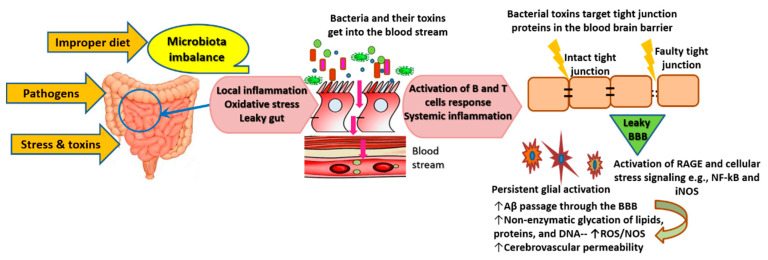
Figure 1
Figure 1
Contribution of disrupted microbiota to the permeability of the blood brain barrier and neuroinflammation in Alzheimer’s disease. Abbreviations: ↑ denotes increase, BBB: blood brain barrier, RAGE: receptor for advanced glycation end products, NF-κB: nuclear factor-kappa B, iNOS: inducible nitric oxide synthase, Aβ: beta-amyloid protein fragments, ROS: reactive oxygen species, NOS: nitric oxide species.
Figure 2
Figure 2
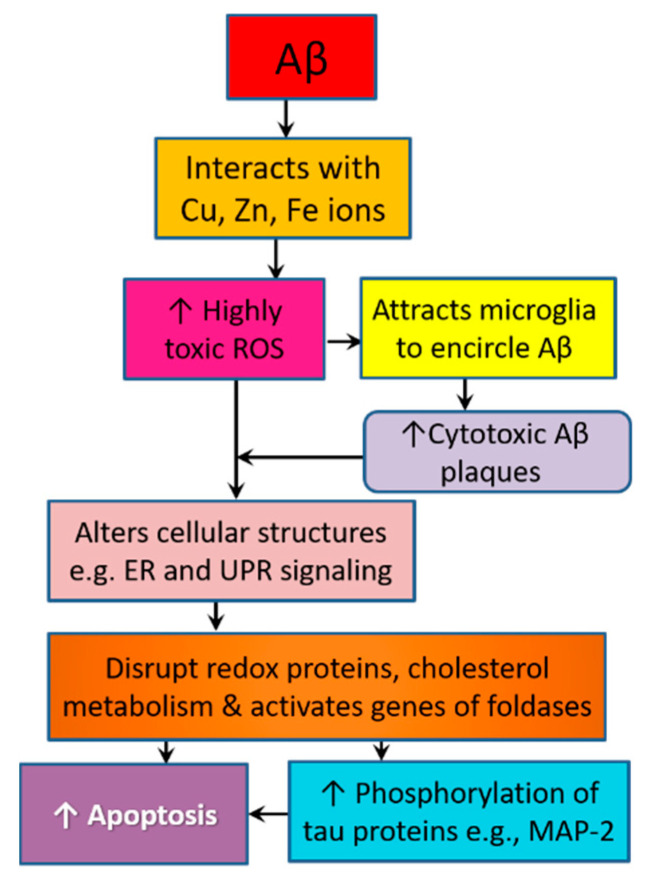
Beta-amyloid protein fragments induce multiple molecular and cellular changes that promote neurodegeneration. Abbreviations: ↑ denotes increase, Aβ: beta-amyloid protein fragments, ROS: reactive oxygen species, ER: endoplasmic reticulum, UPR: unfolded protein response, MAP-2: microtubule-associated protein 2. Aβ pathology contributes to various molecular and cellular changes that induce neuronal death.
Figure 3
Figure 3
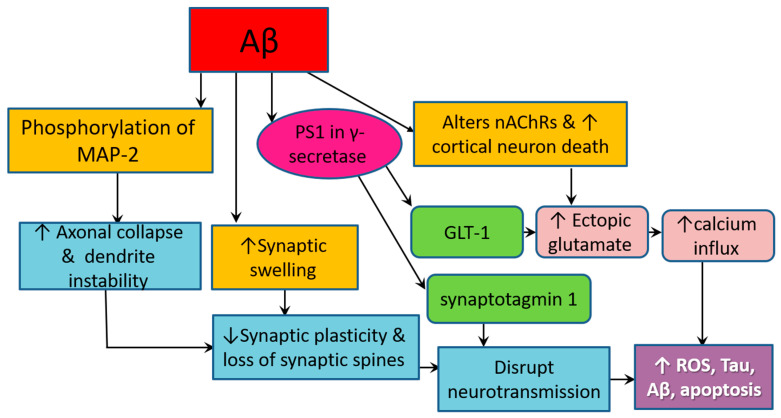
Schematic illustration of the mechanism underlying synaptic destruction by beta-amyloid peptide (Aβ). Abbreviations: ↑ denotes increase, ↓ denotes decrease, Aβ: beta-amyloid protein fragments, MAP-2: microtubule-associated protein 2, PS1: presenilin 1, nAChRs: nicotinic acetylcholine receptors, GLT-1: glutamate transporter 1, ROS: reactive oxygen species. Aβ pathology contributes to synaptic destruction, which promotes neuronal apoptosis through various mechanisms.
Figure 4
Figure 4
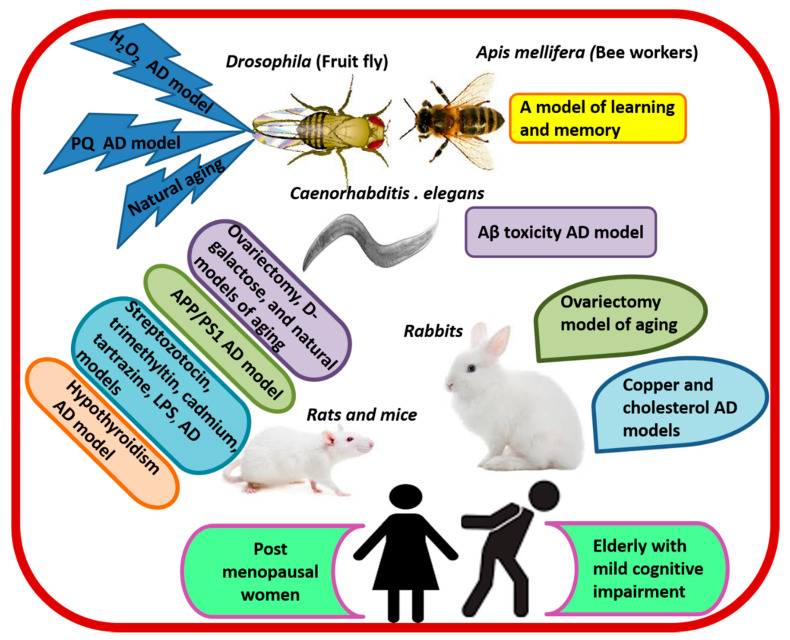
Royal jelly improves cognitive function-related parameters in various animal models and in humans. Abbreviations: AD: Alzheimer’s disease, PQ: paraquat, H2O2: hydrogen peroxide, Aβ: beta-amyloid peptide, APP/PS1 mice express 2 mutations associated with early-onset AD—chimeric mouse/human APP (Mo/HuAPP695swe) and human PS1 (PS1-dE9), LPS: lipopolysaccharide.
Figure 5
Figure 5
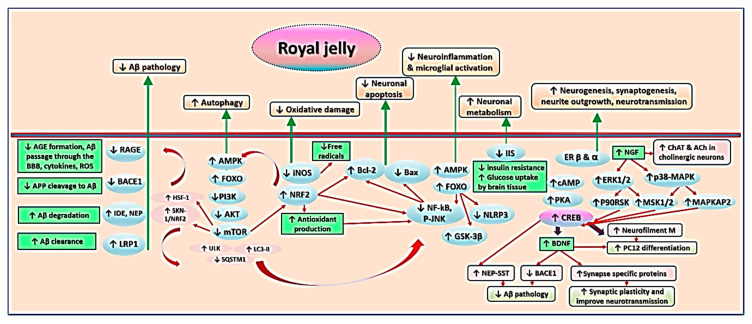
Possible mechanisms of action behind royal jelly-related effects in cognitive aging and Alzheimer’s disease. Abbreviations: ↑ denotes increase, ↓ denotes decrease, Aβ: beta-amyloid protein fragments, RAGE: receptor for advanced glycation end products, BBB: blood brain barrier, ROS: reactive oxygen species, APP: amyloid precursor protein, BACE1: beta-site APP cleaving enzyme 1, IDE: insulin-degrading enzyme, NEP: neprilysin, SST: somatostatin, LRP-1: low density lipoprotein) receptor-related protein 1, iNOS: inducible nitric oxide synthase, NRF2: nuclear factor-erythroid 2-related factor 2, AMPK: AMP-activated protein kinase, FOXO: Forkhead Box O transcription factor, HSF-1: heat shock transcription factor 1, PI3K: phosphatidylinositol 3-kinase, PKA: cAMP-dependent protein kinase, cAMP: cyclic adenosine mono phosphate, CREB: cAMP-response element (CRE)-binding protein, mTOR: mammalian target of rapamycin, ULK: Unc-51-like kinase, LC3-II: microtubule-associated protein 1 light chain 3-II, SQSTM1: sequestosome 1, Bcl-2: B-cell lymphoma-2, Bax: Bcl-2-associated X protein, NF-κB: nuclear factor-kappa B, JNK: c-Jun NH2-terminal kinases, NLRP3: nucleotide-binding domain and leucine-rich repeat containing protein 3, GSK-3β: glycogen synthase kinase-3β, IIS: insulin/insulin-like growth factor, ER β and α: estrogen receptors β and α, MAPK: mitogen-activated protein kinase, ERK1/2: extracellular signal-regulated kinase 1 or 2, NGF: nerve growth factor, ACh: acetylcholine, ChAT: choline acetyltransferase, BDNF: brain derived neurotrophic factor, p90RSK: pp90 ribosomal S6 kinase, MSK1/2 and MAPKAP: mitogen- and stress-activated protein kinase and kinase 2, PC12: progenitor stem cells.

References

    1. Tobore T.O. On the etiopathogenesis and pathophysiology of Alzheimer’s disease: A comprehensive theoretical review. J. Alzheimers Dis. 2019;68:417–437. doi: 10.3233/JAD-181052. - DOI - PubMed
    1. Miljkovic N., Lim J.Y., Miljkovic I., Frontera W.R. Aging of skeletal muscle fibers. Ann. Rehabil. Med. 2015;39:155–162. doi: 10.5535/arm.2015.39.2.155. - DOI - PMC - PubMed
    1. Niraula A., Sheridan J.F., Godbout J.P. Microglia priming with aging and stress. Neuropsychopharmacology. 2017;42:318–333. doi: 10.1038/npp.2016.185. - DOI - PMC - PubMed
    1. De Nobrega A.K., Lyons L.C. Aging and the clock: Perspective from flies to humans. Eur. J. Neurosci. 2018 doi: 10.1111/ejn.14176. - DOI - PMC - PubMed
    1. Budni J., Bellettini-Santos T., Mina F., Garcez M.L., Zugno A.I. The involvement of BDNF, NGF and GDNF in aging and Alzheimer’s disease. Aging Dis. 2015;6:331–341. doi: 10.14336/AD.2015.0825. - DOI - PMC - PubMed

LinkOut - more resources