


Analysis of Serum miRNA in Glioblastoma Patients: CD44-Based Enrichment of Extracellular Vesicles Enhances Specificity for the Prognostic Signature
- PMID: 33003586
- PMCID: PMC7583802
- DOI: 10.3390/ijms21197211
Analysis of Serum miRNA in Glioblastoma Patients: CD44-Based Enrichment of Extracellular Vesicles Enhances Specificity for the Prognostic Signature
Abstract
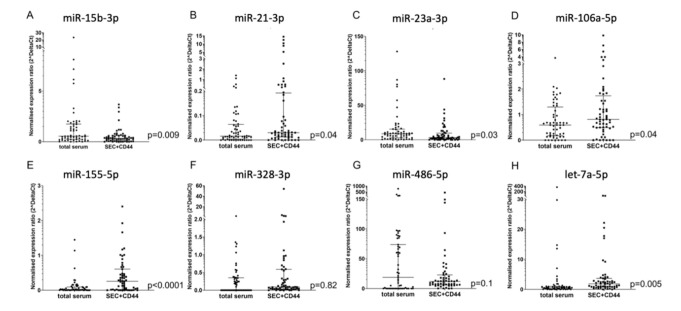
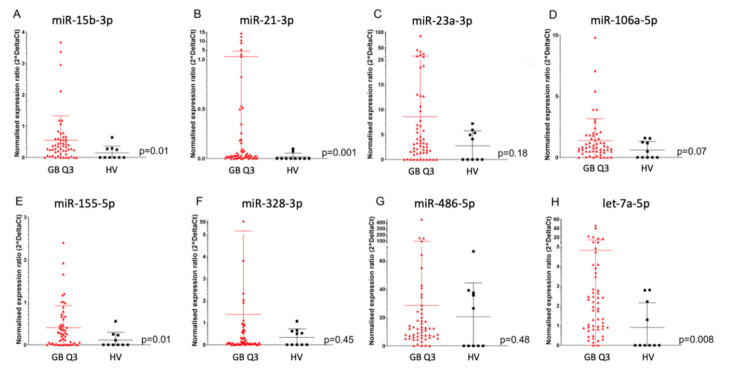
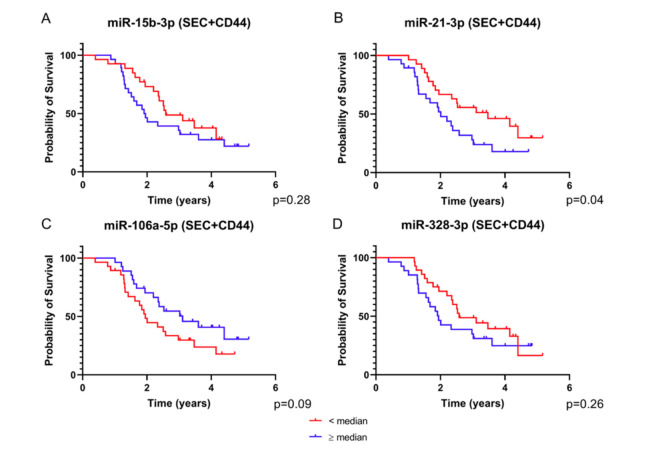
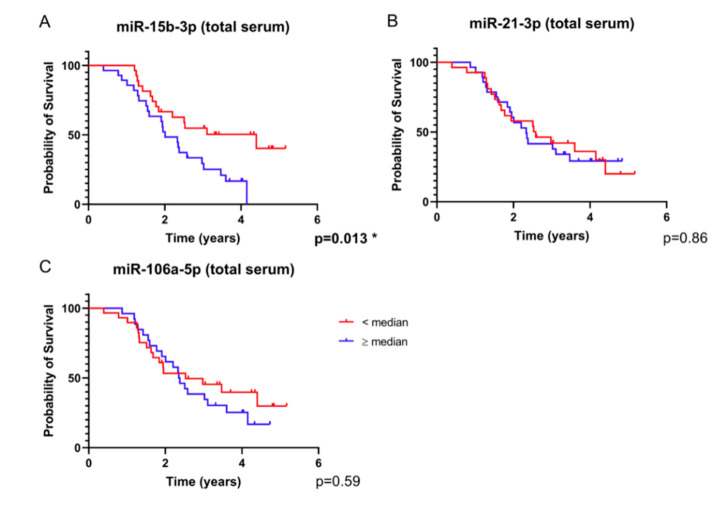
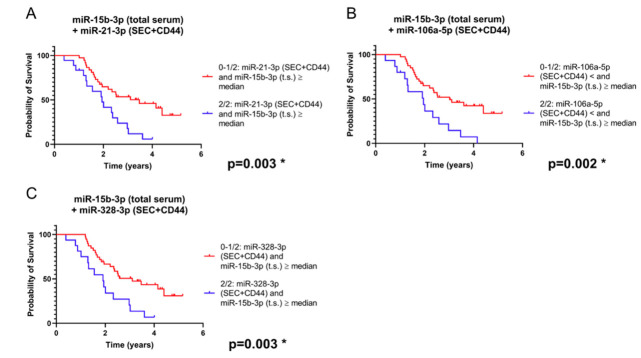
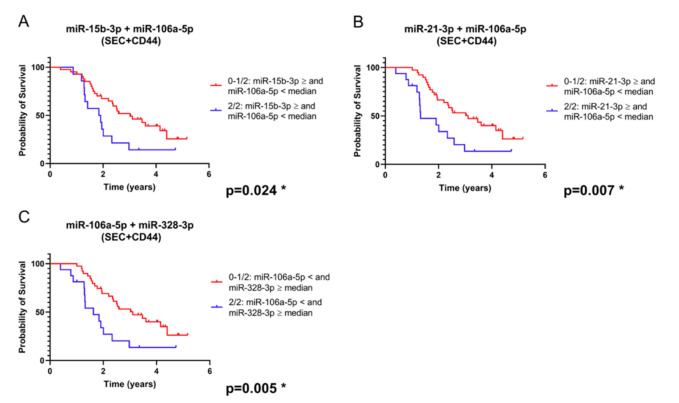
Glioblastoma is a devastating disease, for which biomarkers allowing a prediction of prognosis are urgently needed. microRNAs have been described as potentially valuable biomarkers in cancer. Here, we studied a panel of microRNAs in extracellular vesicles (EVs) from the serum of glioblastoma patients and evaluated their correlation with the prognosis of these patients. The levels of 15 microRNAs in EVs that were separated by size-exclusion chromatography were studied by quantitative real-time PCR, followed by CD44 immunoprecipitation (SEC + CD44), and compared with those from the total serum of glioblastoma patients (n = 55) and healthy volunteers (n = 10). Compared to total serum, we found evidence for the enrichment of miR-21-3p and miR-106a-5p and, conversely, lower levels of miR-15b-3p, in SEC + CD44 EVs. miR-15b-3p and miR-21-3p were upregulated in glioblastoma patients compared to healthy subjects. A significant correlation with survival of the patients was found for levels of miR-15b-3p in total serum and miR-15b-3p, miR-21-3p, miR-106a-5p, and miR-328-3p in SEC + CD44 EVs. Combining miR-15b-3p in serum or miR-106a-5p in SEC + CD44 EVs with any one of the other three microRNAs in SEC + CD44 EVs allowed for a prognostic stratification of glioblastoma patients. We have thus identified four microRNAs in glioblastoma patients whose levels, in combination, can predict the prognosis for these patients.
Keywords: CD44; biomarkers; extracellular vesicles; glioblastoma; immunoprecipitation; microRNA.
Conflict of interest statement
U.H. reports grants and personal fees from Roche; personal fees and non-financial support from Medac and Bristol-Myers Squibb; and personal fees from Novocure, Novartis, Daichii-Sankyo, Riemser, and Noxxon. N.S. reports personal fees and other support from Roche and received honoraria for advisory board from Bayer. M.G. reports grants, personal fees, and other support from Novocure and Medac, and personal fees from Merck. C.S. reports personal fees from Roche. S.W. and C.C. are employed by Miltenyi Biomedicine. All other authors declare no conflicts of interest.
Figures
References
-
- Herrlinger U., Tzaridis T., Mack F., Steinbach J.P., Schlegel U., Sabel M., Hau P., Kortmann R.-D., Krex D., Grauer O., et al. Lomustine-temozolomide combination therapy versus standard temozolomide therapy in patients with newly diagnosed glioblastoma with methylated MGMT promoter (CeTeG/NOA–09): A randomised, open-label, phase 3 trial. Lancet. 2019;393:678–688. doi: 10.1016/S0140-6736(18)31791-4. - DOI - PubMed
-
- Weller J., Tzaridis T., Mack F., Steinbach J.P., Schlegel U., Hau P., Krex D., Grauer O., Goldbrunner R., Bähr O., et al. Health-related quality of life and neurocognitive functioning with lomustine–temozolomide versus temozolomide in patients with newly diagnosed, MGMT-methylated glioblastoma (CeTeG/NOA-09): A randomised, multicentre, open-label, phase 3 trial. Lancet Oncol. 2019;20:1444–1453. doi: 10.1016/S1470-2045(19)30502-9. - DOI - PubMed
MeSH terms
Substances
Grants and funding
LinkOut - more resources
Full Text Sources
Other Literature Sources
Miscellaneous
