


Effect of heel elevation on breakover phase in horses with laminitis
- PMID: 33004040
- PMCID: PMC7528610
- DOI: 10.1186/s12917-020-02571-5
Effect of heel elevation on breakover phase in horses with laminitis
Abstract
Background: In a laminitic horse, the maximal loading of the toe region occurs during the breakover phase. To date, no kinetic data demonstrates the effect of supportive orthopaedic therapy in horses with laminitis on breakover phase. Thus, the purpose of this study was to examine the effect of heel elevation on the breakover phase. Eight horses with acute laminitis treated medically as well as with application of a hoof cast with heel wedge (HCHW) were included in this study. Immediately following cessation of clinical signs of acute laminitis, two measurements using the Hoof™ System were taken: the first with HCHW and the second immediately following removal of the HCHW, i.e. in barefoot condition (BFC). The hoof print was divided into three regions: toe, middle hoof, and heel. Kinetic parameters included vertical force (VF), stance duration, contact area (CA) for all hoof regions during stance phase, duration of breakover, VF in the toe region at onset of breakover and location of centre of force.
Results: The VF and CA were higher in the heel region (63 and 61%, respectively) and decreased significantly after removal of the HCHW (43 and 28% after removal, respectively). The breakover phase in horses with HCHW lasted 2% of stance phase and was significantly shorter than that in BFC, which lasted 6% of stance phase. The VF at onset of breakover for the toe region in horses with HCHW was significantly lower than that in BFC. The centre of the force was located at the heel region in all horses with the HCHW, and at the middle the hoof region in BFC.
Conclusions: Heel elevation in horses with laminitis as examined on a concrete surface significantly shortens breakover phase and decreases the vertical force in the toe region during breakover. HCHW provides adequate support to the palmar hoof structures by increasing the contact area in the heel region and incorporating the palmar part of frog and sole into weight bearing, thus decreasing the stress on the lamellae. Hoof cast with heel elevation could be a beneficial orthopaedic supportive therapy for horses suffering from acute laminitis.
Keywords: Heel elevation; Hoof kinetics; Hoof™ system; Horse; Laminitis.
Conflict of interest statement
None.
Figures
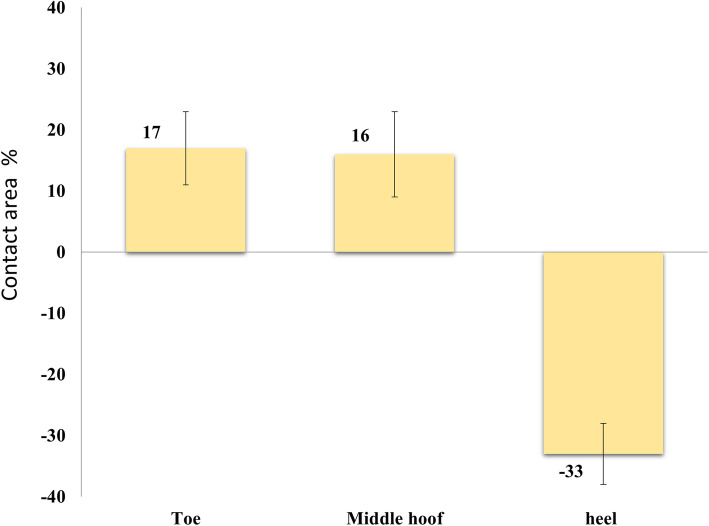
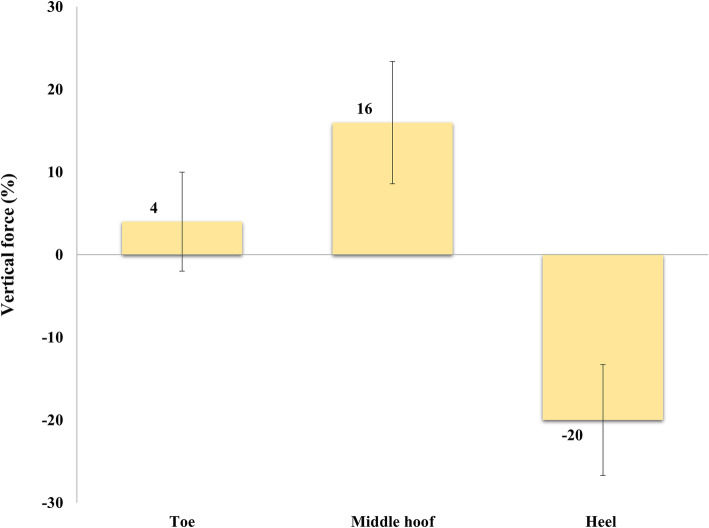


 ) of a horse (number 6) with (a) and without the HCHW (b) during the stance phase. Lateral is to the left and dorsal is in the top. The pressure distribution is colour coded: red = highest pressure forces and deep blue = lowest pressure forces, as seen on the pressure scale. With HCHW, the centre of the force was located palmary in the heel region. The hoof contact area decreased after removal of the HCHW in the heel region and the centre of the force shifted dorsally to the middle hoof region compared with HCHW. BFC = barefoot condition; HCHW = hoof cast with heel elevation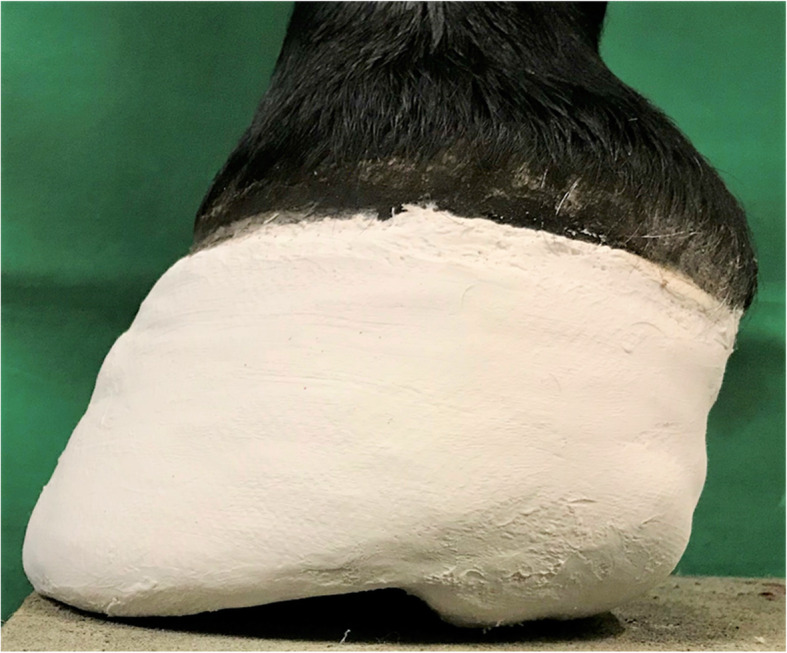

References
-
- Huskamp B. Some notes for the orthopedic treatment of laminitis (Anmerkungen zur orthopädischen Behandlung der Hufrehe) Pferdeheilkunde. 1990;6:3–9. doi: 10.21836/PEM19900101. - DOI
-
- Al Naem M, Geburek F, Röcken M, Litzke LF. Investigation of the load distribution pattern in laminitic horses using hoof™ system. Scientific presentation abstracts: 2019 ECVS 28th annual scientific meeting, July 2-4, 2019 – Budapest, Hungary. Vet Surg. 2019;48:631–684. doi: 10.1111/vsu.13248. - DOI
MeSH terms
LinkOut - more resources
Full Text Sources
Medical
Miscellaneous
