Review
. 2020 Oct 1;19(1):146.
doi: 10.1186/s12943-020-01262-x.

The role of ubiquitination and deubiquitination in cancer metabolism

Affiliations
Review

The role of ubiquitination and deubiquitination in cancer metabolism

Tianshui Sun et al. Mol Cancer. .

Abstract

Metabolic reprogramming, including enhanced biosynthesis of macromolecules, altered energy metabolism, and maintenance of redox homeostasis, is considered a hallmark of cancer, sustaining cancer cell growth. Multiple signaling pathways, transcription factors and metabolic enzymes participate in the modulation of cancer metabolism and thus, metabolic reprogramming is a highly complex process. Recent studies have observed that ubiquitination and deubiquitination are involved in the regulation of metabolic reprogramming in cancer cells. As one of the most important type of post-translational modifications, ubiquitination is a multistep enzymatic process, involved in diverse cellular biological activities. Dysregulation of ubiquitination and deubiquitination contributes to various disease, including cancer. Here, we discuss the role of ubiquitination and deubiquitination in the regulation of cancer metabolism, which is aimed at highlighting the importance of this post-translational modification in metabolic reprogramming and supporting the development of new therapeutic approaches for cancer treatment.

Keywords: Cancer; Deubiquitination; Metabolic reprogramming; Ubiquitination.


Conflict of interest statement

The authors declare that there is no potential competing interest.

Figures
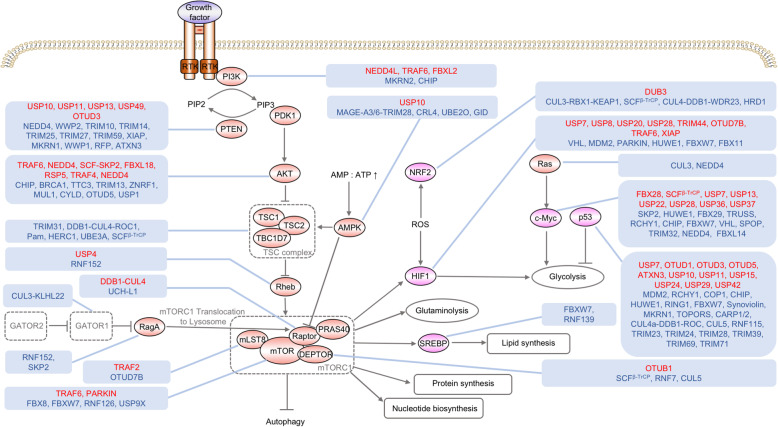
Fig. 1
Fig. 1
Regulation of signaling pathways and transcription factors associated with cancer metabolism by ubiquitination and deubiquitination. Aberrant activation of signaling pathways like PI3K-AKT-mTORC1, loss of tumor suppressive transcription factors like p53 and activation of oncogenic transcription factors like c-Myc control cancer metabolism. Ubiquitination and deubiquitination indirectly regulate cancer metabolism by modulating these signaling molecules and transcription factors. The ubiquitin ligases and deubiquitinating enzymes in red font positively regulate the activity or expression level of substrate proteins. The ubiquitin ligases and deubiquitinating enzymes in blue font negatively regulate the activity or expression level of substrate proteins. AMP, adenosine monophosphate; ATP, adenosine triphosphate; mTORC1, mTOR complex 1; PIP2, phosphatidylinositol 4,5-bisphosphate; PIP3, phosphatidylinositol (3,4,5)-trisphosphate; ROS, reactive oxygen species; RTK, receptor tyrosine kinase; TSC, tuberous sclerosis complex
Fig. 2
Fig. 2
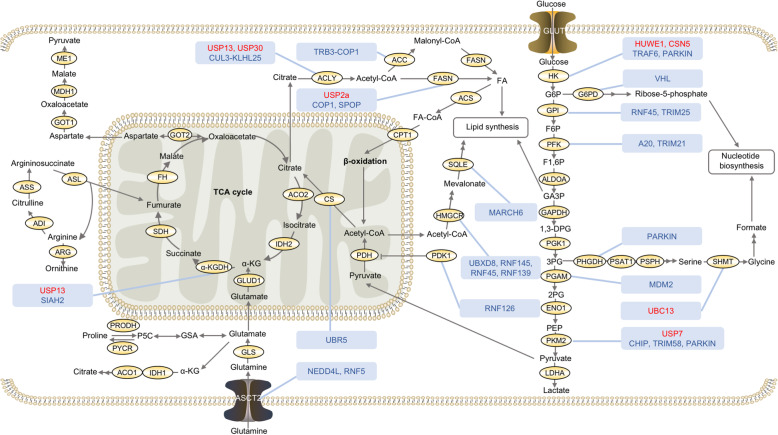
Regulation of metabolic enzymes by ubiquitination and deubiquitination in cancer metabolism. Glycolysis is upregulated to provide more glycolytic intermediates for biosynthesis of macromolecules. Glutamine uptake is enhanced to maintain mitochondrial ATP production. Fatty acids synthesis is increased for membrane biosynthesis. Metabolic enzymes involved in the glucose, fatty acid and amino acid metabolic pathways are under the regulation of ubiquitination and deubiquitination to control cancer metabolism. The ubiquitin ligases and deubiquitinating enzymes in red font positively regulate the activity or expression level of substrate proteins. The ubiquitin ligases and deubiquitinating enzymes in blue font negatively regulate the activity or expression level of substrate proteins. ACC, Acetyl-coenzyme A carboxylase; ACLY, ATP citrate lyase; ACO1/2, Aconitate hydratase 1/2; ACS, Acyl-CoA synthetase; ADI, Arginine deiminase; ALDOA, Fructose-bisphosphate aldolase A; ARG, Arginase; ASCT2, Neutral amino acid transporter B; ASL, Argininosuccinate lyase; ASS, Argininosuccinate synthase; CPT1, Carnitine O-palmitoyltransferase 1; CS, Citrate synthase; ENO 1, Enolase 1; FASN, Fatty acid synthase; FH, Fumarate hydratase; G6PD, Glucose-6-phosphate dehydrogenase; GAPDH, Glyceraldehyde-3-phosphate dehydrogenase; GLS1, Glutaminase 1; GLUD1, Glutamate dehydrogenase 1; GLUT1, Glucose transporter type 1; GOT, Aspartate aminotransferase; HK1, Hexokinase 1; HMGCR, 3-hydroxy-3-methylglutaryl-coenzyme A reductase; IDH1/2, Isocitrate dehydrogenase1/2; LDHA, L-lactate dehydrogenase A chain; MDH, Malate dehydrogenase; ME, NADP-dependent malic enzyme; PDH, Pyruvate dehydrogenase; PDK, Pyruvate dehydrogenase kinase; PFK, Phosphofructokinase; PFKFB3, 6-phosphofructo-2-kinase/fructose-2,6-bisphosphatase 3; PFKL, PFK liver type; PFKP, PFK1 platelet isoform; PGAM5, Phosphoglycerate mutase 5; PGK1, Phosphoglycerate kinase 1; PHGDH, D-3-phosphoglycerate dehydrogenase; PKM2, Pyruvate kinase M2; PRODH, Proline dehydrogenase; PSAT1, Phosphoserine aminotransferase 1; PSPH, Phosphoserine phosphatase; PYCR, Pyrroline-5-carboxylate reductase; SDH, Succinate dehydrogenase; SHMT1, Serine hydroxymethyltransferase 1; SQLE, Squalene epoxidase; TCA, Tricarboxylic acid; α-KGDH, α-ketoglutarate dehydrogenase

References

    1. DeBerardinis RJ, Chandel NS. Fundamentals of cancer metabolism. Sci Adv. 2016;2:e1600200. doi: 10.1126/sciadv.1600200. - DOI - PMC - PubMed
    1. Lunt SY, Vander Heiden MG. Aerobic glycolysis: meeting the metabolic requirements of cell proliferation. Annu Rev Cell Dev Biol. 2011;27:441–464. doi: 10.1146/annurev-cellbio-092910-154237. - DOI - PubMed
    1. Faubert B, Li KY, Cai L, Hensley CT, Kim J, Zacharias LG, Yang C, Do QN, Doucette S, Burguete D, et al. Lactate metabolism in human lung tumors. Cell. 2017;171:358–371 e359. doi: 10.1016/j.cell.2017.09.019. - DOI - PMC - PubMed
    1. Moreau P, Attal M, Caillot D, Macro M, Karlin L, Garderet L, Facon T, Benboubker L, Escoffre-Barbe M, Stoppa AM, et al. Prospective evaluation of magnetic resonance imaging and [(18)F]Fluorodeoxyglucose positron emission tomography-computed tomography at diagnosis and before maintenance therapy in symptomatic patients with multiple myeloma included in the IFM/DFCI 2009 trial: results of the IMAJEM study. J Clin Oncol. 2017;35:2911–2918. doi: 10.1200/JCO.2017.72.2975. - DOI - PMC - PubMed
    1. Xie H, Hanai J, Ren JG, Kats L, Burgess K, Bhargava P, Signoretti S, Billiard J, Duffy KJ, Grant A, et al. Targeting lactate dehydrogenase--a inhibits tumorigenesis and tumor progression in mouse models of lung cancer and impacts tumor-initiating cells. Cell Metab. 2014;19:795–809. doi: 10.1016/j.cmet.2014.03.003. - DOI - PMC - PubMed

Publication types

MeSH terms