


Slower perception of time in depressed and suicidal patients
- PMID: 33004229
- PMCID: PMC7655720
- DOI: 10.1016/j.euroneuro.2020.09.004
Slower perception of time in depressed and suicidal patients
Abstract
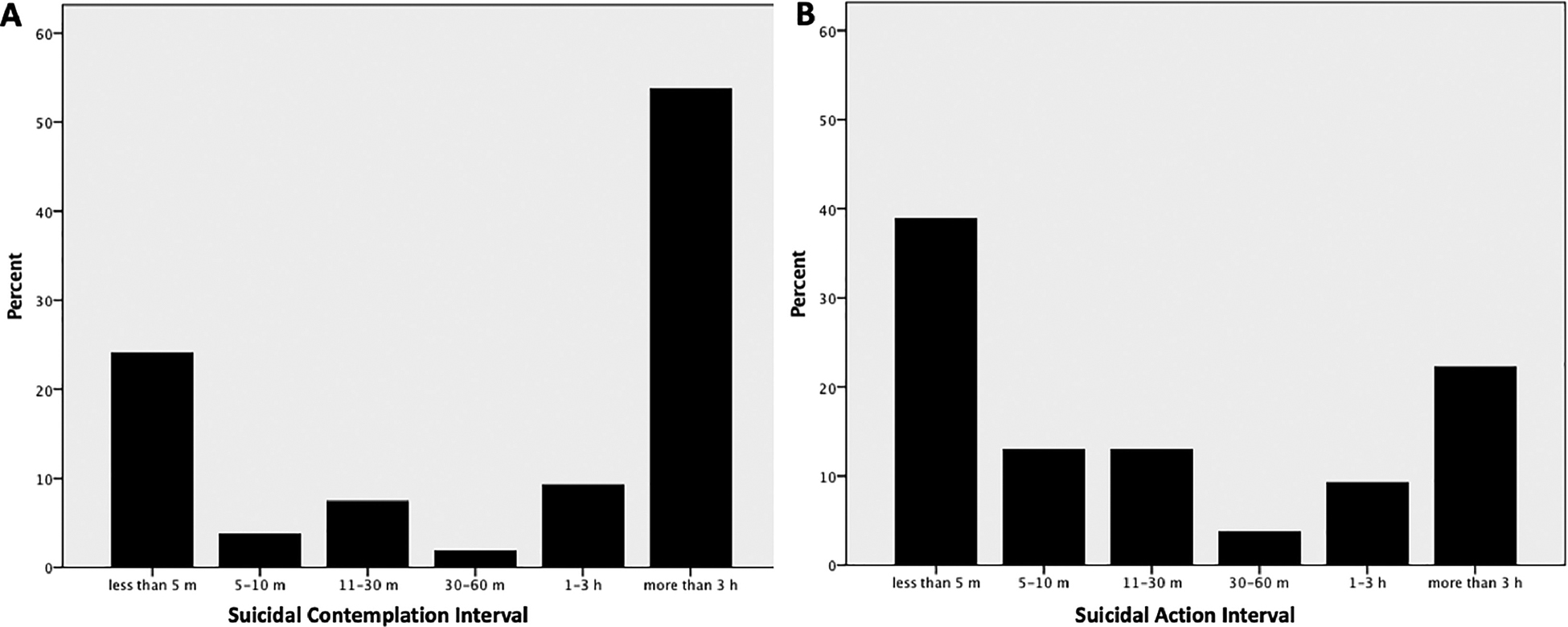
Effective suicide prevention is hindered by a limited understanding of the natural progression and neurobiology of the suicidal process. Our objective was to characterize the duration of the suicidal process and its relation to possible determinants: time judgment and cognitive impulsivity. In four groups of adults of both sexes including recent suicide attempters (n = 57), suicidal ideators (n = 131), non-suicidal depressed controls (n = 51) and healthy controls (n = 48) we examined time estimation and production, impulsivity and other cognitive variables. Duration of the suicidal process was recorded in suicide attempters. The suicide process duration, suicide contemplation and action intervals, had a bimodal distribution, ∼40% of attempters took less than 5 min from decision to attempt. Time slowing correlated negatively with the suicidal action interval (time from the decision to kill oneself to suicide attempt) (p = .003). Individuals with suicide contemplation interval shorter than three hours showed increased time slowing, measured as shorter time production at 35 s (p = .011) and 43 s (p = .036). Delay discounting for rewards correlated with time estimation at 25 min (p = .02) and 90 s (p = .01). Time slowing correlated positively with suicidal ideation severity, independently of depression severity (p < .001). Perception of time slowing may influence both the intensity and the duration of the suicidal process. Time slowing may initially be triggered by intense psychological pain, then worsen the perception of inescapability in suicidal patients.
Keywords: Depression; Impulsivity; Suicidal process; Suicide; Time perception.
Published by Elsevier B.V.
Conflict of interest statement
Conflict of Interest
The authors declare no conflict of interest.
Figures
References
-
- Alves H, Koch A, Unkelbach C, 2017. Why Good Is More Alike Than Bad: Processing Implications. Trends Cogn Sci 21, 69–79. - PubMed
-
- Anestis MD, Soberay KA, Gutierrez PM, Hernandez TD, Joiner TE, 2014. Reconsidering the link between impulsivity and suicidal behavior. Pers Soc Psychol Rev 18, 366–386. - PubMed
-
- Aschoff J, 1998. Human perception of short and long time intervals: its correlation with body temperature and the duration of wake time. J Biol Rhythms 13, 437–442. - PubMed
-
- Baca-Garcia E, Diaz-Sastre C, Basurte E, Prieto R, Ceverino A, Saiz-Ruiz J, de Leon J, 2001. A prospective study of the paradoxical relationship between impulsivity and lethality of suicide attempts. J Clin Psychiatry 62, 560–564. - PubMed
-
- Bagge CL, Littlefield AK, Lee HJ, 2013. Correlates of proximal premeditation among recently hospitalized suicide attempters. J Affect Disord 150, 559–564. - PubMed
Publication types
MeSH terms
Grants and funding
LinkOut - more resources
Full Text Sources
Medical
