Metabolism in tumour-associated macrophages: a quid pro quo with the tumour microenvironment
- PMID: 33004525
- PMCID: PMC9488699
- DOI: 10.1183/16000617.0134-2020
Metabolism in tumour-associated macrophages: a quid pro quo with the tumour microenvironment
Abstract
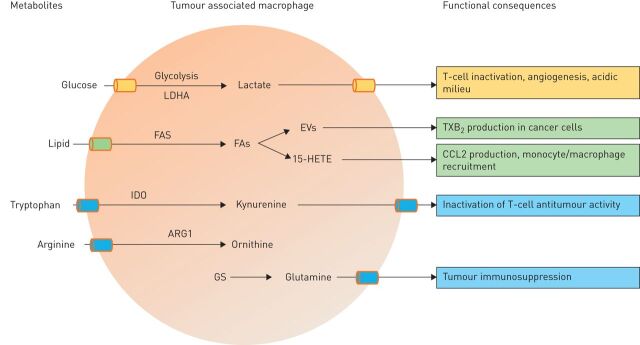
Lung cancer is the leading cause of death from cancer worldwide. Recent studies demonstrated that the tumour microenvironment (TME) is pivotal for tumour progression, providing multiple targeting opportunities for therapeutic strategies. As one of the most abundant stromal cell types in the TME, tumour-associated macrophages (TAMs) exhibit high plasticity. Malignant cells alter their metabolic profiles to adapt to the limited availability of oxygen and nutrients in the TME, resulting in functional alteration of TAMs. The metabolic features of TAMs are strongly associated with their functional plasticity, which further impacts metabolic profiling in the TME and contributes to tumourigenesis and progression. Here, we review the functional determination of the TME by TAM metabolic alterations, including glycolysis as well as fatty acid and amino acid metabolism, which in turn are influenced by environmental changes. Additionally, we discuss metabolic reprogramming of TAMs to a tumouricidal phenotype as a potential antitumoural therapeutic strategy.
Copyright ©ERS 2020.
Conflict of interest statement
Conflict of interest: X. Zheng has nothing to disclose. Conflict of interest: S. Mansouri has nothing to disclose. Conflict of interest: A. Karger has nothing to disclose. Conflict of interest: F. Grimminger has nothing to disclose. Conflict of interest: W. Seeger has nothing to disclose. Conflict of interest: S. Savai Pullamsetti has nothing to disclose. Conflict of interest: C. Wheelock has nothing to disclose. Conflict of interest: R. Savai has nothing to disclose.
Figures

References
Publication types
MeSH terms
LinkOut - more resources
Full Text Sources
Medical
Research Materials