


Homoeologous Exchanges, Segmental Allopolyploidy, and Polyploid Genome Evolution
- PMID: 33005183
- PMCID: PMC7485112
- DOI: 10.3389/fgene.2020.01014
Homoeologous Exchanges, Segmental Allopolyploidy, and Polyploid Genome Evolution
Abstract
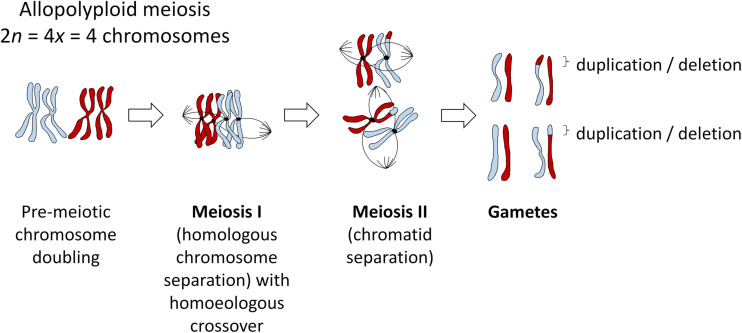
Polyploidy is a major force in plant evolution and speciation. In newly formed allopolyploids, pairing between related chromosomes from different subgenomes (homoeologous chromosomes) during meiosis is common. The initial stages of allopolyploid formation are characterized by a spectrum of saltational genomic and regulatory alterations that are responsible for evolutionary novelty. Here we highlight the possible effects and roles of recombination between homoeologous chromosomes during the early stages of allopolyploid stabilization. Homoeologous exchanges (HEs) have been reported in young allopolyploids from across the angiosperms. Although all lineages undergo karyotype change via chromosome rearrangements over time, the early generations after allopolyploid formation are predicted to show an accelerated rate of genomic change. HEs can also cause changes in allele dosage, genome-wide methylation patterns, and downstream phenotypes, and can hence be responsible for speciation and genome stabilization events. Additionally, we propose that fixation of duplication - deletion events resulting from HEs could lead to the production of genomes which appear to be a mix of autopolyploid and allopolyploid segments, sometimes termed "segmental allopolyploids." We discuss the implications of these findings for our understanding of the relationship between genome instability in novel polyploids and genome evolution.
Keywords: chromosome behavior; genome evolution; homoeologous exchanges; polyploidy; synthetics.
Copyright © 2020 Mason and Wendel.
Figures

References
-
- Abel S., Becker H. C. (2007). The effect of autopolyploidy on biomass production in homozygous lines of Brassica rapa and Brassica oleracea. Plant Breed. 126 642–643. 10.1111/j.1439-0523.2007.01405.x - DOI
-
- Ainouche M. L., Baumel A., Salmon A. (2004). Spartina anglica C. E. Hubbard: a natural model system for analysing early evolutionary changes that affect allopolyploid genomes. Biol. J. Linn. Soc. 82 475–484. 10.1111/j.1095-8312.2004.00334.x - DOI
-
- Ashton P. A., Abbott R. J. (1992). Multiple origins and genetic diversity in the newly arisen allopolyploid species, Senecio cambrensis Rosser (Compositae). Heredity 68 25–32. 10.1038/hdy.1992.3 - DOI
Publication types
LinkOut - more resources
Full Text Sources
