


Estimating the contribution of Greenland Halibut (Reinhardtius hippoglossoides) stocks to nurseries by means of genotyping-by-sequencing: Sex and time matter
- PMID: 33005216
- PMCID: PMC7513701
- DOI: 10.1111/eva.12979
Estimating the contribution of Greenland Halibut (Reinhardtius hippoglossoides) stocks to nurseries by means of genotyping-by-sequencing: Sex and time matter
Abstract
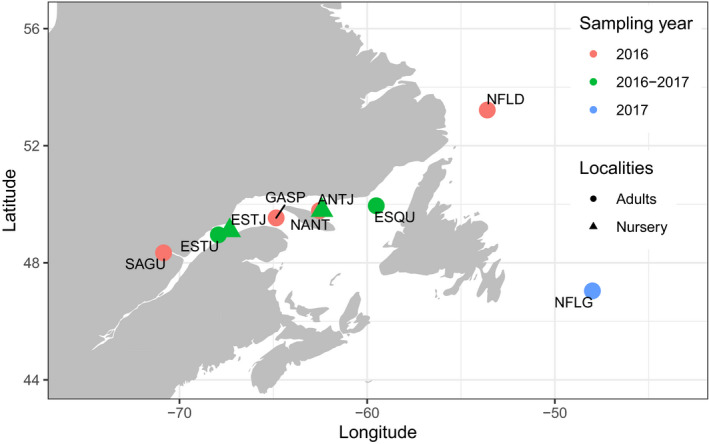
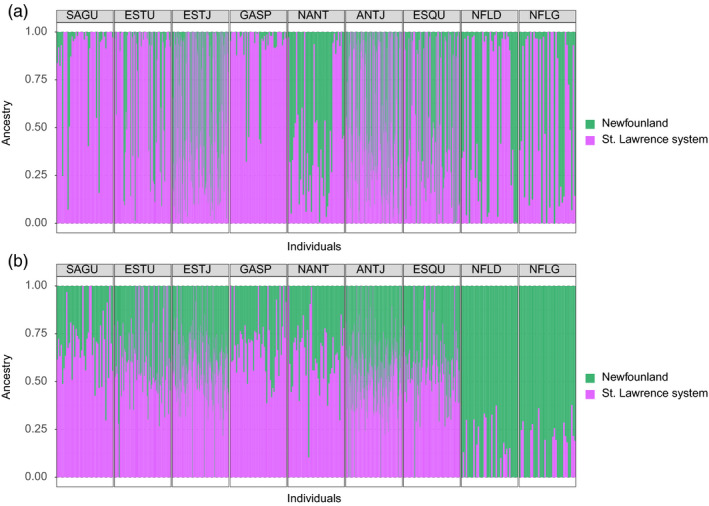
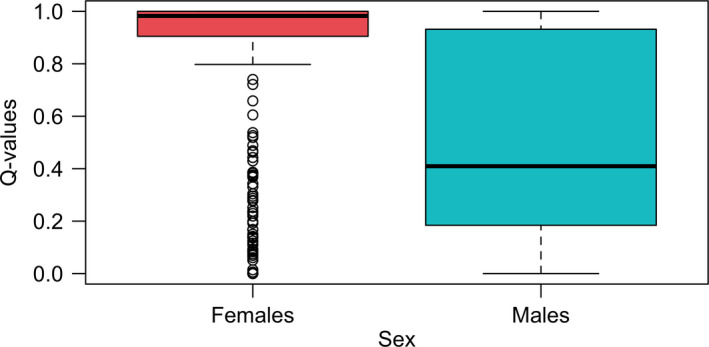
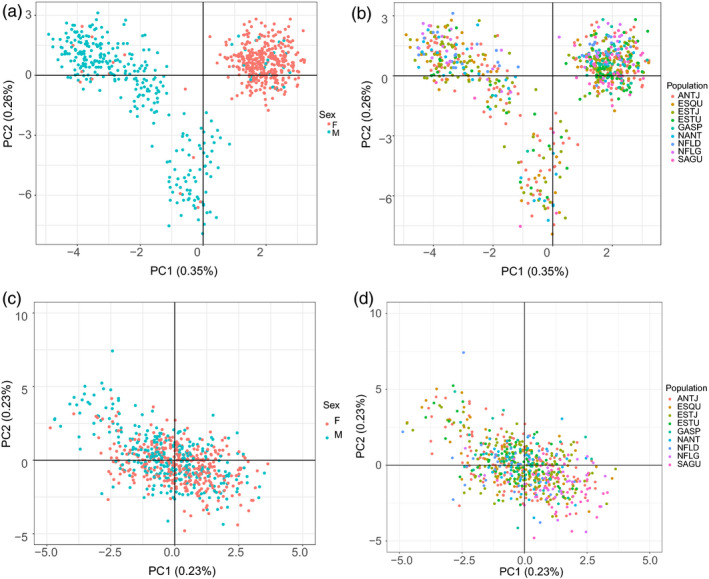
Identification of stocks and quantification of their relative contribution to recruitment are major objectives toward improving the management and conservation of marine exploited species. Next-generation sequencing allows for thousands of genomic markers to be analyzed, which provides the resolution needed to address these questions in marine species with weakly differentiated populations. Greenland Halibut (Reinhardtius hippoglossoides) is one of the most important exploited demersal species throughout the North Atlantic, in particular in the Gulf of St. Lawrence, Canada. There, two nurseries are known, the St. Lawrence Estuary and the northern Anticosti Island, but their contribution to the renewal of stocks remains unknown. The goals of this study were (a) to document the genetic structure and (b) to estimate the contribution of the different identified breeding stocks to nurseries. We sampled 100 juveniles per nursery and 50 adults from seven sites ranging from Saguenay Fjord to offshore Newfoundland, with some sites sampled over two consecutive years in order to evaluate the temporal stability of the contribution. Our results show that after removing sex-linked markers, the Estuary/Gulf of St. Lawrence represents a single stock which is genetically distinct from the Atlantic around Newfoundland (F ST = 0.00146, p-value = .001). Population assignment showed that recruitment in both nurseries is predominantly associated with the St. Lawrence stock. However, we found that the relative contribution of both stocks to the nurseries is temporally variable with 1% contribution of the Newfoundland stock one year but up to 33% for the second year, which may be caused by year-to-year variation in larval transport into the Gulf of St. Lawrence. This study serves as a model for the identification of stocks for fisheries resources in a context where few barriers to dispersal occur, in addition to demonstrating the importance of considering sex-linked markers and temporal replicates in studies of population genomics.
Keywords: Greenland Halibut; management; marine genomics; population assignment; stock identification; temporal stability.
© 2020 The Authors. Evolutionary Applications published by John Wiley & Sons Ltd.
Conflict of interest statement
None declared.
Figures
References
-
- Abed, A. , Légaré, G. , Pomerleau, S. , St‐Cyr, J. , Boyle, B. , & Belzile, F. J. (2019). Genotyping‐by‐sequencing on the ion torrent platform in barley In Barley (pp. 233–252). New York, NY: Humana Press. - PubMed
-
- Anderson, E. C. , Waples, R. S. , & Kalinowski, S. T. (2008). An improved method for predicting the accuracy of genetic stock identification. Canadian Journal of Fisheries and Aquatic Sciences, 65(7), 1475–1486. 10.1139/F08-049 - DOI
-
- Andrews, S. (2010). FastQC. A quality control tool for high throughput sequence data, 370.
LinkOut - more resources
Full Text Sources
