Review
. 2020 Sep 8:18:2401-2415.
doi: 10.1016/j.csbj.2020.08.031. eCollection 2020.

CRISPR-Cas systems: Overview, innovations and applications in human disease research and gene therapy

Affiliations
Review

CRISPR-Cas systems: Overview, innovations and applications in human disease research and gene therapy

Yuanyuan Xu et al. Comput Struct Biotechnol J. .

Abstract

Genome editing is the modification of genomic DNA at a specific target site in a wide variety of cell types and organisms, including insertion, deletion and replacement of DNA, resulting in inactivation of target genes, acquisition of novel genetic traits and correction of pathogenic gene mutations. Due to the advantages of simple design, low cost, high efficiency, good repeatability and short-cycle, CRISPR-Cas systems have become the most widely used genome editing technology in molecular biology laboratories all around the world. In this review, an overview of the CRISPR-Cas systems will be introduced, including the innovations, the applications in human disease research and gene therapy, as well as the challenges and opportunities that will be faced in the practical application of CRISPR-Cas systems.

Keywords: CRISPR; Cas9; Gene therapy; Genome editing; Human disease models; Off target effects; Rabbit.


Conflict of interest statement

The authors declare that they have no known competing financial interests or personal relationships that could have appeared to influence the work reported in this paper.

Figures
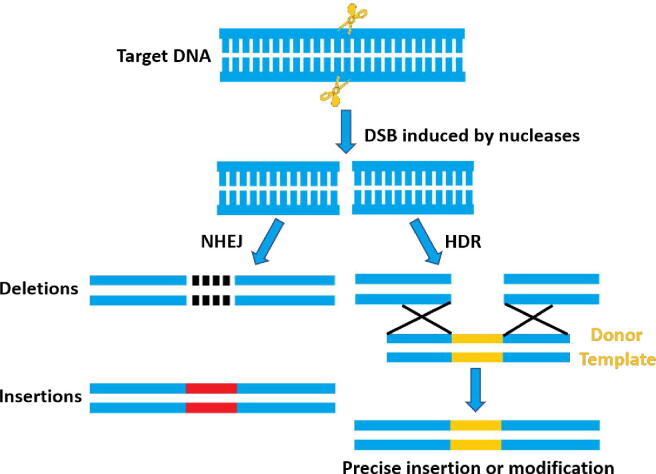
Fig. 1
Fig. 1
Mechanism of genome editing. Double-strand break (DSB) induced by nucleases can be repaired by non-homologous end joining (NHEJ) or homology-directed repair (HDR) pathways. NHEJ can introduce random insertions or deletions (indels) of varying length at the site of the DSB. Alternatively, HDR can introduce precise genomic modifications at the target site by using a homologous DNA donor template.
Fig. 2
Fig. 2
Generation of PAX4 gene knockout (KO) rabbits using CRISPR-Cas9 system. (A) Schematic diagram of the sgRNA target sites located in the rabbit PAX4 locus. PAX4 exons are indicated by yellow rectangles; target sites of the two sgRNA sequences, sgRNA1 and sgRNA2, are highlighted in green; protospacer-adjacent motif (PAM) sequence is highlighted in red. Primers F and R are used for mutation detection in pups. (B) Microinjection and embryo transfer. First a mixture of Cas9 mRNA and sgRNA is microinjected into the cytoplasm of the zygote at the pronuclear stage. Then the injected embryos are transferred into the oviduct of recipient rabbits. After 30 days gestation, PAX4 KO rabbits are born. (For interpretation of the references to colour in this figure legend, the reader is referred to the web version of this article.)

References

    1. Charpentier E., Marraffini L.A. Harnessing CRISPR-Cas9 immunity for genetic engineering. Curr Opin Microbiol. 2014;19:114–119. - PMC - PubMed
    1. Hsu P.D., Lander E.S., Zhang F. Development and applications of CRISPR-Cas9 for genome engineering. Cell. 2014;157:1262–1278. - PMC - PubMed
    1. Knott G.J., Doudna J.A. CRISPR-Cas guides the future of genetic engineering. Science. 2018;361:866–869. - PMC - PubMed
    1. Cox D.B., Platt R.J., Zhang F. Therapeutic genome editing: prospects and challenges. Nat Med. 2015;21:121–131. - PMC - PubMed
    1. Wang H., La Russa M., Qi L.S. CRISPR/Cas9 in genome editing and beyond. Annu Rev Biochem. 2016;85:227–264. - PubMed

LinkOut - more resources