


Best environmental predictors of breeding phenology differ with elevation in a common woodland bird species
- PMID: 33005377
- PMCID: PMC7520200
- DOI: 10.1002/ece3.6684
Best environmental predictors of breeding phenology differ with elevation in a common woodland bird species
Abstract
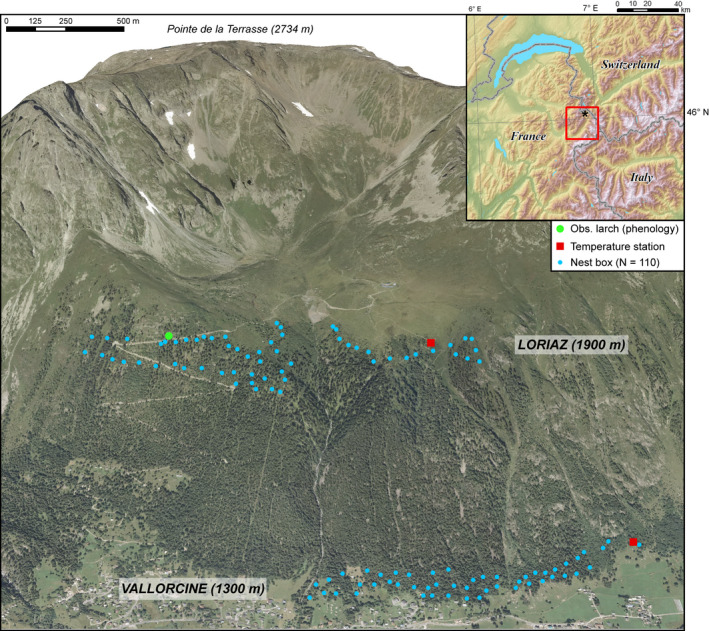
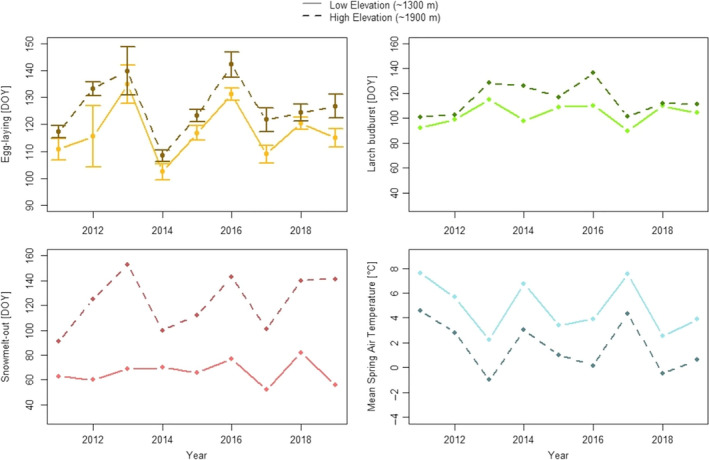
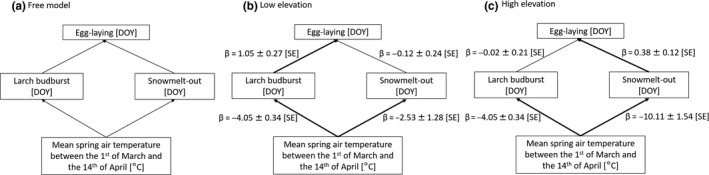
Temperatures in mountain areas are increasing at a higher rate than the Northern Hemisphere land average, but how fauna may respond, in particular in terms of phenology, remains poorly understood. The aim of this study was to assess how elevation could modify the relationships between climate variability (air temperature and snow melt-out date), the timing of plant phenology and egg-laying date of the coal tit (Periparus ater). We collected 9 years (2011-2019) of data on egg-laying date, spring air temperature, snow melt-out date, and larch budburst date at two elevations (~1,300 m and ~1,900 m asl) on a slope located in the Mont-Blanc Massif in the French Alps. We found that at low elevation, larch budburst date had a direct influence on egg-laying date, while at high-altitude snow melt-out date was the limiting factor. At both elevations, air temperature had a similar effect on egg-laying date, but was a poorer predictor than larch budburst or snowmelt date. Our results shed light on proximate drivers of breeding phenology responses to interannual climate variability in mountain areas and suggest that factors directly influencing species phenology vary at different elevations. Predicting the future responses of species in a climate change context will require testing the transferability of models and accounting for nonstationary relationships between environmental predictors and the timing of phenological events.
Keywords: French Alps; budburst; climate change; coal tit; elevation; laying date; mountain; snow melt‐out.
© 2020 The Authors. Ecology and Evolution published by John Wiley & Sons Ltd.
Conflict of interest statement
None declared.
Figures
References
-
- Asse, D. , Chuine, I. , Vitasse, Y. , Yoccoz, N. G. , Delpierre, N. , Badeau, V. , … Randin, C. F. (2018). Warmer winters reduce the advance of tree spring phenology induced by warmer springs in the Alps. Agricultural and Forest Meteorology, 252, 220–230. 10.1016/j.agrformet.2018.01.030 - DOI
-
- Beniston, M. (2012). Is snow in the Alps receding or disappearing? Wiley Interdisciplinary Reviews: Climate Change, 3(4), 349–358. 10.1002/wcc.179 - DOI
-
- Beniston, M. , Farinotti, D. , Stoffel, M. , Andreassen, L. M. , Coppola, E. , Eckert, N. , … Vincent, C. (2018). The European mountain cryosphere: A review of its current state, trends and future challenges. Cryosphere, 12(2), 759–794. 10.5194/tc-12-759-2018 - DOI
-
- Beniston, M. , Keller, F. , Koffi, B. , & Goyette, S. (2003). Estimates of snow accumulation and volume in the Swiss Alps under changing climatic conditions. Theoretical and Applied Climatology, 76(3–4), 125–140. 10.1007/s00704-003-0016-5 - DOI
LinkOut - more resources
Full Text Sources
