The timing mega-study: comparing a range of experiment generators, both lab-based and online
- PMID: 33005482
- PMCID: PMC7512138
- DOI: 10.7717/peerj.9414
The timing mega-study: comparing a range of experiment generators, both lab-based and online
Abstract
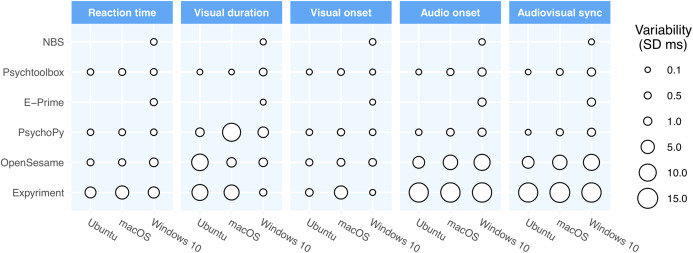
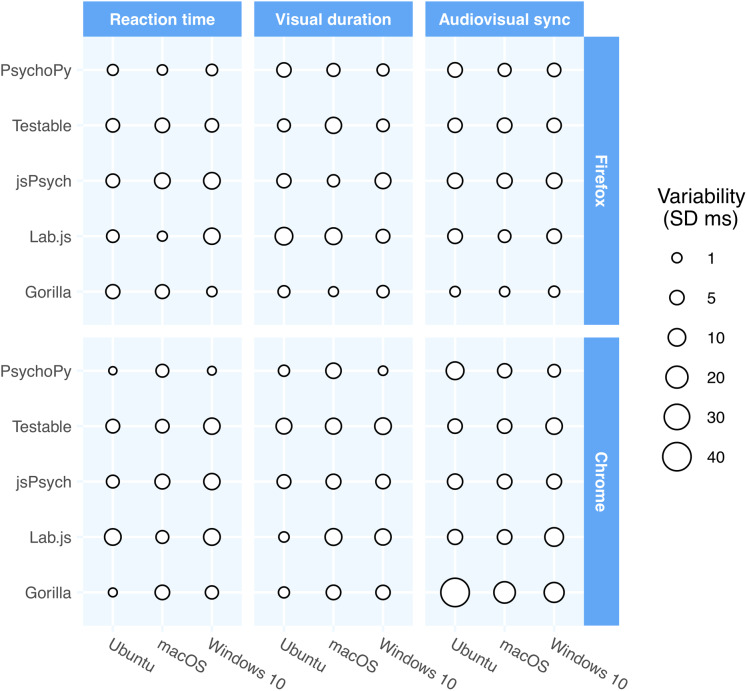
Many researchers in the behavioral sciences depend on research software that presents stimuli, and records response times, with sub-millisecond precision. There are a large number of software packages with which to conduct these behavioral experiments and measure response times and performance of participants. Very little information is available, however, on what timing performance they achieve in practice. Here we report a wide-ranging study looking at the precision and accuracy of visual and auditory stimulus timing and response times, measured with a Black Box Toolkit. We compared a range of popular packages: PsychoPy, E-Prime®, NBS Presentation®, Psychophysics Toolbox, OpenSesame, Expyriment, Gorilla, jsPsych, Lab.js and Testable. Where possible, the packages were tested on Windows, macOS, and Ubuntu, and in a range of browsers for the online studies, to try to identify common patterns in performance. Among the lab-based experiments, Psychtoolbox, PsychoPy, Presentation and E-Prime provided the best timing, all with mean precision under 1 millisecond across the visual, audio and response measures. OpenSesame had slightly less precision across the board, but most notably in audio stimuli and Expyriment had rather poor precision. Across operating systems, the pattern was that precision was generally very slightly better under Ubuntu than Windows, and that macOS was the worst, at least for visual stimuli, for all packages. Online studies did not deliver the same level of precision as lab-based systems, with slightly more variability in all measurements. That said, PsychoPy and Gorilla, broadly the best performers, were achieving very close to millisecond precision on several browser/operating system combinations. For response times (measured using a high-performance button box), most of the packages achieved precision at least under 10 ms in all browsers, with PsychoPy achieving a precision under 3.5 ms in all. There was considerable variability between OS/browser combinations, especially in audio-visual synchrony which is the least precise aspect of the browser-based experiments. Nonetheless, the data indicate that online methods can be suitable for a wide range of studies, with due thought about the sources of variability that result. The results, from over 110,000 trials, highlight the wide range of timing qualities that can occur even in these dedicated software packages for the task. We stress the importance of scientists making their own timing validation measurements for their own stimuli and computer configuration.
Keywords: Experiments; MTurk; Online testing; Open-source; Precision; Reaction times; Software; Stimuli; Sub-millisecond; Timing.
© 2020 Bridges et al.
Conflict of interest statement
Although we are authors of one of the packages being compared here (PsychoPy/PsychoJS), that software is provided free and open-source to all users. We are also shareholders of Open Science Tools Ltd, which receives income from studies being conducted on Pavlovia.org. Pavlovia.org is agnostic to the software package creating the studies—it supports studies from PsychoPy, jsPsych and Lab.js—and the resulting income funds further development of the open-source software packages on which the studies are created.
Figures
References
-
- Anwyl-Irvine AL, Dalmaijer ES, Hodges N, Evershed J. Online timing accuracy and precision: a comparison of platforms, browsers, and participant’s devices. 2020. https://doi.org/10.31234/osf.io/jfeca https://doi.org/10.31234/osf.io/jfeca
-
- Brand A, Bradley MT. Assessing the effects of technical variance on the statistical outcomes of web experiments measuring response times. Social Science Computer Review. 2012;30(3):350–357. doi: 10.1177/0894439311415604. - DOI
Grants and funding
LinkOut - more resources
Full Text Sources
Research Materials
Miscellaneous